Make Money From Home: 6 Checks Before You Start, Plus the Hourly-Rate Math
2026-10-08
If a video says it makes $10,000 a month, how much is that per hour? Search make money from home on YouTube and that exact claim sits in the top five results, with no hours attached.
A monthly number only means something next to the time and money that went into it. This post turns the claim into an hourly rate against the US federal minimum wage, then lists six things to check before you start any work from home plan.
1.What the top make money from home videos leave out
On October 7, 2026 we searched YouTube for make money from home. Two of the top ten titles carry a dollar figure. Most of the rest are lists of ways and side hustles.
The one used here is titled "How I make $10,000 a month as a STUDENT (and how you can too)". It was posted on December 9, 2025 and had about 2.5 million views on October 7 (YouTube video).
Only the number in the title goes into the math.
2.Turn the monthly number in the video into an hourly rate
The title gives a monthly figure and no hours. So start from the other end: how many hours would $10,000 take at the lowest legal hourly rate?
The federal minimum wage is $7.25 an hour, in effect since July 24, 2009 (US Department of Labor). The same page notes that some state laws give workers more protection, so treat $7.25 as the lowest bar.
- Hours in a month: $10,000 ÷ $7.25 = about 1,379 hours
- Hours in a day: 1,379 ÷ 30 days = about 46 hours
- Hours a day actually has: 24
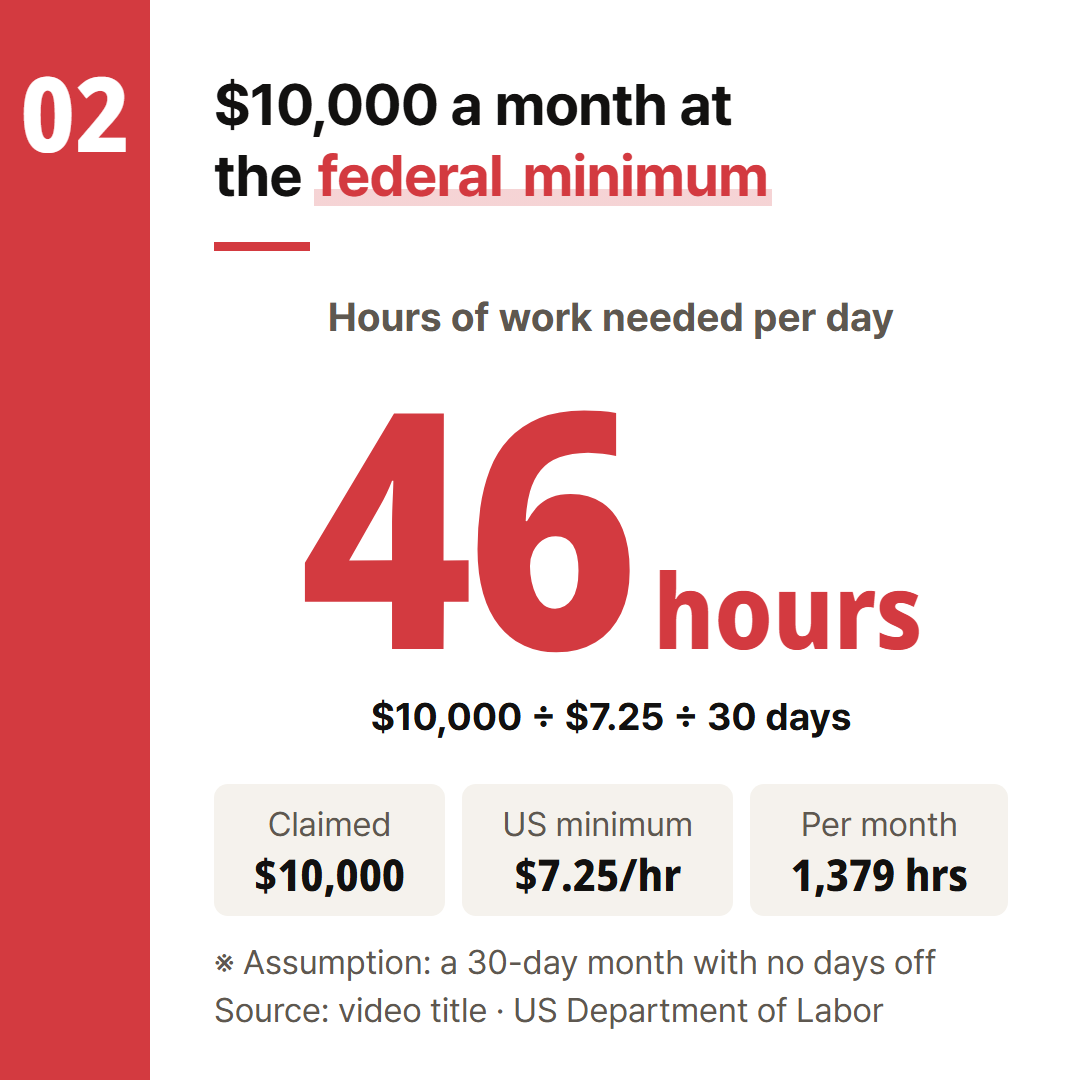
At the minimum wage, $10,000 a month would take more hours than a day has.
So the money has to come from something other than hours. It could be a skill that pays far above the minimum, an audience built over years, money put in at the start, or selling the method to other people.
That leaves one question for anyone copying the plan. Can you bring the same things the creator brought?

Hourly rate: monthly income minus that month's costs, divided by every hour put in, setup and messages included.
The same test works on your own side hustle. Say you make $400 in a month, pay $40 for tools, and work 2 hours a day for 30 days. These are assumed numbers, picked only to show the math.
- Money left: $400 minus $40 = $360
- Hours: 2 hours × 30 days = 60 hours
- Hourly rate: $360 ÷ 60 hours = $6.00
In this example you earn $1.25 an hour less than the federal minimum. The income screen shows $400, but time and costs change the picture.
3.Six checks before you start
The math above turns into six lines. Run each one against any video or ad before you sign up for anything.
- Hourly rate: you divided monthly income by the real hours and compared it with $7.25
- Hidden hours: setup, learning, filming and messages are in the count
- Money spent: courses, tool subscriptions and supplies are taken out of the income
- Proof: you can see deposits or payout records for the same month, not only a screenshot
- Staying power: you know if it was one good month or several in a row
- Money source: you know if it comes from the work itself or from selling a course
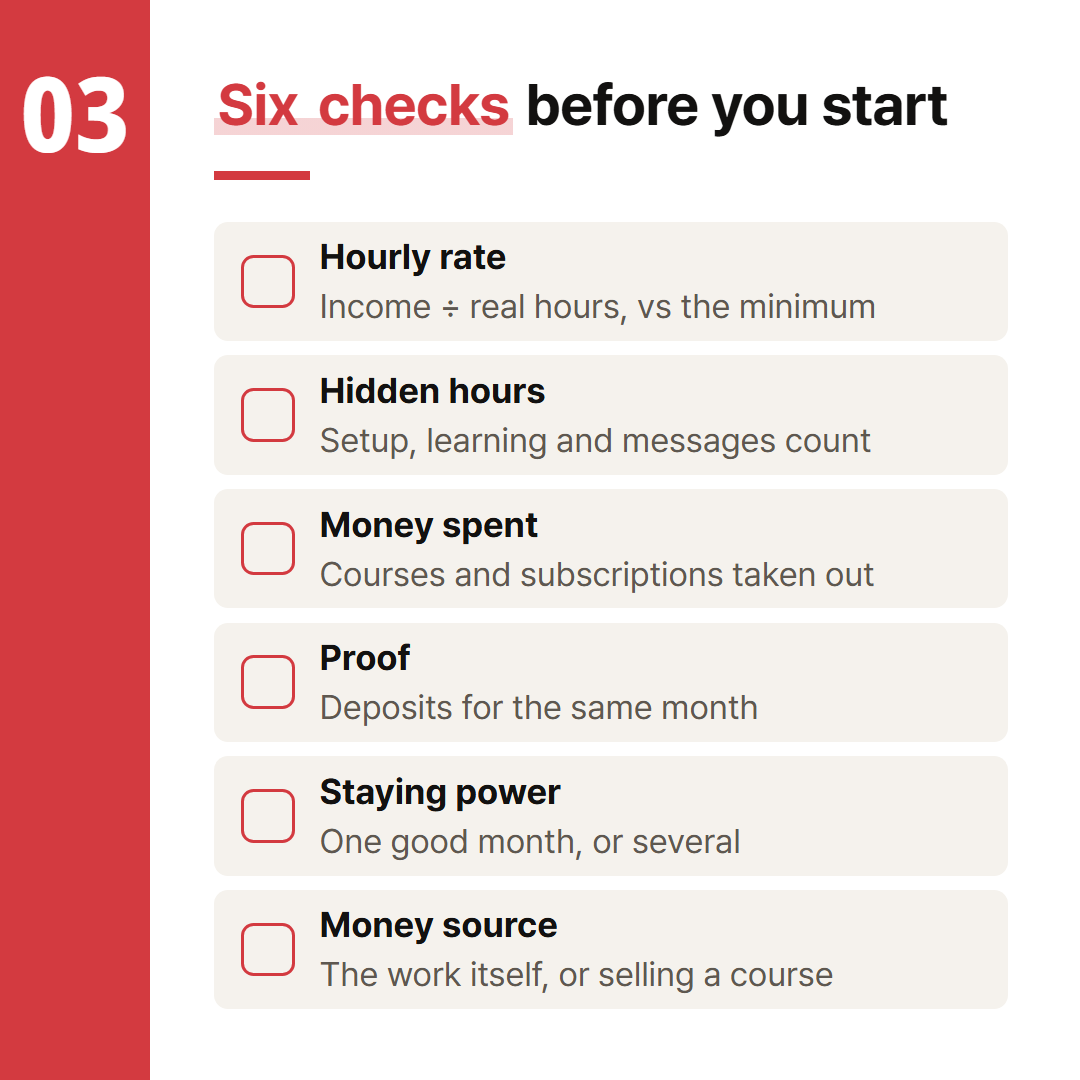
Lines four and five are the hardest to check, because one screenshot only shows the numbers at the moment it was taken. Asking for several months of deposits, and seeing whether an answer comes back, is a fair test.
Clues for line six can sit in the video description or the last scene. If either one points to a paid course or a private group, the monthly figure may include course sales on top of the side hustle itself.
If the person showing income also sells a course, ask if the income came from the hustle or the sales.
4.Why the hourly rate matters most when time is short
A student or a parent may only have an hour or two a day to spare. Two hours a day for 30 days is 60 hours, and 60 hours at $7.25 comes to $435 before tax. A job outside the home also costs travel time, which counts in favor of working from home.
If a work from home plan pays less than that for the same 60 hours, the gap is the price of staying home. For the assumed side hustle above ($360 for 60 hours), that price is $435 minus $360, or $75 for the month.
5.One-line conclusion
When a make money from home video shows a monthly figure, write the hours and costs next to it and compare the hourly rate.
Hiddenpick is a Windows program that keeps on its server the betting rules that pick owners do not make public, and runs them as they are on the PC of the person who received them through a referral code. It currently runs on Evolution live baccarat at Stake (stake.com). Automation can handle the clicks, but the odds of the game stay the same, as our baccarat auto betting program guide explains.
- 25,000+ real shoes collected and analysed since September 2026
- 90+ baccarat tables from the lobby on one screen · refreshed every 0.35s · seated 2 to 4 seconds after a click
- Stops by itself at your take-profit and stop-loss · tie several PCs into one team and stop on the total
- No browser extension · your money stays in your own Stake account · 12 languages