Fake casino sites: lookalike baccarat site addresses and the padlock icon, checked against phishing reports
2026-10-16
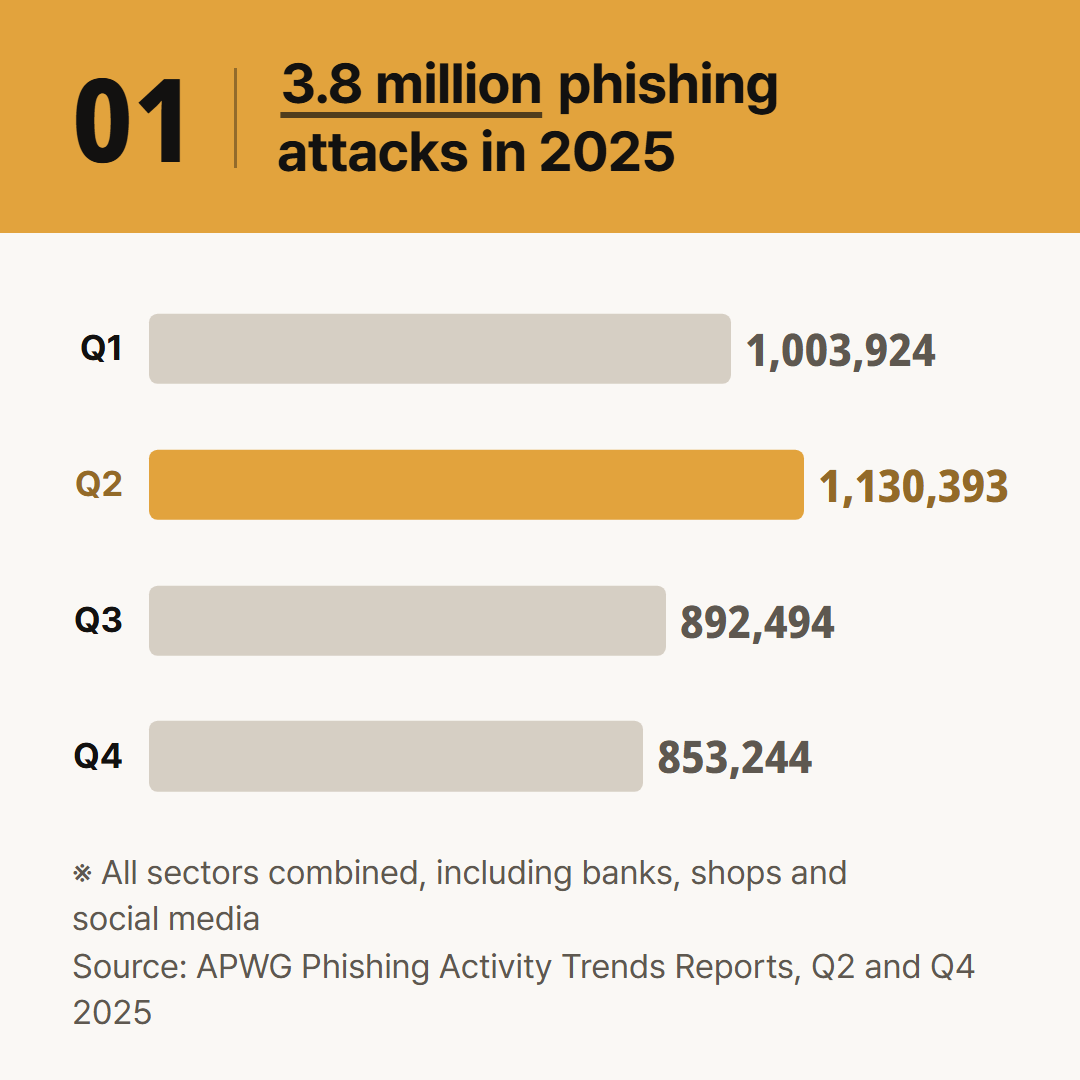
3.8 million. That is how many phishing attacks the Anti-Phishing Working Group (APWG) counted across 2025.
The figure covers every sector, from banks and shops to social media, so it is not a count of gambling sites alone. But the risk at the moment of opening a searched address is the same whatever the sector.
This post does not give any site address and does not cover ways around blocking. It goes through four moments when an address already in hand has to be checked, as questions and answers.
1.Is it fine to click the address at the top of the search results?
A search ranking is not proof that the address is real. The APWG report notes that a single phishing site may be spread as thousands of slightly changed links (APWG Q4 2025 report).
In the same report, 295,691 phishing sites were reported in December 2025 alone. Divided by the days in the month, that is a little over 9,500 a day.
With thousands of fake addresses reported every day, finding some in search results is no surprise. Read an address found through search as in section 2 before opening it.
2.How can a one-letter difference be spotted?
The FBI's Internet Crime Complaint Center (IC3) advises checking links for misspellings or wrong domains (IC3 notice, June 2019). It is a visual check, so a fixed order helps.
First find where the real name sits. The part after https:// and before the first / is the site name, and the last two parts of it are the real owner. Where the ending itself has two parts, such as .co.uk, look at the last three.
For example, example.com.ab.xyz looks like example, but the owner is ab.xyz.
Anyone can put any words in front.
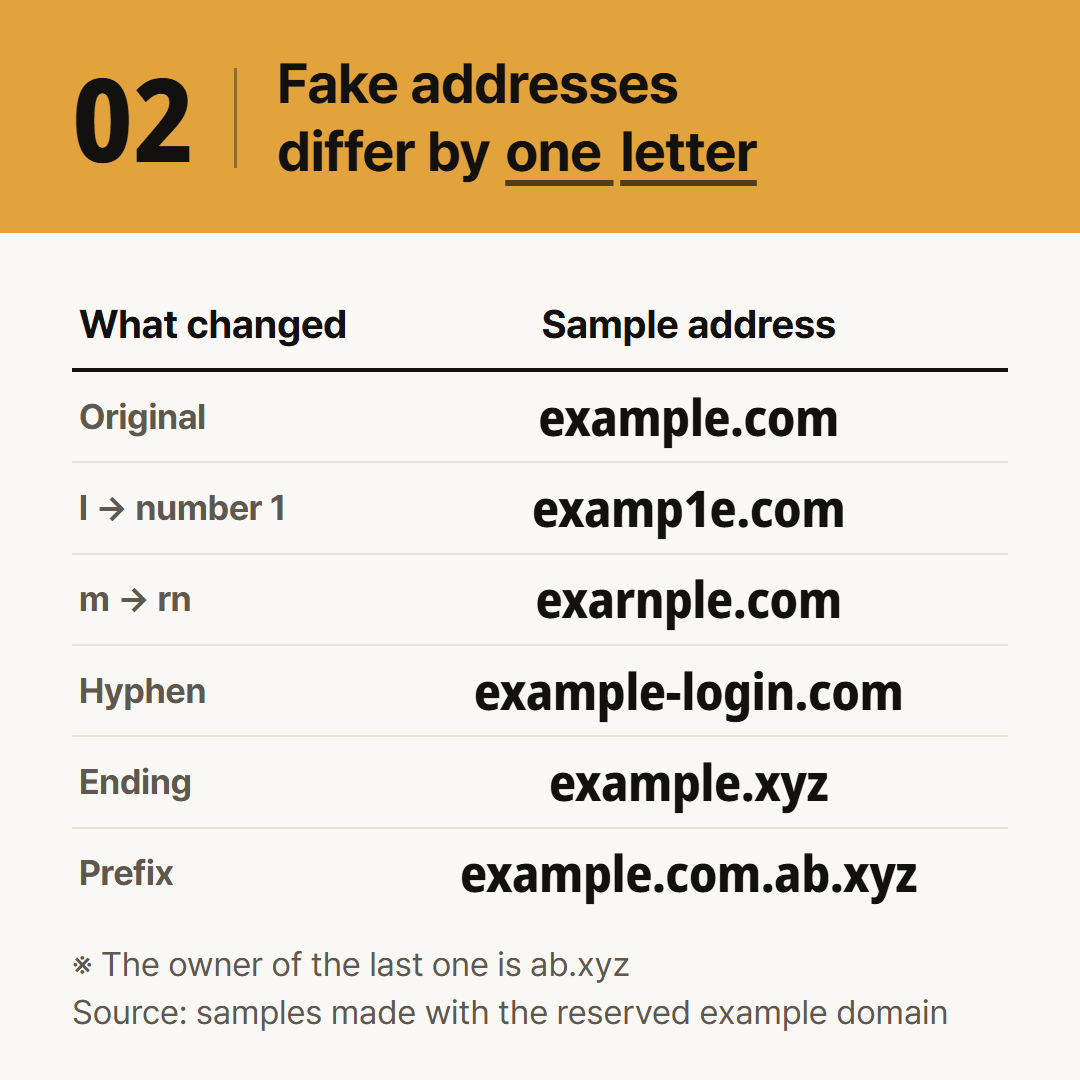
Fake addresses often take these shapes.
- Lookalike letters: the number 1 for a lowercase l, the number 0 for the letter o, r and n written together as rn in place of m
- Added hyphens: a - inserted into the name, or words such as login or secure attached
- A changed ending: .com swapped for .net, .co, .xyz and so on
- Encoded addresses: an address starting with xn-- is how an address mixing letters from other alphabets is encoded, so it can look normal on screen and still be a different address
A one-letter difference is especially hard to see in a phone address bar. Tap the bar to show the full address and read it letter by letter.
APWG recorded 866 brands whose names were used in phishing reports in Q4 2025. The better known a name is, the more addresses imitate it.
The real address to compare against should come from an official source. Public registers kept by licensing bodies, such as the UK Gambling Commission, list each business's domain names and their status (UK Gambling Commission business register). Those domains are supplied by the business, though, so updates can lag.
3.Does a padlock in the address bar mean the site is safe?
No.
In the same notice, IC3 says not to trust a website just because it shows a lock icon or https.
The padlock means the traffic is encrypted. It says nothing about who owns the site or whether it can be trusted.
A fake site can get a certificate and show a padlock too. The certificate details show which domain name it was issued to, so compare that with the name checked in section 2.

4.What if a message says "our address has changed", or it has already been clicked?
Do not tap a new address sent by text or messenger. In Korea, the Korea Internet and Security Agency runs a smishing check service on its Boho site and takes hacking and spam calls on 118 (Boho).
If an ID and password were already entered, change that password first. Change it on any other account that uses the same password as well.
If money has left the account, go to the police (112 in Korea) or the cyber crime report channel. Unlicensed online gambling in Korea falls under Article 246 of the Criminal Act, so that may also come up during a report.
Where to look in the terms when a withdrawal is blocked is covered in when a baccarat site will not pay out, and the costs that can be counted when choosing a site are in how to choose a baccarat site.
Summary
- APWG counted 3.8 million phishing attacks in 2025, and 295,691 phishing sites were reported in December alone
- The owner is the last two parts of the name before the first /, so check lookalike letters, hyphens, endings and xn-- one letter at a time
- A padlock only means encryption, a new address sent by message should not be tapped, and 118 takes questions in Korea
Hiddenpick is a Windows program that keeps on its server the betting rules that pick owners do not make public, and runs them as they are on the PC of the person who received them through a referral code. It currently runs on Evolution live baccarat at Stake (stake.com). What the program does and does not do is in the baccarat bot guide. We are recruiting national pickster representatives, and those selected receive benefits worth $12,000, a one-year pass (apply at hiddenpick.my/pickster).
- 25,000+ real shoes collected and analysed since September 2026
- 90+ baccarat tables from the lobby on one screen · refreshed every 0.35s · seated 2 to 4 seconds after a click
- Stops by itself at your take-profit and stop-loss · tie several PCs into one team and stop on the total
- No browser extension · your money stays in your own Stake account · 12 languages