Task scam steps behind automatic side job ads, from a 5,000 won first payout to a deleted chat, with the dates of Korea's account freeze rules
2026-11-05

Could 5,000 won for clicking a few ratings be the first step toward losing more than 70 million won?
Side job ads that say money comes in automatically keep showing up near the top of YouTube searches. Videos exposing side job scams sit in the same list. This post lays out the order of one real case and the dates the rules changed, like a calendar.
1.Where automatic side jobs and task scams meet
Task scam: pays small sums for easy tasks, then pulls the victim into paid team missions.
Lee Seung-hwan, an inspector at the Korean National Police Agency Security Intelligence Bureau, cited agency data in a Nocut News column on 14 July 2026. From January to May 2026 there were 1,887 team mission scams, against 16,892 phishing crimes in the same period (Nocut News column).
The column put this at 11.7% of all phishing crimes. Dividing the two numbers directly gives about 11.2%.
The words the two share are "automatic" and "from home". The hope of earning with less effort, without leaving the house, is used in the very first message.
2.Six steps from the first payout to the disappearance
Below is the case of a woman in her 40s from the same column, in order. The column gives steps, not dates, so the list below has no dates either.
Step 1, a home side job text and easy tasks
A text advertising a home side job arrives and leads to a chat on a messenger. The tasks are things like managing shopping mall ratings or pressing like, and 5,000~10,000 won per task really arrives.
The fact that the first money is real becomes the reason to trust.
Step 2, a 300,000 won three person team mission
Next comes a mission where three people form a team. Put in 300,000 won and 330,000 won comes back. Once again, the money returns.
From this step the direction of the money changes. Before, the victim only received. From here on, money goes in first and comes back later.
Step 3, 1.5 million won and a VIP level
The mission amount rises to 1.5 million won, with a notice about moving up to a VIP level. The amount grows fivefold here.
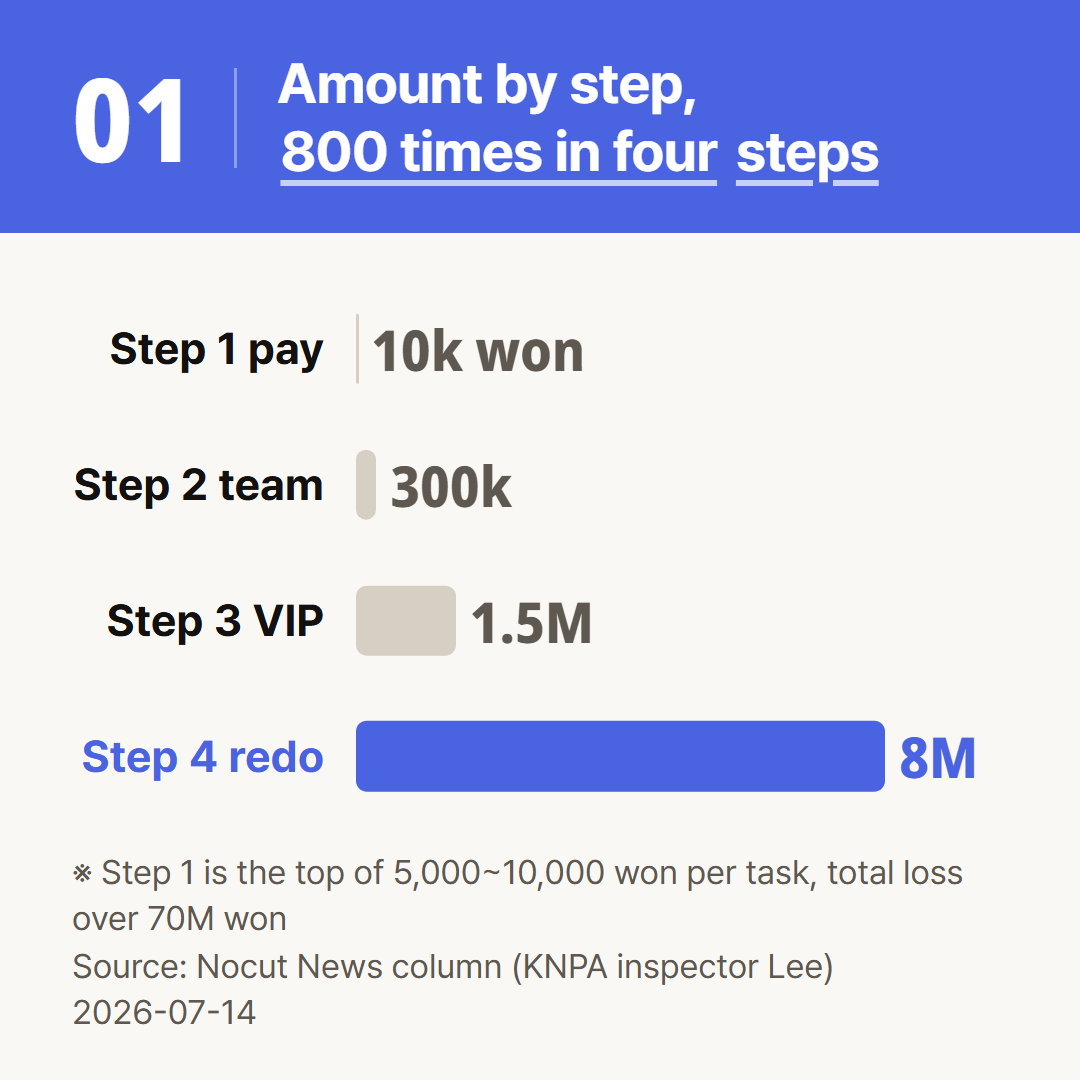
Step 4, an 8 million won mission and a teammate error
In the 8 million won mission, the victim is told a teammate made a mistake and the same amount must be paid in again. Pulling out, they say, would make the whole team lose.
Step 5, extra transfers under new names
System error, deposit, transaction recovery cost and tax appear one after another. The labels change, but the demand is the same: send more money.
Once someone says money must be paid before a withdrawal, the scam is already close to its last step.
Step 6, blocked and the chat gone
After the victim told her family, the messenger account was blocked and the team chat disappeared. By then living money, savings and a loan, more than 70 million won in all, had gone.

3.After sending money, why a freeze may not come quickly
For voice phishing, Korean law gives a route to ask the bank for an immediate account freeze. A side job scam may be different.
In a Segye Ilbo column on 15 September 2025, lawyer Seo A-ram explained that the Telecommunications Fraud Refund Act leaves acts disguised as supplying goods or services out of its definition. Side job scams can be treated as ordinary fraud, which can make relief such as an account freeze hard to get (Segye Ilbo column).
Moving other people's money as a side job can make a victim a suspect too (same column).
So the longer the wait, the worse it gets. Gather transfer records and chat screens in time order and report to the police (112 in Korea) right away.
4.Rule calendar, August 2024 to August 2026
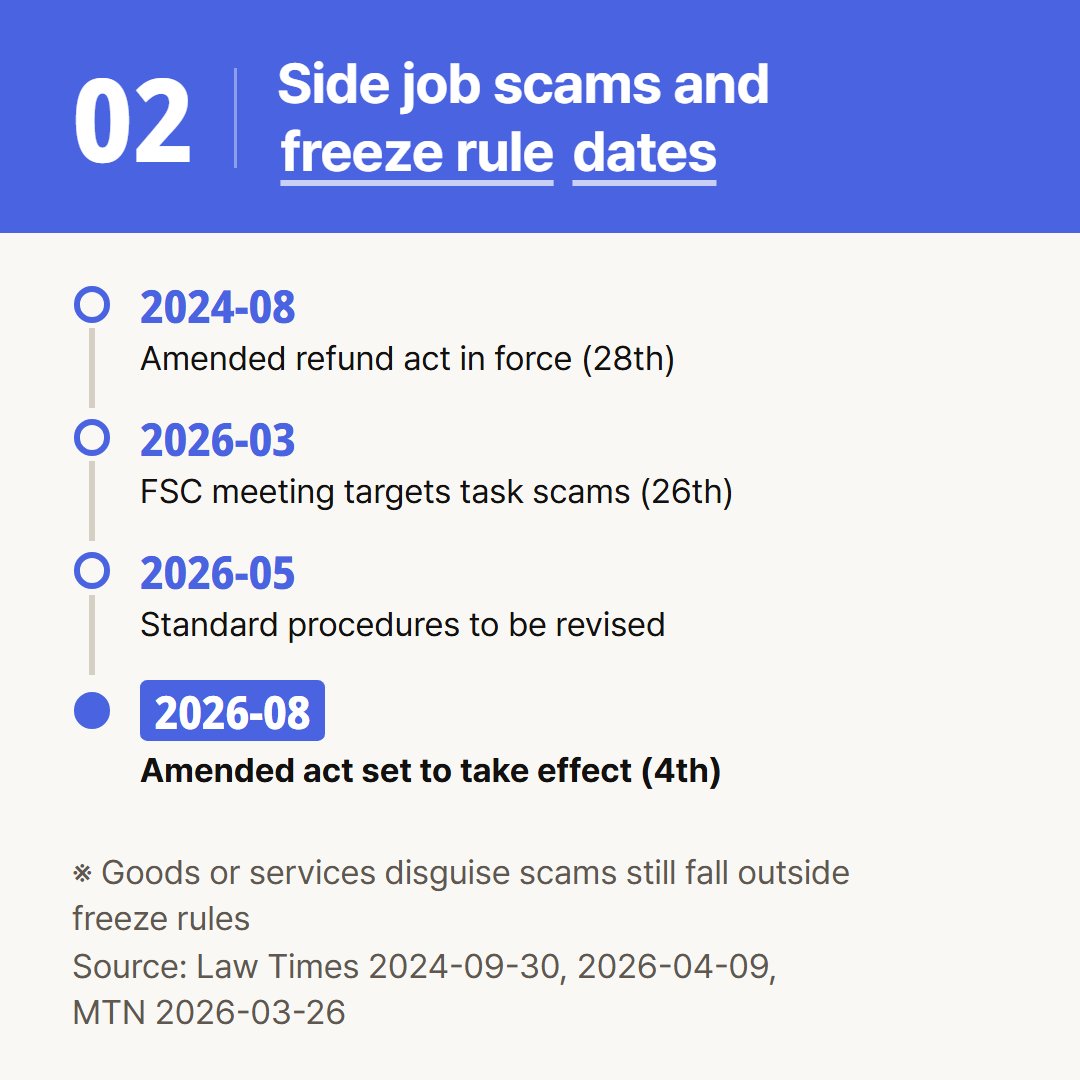
- 28 August 2024: amended Telecommunications Fraud Refund Act and decree in force, with objection and end rules for freezes reworked (Law Times)
- 26 March 2026: Financial Services Commission meeting announces that new scams such as team mission scams can be frozen after police confirmation (MTN report)
- April~May 2026: standing council launched, standard procedures to be revised
- 4 August 2026: amended act promulgated on 3 February set to take effect (Law Times, Yulchon)
The same column noted again that freeze and recovery provisions do not apply to types disguised as trading goods or services. The rules are moving, but stopping before the transfer is still the fastest protection.
5.What to check on the day a side job ad arrives
Before sending any money
- Payout: a mission asks for more money than has been paid out
- Team: someone else's mistake is used to ask for the same amount again
- Withdrawal: a deposit, tax or recovery fee must be paid before withdrawing
- Account: money goes to a personal name account or a new account each time
- Records: transfer history and chat screens are saved in date order
Hiddenpick is a Windows program that keeps on its server the betting rules that pick owners do not make public, and runs them as they are on the PC of the person who received them through a referral code. It currently runs on Evolution live baccarat and blackjack (21) at Stake (stake.com). What automated betting does and does not do is on the baccarat bot guide.
We are recruiting national pickster representatives, and those selected receive benefits worth $12,000, a one-year pass. Apply: https://hiddenpick.my/pickster
- 25,000+ real shoes collected and analysed since September 2026
- 90+ baccarat tables from the lobby on one screen · refreshed every 0.35s · seated 2 to 4 seconds after a click
- Stops by itself at your take-profit and stop-loss · tie several PCs into one team and stop on the total
- No browser extension · your money stays in your own Stake account · 12 languages