Instagram monetization on autopilot, four questions answered from the source texts, from invite-only bonuses to the first hashtag and AI persona labels
2026-11-04
June 1, 2026. From that day, a post in which an AI generated person recommends a product has to say that the person is virtual. It is the date Korea's Fair Trade Commission put its revised endorsement guidelines into effect.
Search YouTube for Instagram monetization and the top videos promise weekly bonuses from a single photo, or a monthly figure from an AI avatar account. We picked four questions such accounts actually run into and answered them only from Instagram's own pages and the text of the guidelines.
1.Can anyone apply for the weekly bonus from one photo?
There is no way to apply. Instagram's creator page says bonuses are available for a limited time and by invitation only (Instagram bonuses).
The same page says bonuses reward the performance of reels and photos. Photos cover both carousel posts and single image posts.
Which accounts get invited, and how many followers they need, is not on that page. Bonuses are income that Instagram chooses to open. A video about weekly bonus payouts is best read as the record of one invited account.
2.Will a tool that adds followers and likes speed up monetization?
Instagram's Terms of Use forbid creating accounts or accessing and collecting information in an automated way without express permission. Buying and selling accounts or data is also barred (Instagram Terms of Use).
Meta's spam policy reaches further. It bans posting and engaging at very high frequency, whether by hand or automated, and buying or selling likes, follows, views and clicks (Meta spam policy).

The same policy lists an exception. Clearly identified branded content is allowed. That makes labeling the next question.
3.Where does the ad label go when affiliate and sponsored posts are automated?
Cash is not the only reward that counts. The Korean guidelines say that if someone recommends a product after receiving cash, the product itself, gift cards, reward points or discounts, the financial relationship must be disclosed in every single post (KFTC endorsement guidelines).
Instagram points the same way. If you are compensated in any form, add the paid partnership label, and anything received from a business partner, money or not, counts (Instagram branded content).
Disclosure wording: the words saying an advertiser paid for the post. Place, size, wording and language all count.
For photo posts, the guidelines list the places in order.
- In the photo: put the wording on the image, clearly set apart from the background
- First line: if the photo and caption read as one, the wording can go at the start of the caption instead
- Hashtag: if used as a hashtag, it goes first in principle
The wrong places are listed too. Wording in a comment, wording visible only after tapping more, wording mixed into the middle of the text, and wording buried between other hashtags.
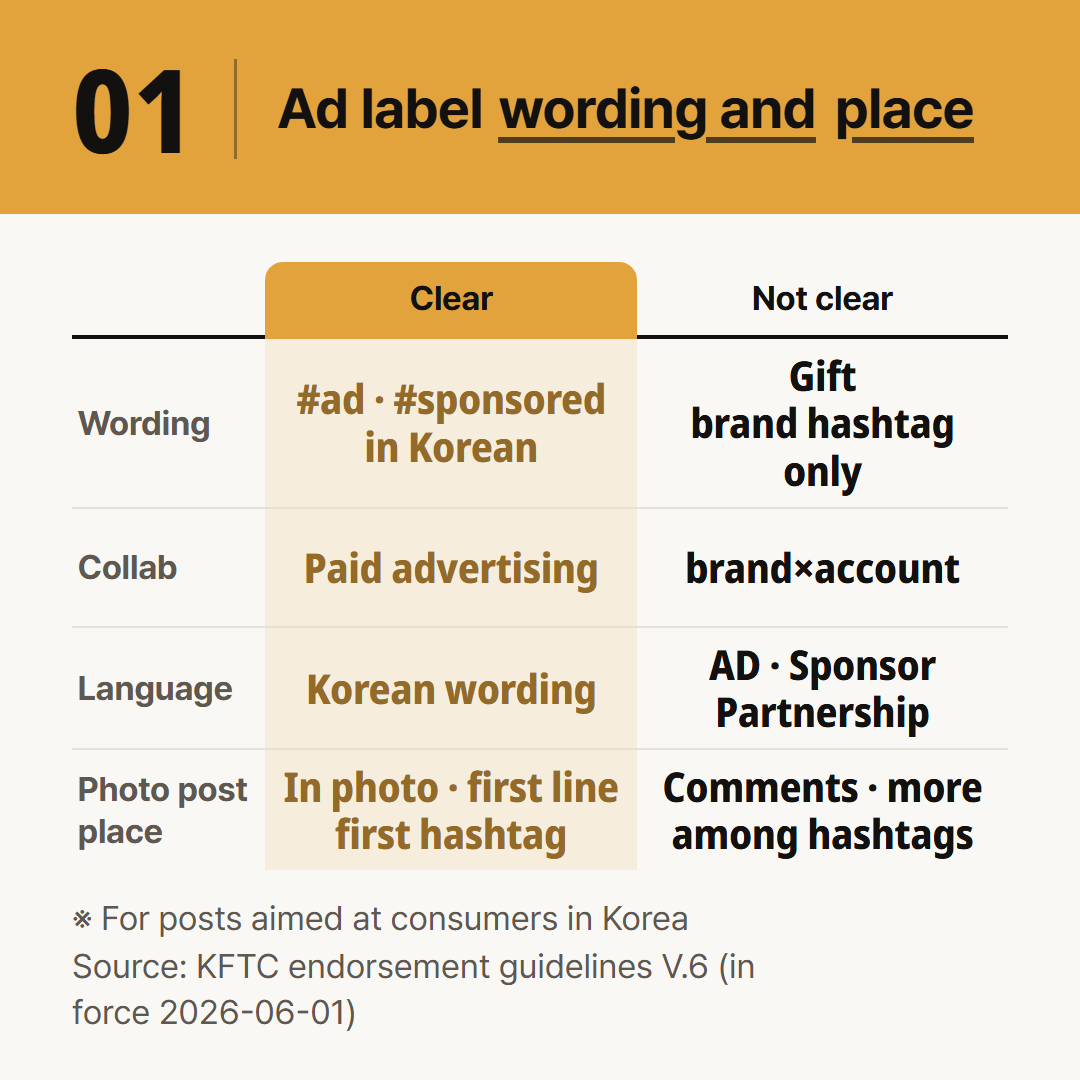
The words are set as well. The Korean words for '#ad' and '#sponsored', 'sponsored product' and 'paid advertising' are clear examples. 'Gift', 'sent to me by…', a hashtag with only the brand name, and '[brand]×[account]' are unclear examples.
For posts aimed at Korean consumers, 'AD', 'Sponsor' and 'Partnership' do not count as the same language. The guidelines want the wording in the same language as the recommendation.
This is where automation bites.
Assume an account schedules ten posts a day. The label has to sit in the first position of each of the ten, and if one template drops it, every post made from that template that day goes out without it.
When a video such as a reel carries the message, the wording goes in the title or in the video. If the whole video is a recommendation, the guidelines want it at the start and end and repeated in between, with an example of a caption shown every 5 minutes.
An ad without the label can be judged deceptive advertising under Korea's Act on Fair Labeling and Advertising. The Act lets the regulator fine a business up to 2% of the related sales (up to KRW 500 million when there are no sales), and sets penalties of up to two years in prison or a fine of up to KRW 150 million (Fair Labeling and Advertising Act).
4.What else must an account with an AI person recommending products disclose?
The guidelines in force since June 1, 2026 say that when a virtual person made with AI or similar tools, hard to tell from a real one, makes a recommendation, the post must disclose that the person is virtual. SBS Biz reported the same start date.
For a text post, a phrase such as 'includes a virtual person' goes in the title or first line. For photos and video, the label sits next to the virtual person for as long as that person is on screen.
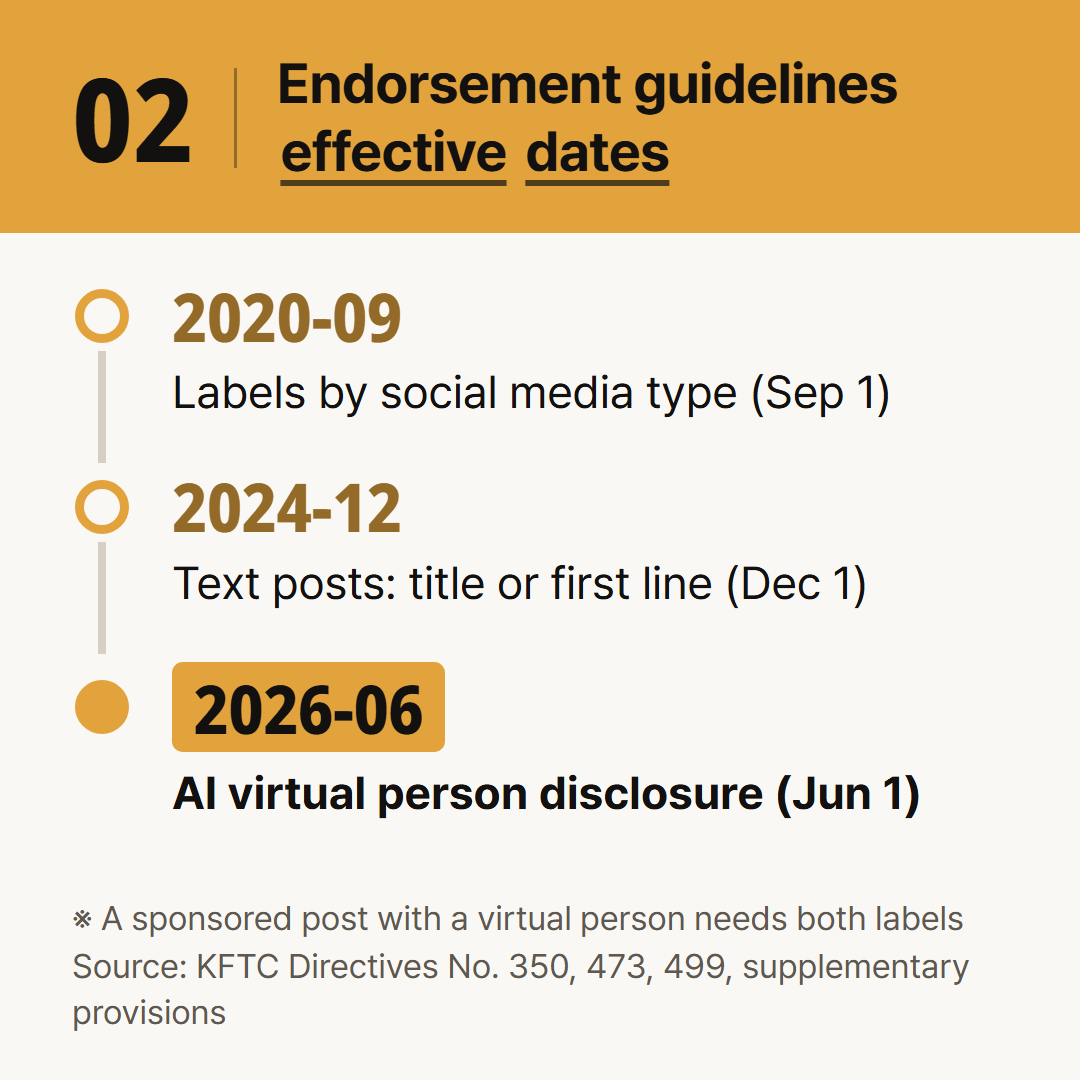
Saying the person is virtual does not end it. The guidelines say a recommendation dressed up as real use can still be unfair advertising if it does not match what actually happened. A sponsored post with a virtual person needs both the virtual person label and the ad label.
5.Instagram monetization checklist before switching an account on
Five lines to check before automating posts
- Bonuses: without an invitation, they are not in the income plan
- Tools: features that buy or auto add followers and likes are off
- Every post: each scheduled template puts the label in the photo, the first line or the first hashtag
- Wording: in the audience's language, not only 'AD' or a brand hashtag
- Virtual people: while an AI person is on screen, a 'virtual person' label sits next to them
Hiddenpick is a Windows program that keeps on its server the betting rules that pick owners do not make public, and runs them as they are on the PC of the person who received them through a referral code. It currently runs on Evolution live baccarat and blackjack (21) at Stake (stake.com). How automated runs meet the numbers set by the rules is laid out on the baccarat bot page.
We are recruiting national pickster representatives, and those selected receive benefits worth $12,000, a one-year pass. Apply: https://hiddenpick.my/pickster
- 25,000+ real shoes collected and analysed since September 2026
- 90+ baccarat tables from the lobby on one screen · refreshed every 0.35s · seated 2 to 4 seconds after a click
- Stops by itself at your take-profit and stop-loss · tie several PCs into one team and stop on the total
- No browser extension · your money stays in your own Stake account · 12 languages