Blackjack dealer bust probability, the ace at 11.5% vs 16.7% compared with and without dealer blackjack, and the soft 17 rule
2026-11-02
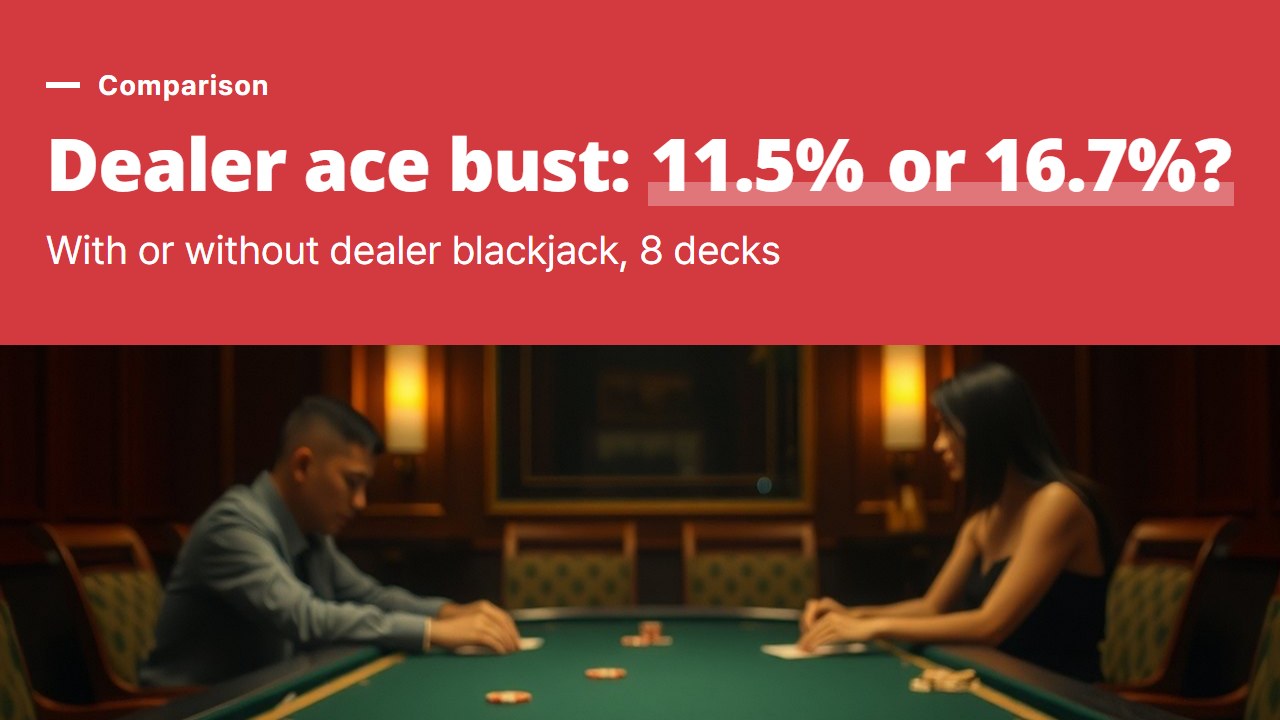
The dealer places one card face up and one face down. The face-up card is a 6. The player holds hard 15, and the hit and stand buttons wait at the bottom of the screen.
This is the moment many players think about blackjack dealer bust probability. Look it up, though, and some charts list the dealer ace at about 11% while others say about 17%. We calculated every case for 8 decks with the dealer standing on soft 17 and compared where the two numbers split.
1.Blackjack dealer bust probability for all 10 upcards
We removed the dealer upcard from 416 cards (8 decks) and counted every way the dealer can draw, one card at a time, until reaching 17 or more. The dealer stands on soft 17.
- Upcards 2 to 6: 35.4% · 37.4% · 39.5% · 41.8% · 42.3%
- Upcards 7 to 10: 26.2% · 24.4% · 22.9% · 21.2%
- Upcard A: 11.5%
Mix the ten upcards by how often each appears and the dealer goes over 21 in 28.2% of rounds. The dealer busts in fewer than three rounds out of ten.
The line that bends between 6 and 7 is covered in the blackjack basic strategy chart post.
Bust: a card total over 21. When the dealer busts, every player hand still standing wins.
2.With and without dealer blackjack compared, why the ace splits into 11.5% and 16.7%
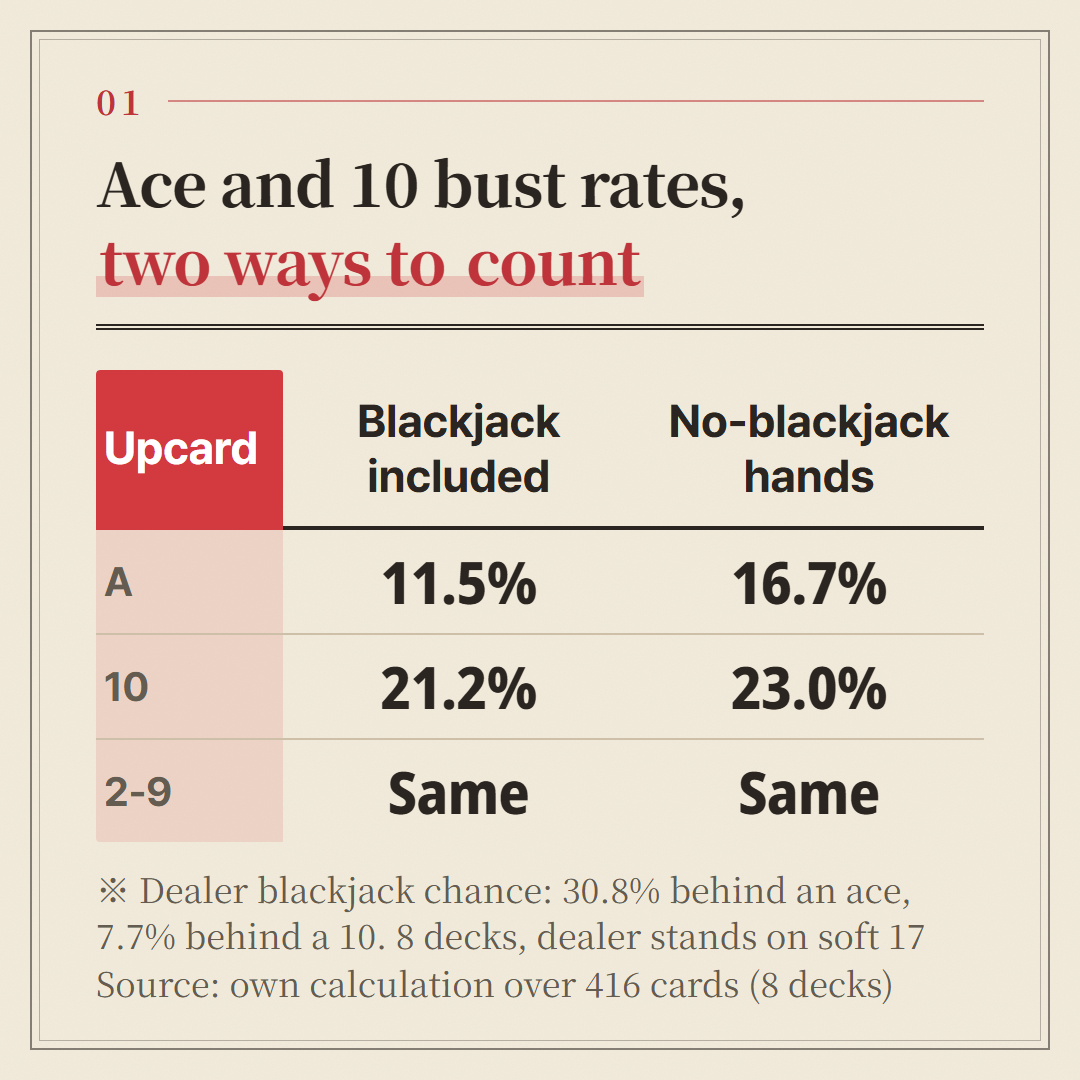
Charts disagree on the ace mainly because of one choice: whether dealer blackjack is counted.
If the hole card behind an ace is worth 10, the dealer has blackjack at once. In a fresh 8-deck shoe, 128 of the remaining 415 cards are worth 10, which is 30.8%. The chance of an ace hiding behind a 10 is 32 cards, or 7.7%.
The first way keeps every round in the denominator, dealer blackjacks included. A round that became blackjack cannot bust, so the rate comes out lower. Ace 11.5% and 10 at 21.2% are written this way.
The second way counts only rounds where the dealer checked the hole card and did not have blackjack. Those blackjack rounds leave the denominator and the rate rises. The ace becomes 16.7% and the 10 becomes 23.0%.
The two values answer different questions, and both are correct.
Which value fits which moment
Before the round starts, when judging the whole round from the upcard alone, the first value is the right one. Once the dealer has checked for blackjack and it is the player's turn, the second value is closer to the situation.
Hole card checks differ by table. With no check, dealer blackjack stays live on your turn, so use the first value.
Where a dealer ace stops
Counting every round, a dealer ace ends on 17, 18, 19 or 20 at 13.0% to 13.1% each, spread evenly. A non-blackjack 21 is 5.4%.
Counting only non-blackjack rounds, 17 to 20 are about 18.8% to 18.9% each, 21 is 7.8% and a bust is 16.7%. Even without blackjack, a dealer showing an ace stops on 17 or more in five rounds out of six.
The 10 barely moves
For a 10 upcard the gap is 21.2% against 23.0%, only 1.8 percentage points. Just 32 aces can hide behind it, so dealer blackjack rounds are few. A 10 without blackjack ends on 20 most often, 36.9% of the time.
3.Stand vs hit on soft 17 compared, only the 6 and ace change
We repeated the calculation for tables where the dealer hits soft 17 (H17). These values include dealer blackjack.
- Upcard 6: from 42.3% to 43.9%
- Upcard A: from 11.5% to 13.9%
- Upcards 2 to 5: up 0.1 to 0.3 points each
- Upcards 7 to 10: unchanged
Why do 7 and up stay the same?
With an upcard of 7 or more, there is no way to make 17 while counting an ace as 11. A 7 plus 11 is already 18.
The 6 moves the most because a 6 followed by an ace is soft 17 right away. On a stand table, a dealer 6 ends on 17 in 16.6% of rounds, higher than 2 to 5 (12.2% to 14.0%). On a hit table that hand takes another card, and the share ending on 17 drops to 11.5%.
The mixed overall bust rate rises from 28.2% to 28.6%. That does not make the rule good news for players. The share of dealer aces ending on 17 falls from 13.0% to 5.7%, and those rounds move up to 18 through 21.
4.Dealer bust vs player bust compared, who acts first
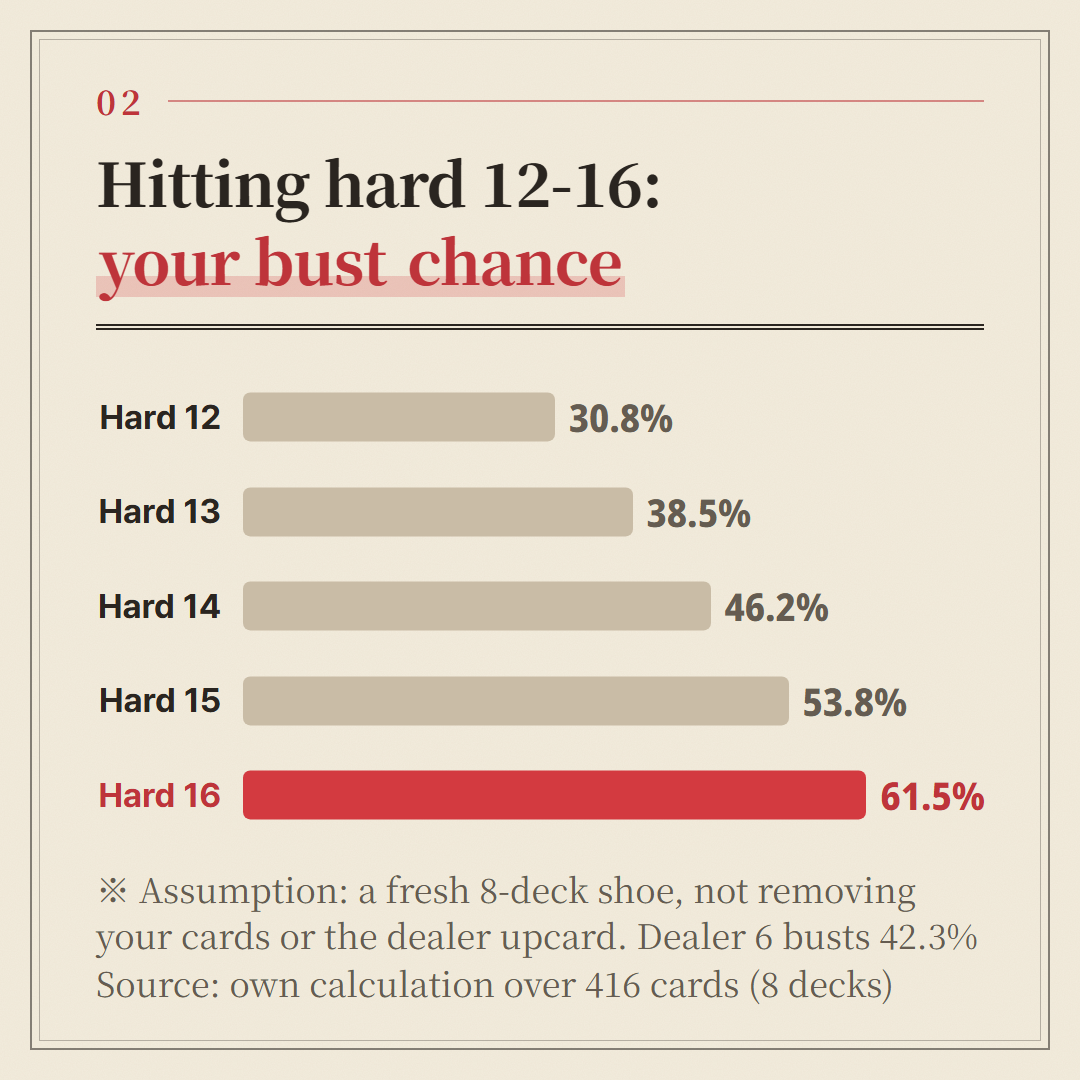
The player draws first.
If the player goes over 21 first, the round is lost even if the dealer busts later. The 42.3% against a dealer 6 only matters while the player's hand is still alive.
Hitting hard 12 busts when one of the 128 ten-value cards comes, 30.8%. Hard 13 is 38.5%, 14 is 46.2%, 15 is 53.8% and 16 is 61.5%, rising 7.7 points with each step.
Hitting hard 16 carries a 61.5% bust chance, higher than the 42.3% bust rate of a dealer 6. Put those two numbers side by side and it becomes clear why the chart stands on many hard 13 to 16 cells against 2 to 6, and takes the risk of hitting against 7 and up.
The house share stays. A 7-seat table with 8 decks and the dealer standing on soft 17 has an RTP of 99.29%.

Before reading a bust chart
- The chart uses the same number of decks as the table
- I checked whether the dealer stands or hits on soft 17
- I checked whether the ace and 10 rows include dealer blackjack
- I know when this table checks the hole card
- I know the overall dealer bust of 28.2% is fewer than three rounds in ten
- I read it next to the 61.5% bust chance of hitting hard 16
Hiddenpick is a Windows program that keeps on its server the betting rules that pick owners do not make public, and runs them as they are on the PC of the person who received them through a referral code. It currently runs on Evolution live baccarat and blackjack (21) at Stake (stake.com). The hit and stand cells for every dealer upcard are laid out on one page in the blackjack basic strategy guide.
We are recruiting national pickster representatives, and those selected receive benefits worth $12,000, a one-year pass (apply at https://hiddenpick.my/pickster).
- 25,000+ real shoes collected and analysed since September 2026
- 90+ baccarat tables from the lobby on one screen · refreshed every 0.35s · seated 2 to 4 seconds after a click
- Stops by itself at your take-profit and stop-loss · tie several PCs into one team and stop on the total
- No browser extension · your money stays in your own Stake account · 12 languages