How to read baccarat board shapes: how common bent columns and one-sided colors really are, in 4 questions
2026-10-16
When a red column at the end of the board hits the bottom and bends sideways, how rare is that picture?
The rules for drawing the board (the Big Road) are simple. A win for the same side goes one cell down, and a win for the other side starts a new column to the right.
At a real table, the question that comes up is whether a shape is common.
We picked four such questions and answered them with 38,456 clean shoes we collected (September 9 to October 13, 2026, about 2.57 million hands).
1.How many columns fit on one board?
A shoe had 66.8 hands on average, ties included. Drawn on the board, that comes to 30.8 columns on average, with a median of 31.
Eight in ten shoes landed between 25 and 36 columns. The fewest was 14 and the most was 40.
Column: one vertical line on the board, growing down while the same side keeps winning.
A shoe with only 14 columns had many long runs, and a shoe with 40 had many one or two cell columns. The share of each column length is counted separately in Are long baccarat streaks rigged?.
2.How common is a column that hits the bottom and bends sideways?
The board has six rows. When the same side wins a seventh time in a row, there is no cell left below, so the mark turns right. Players often call this the dragon tail.
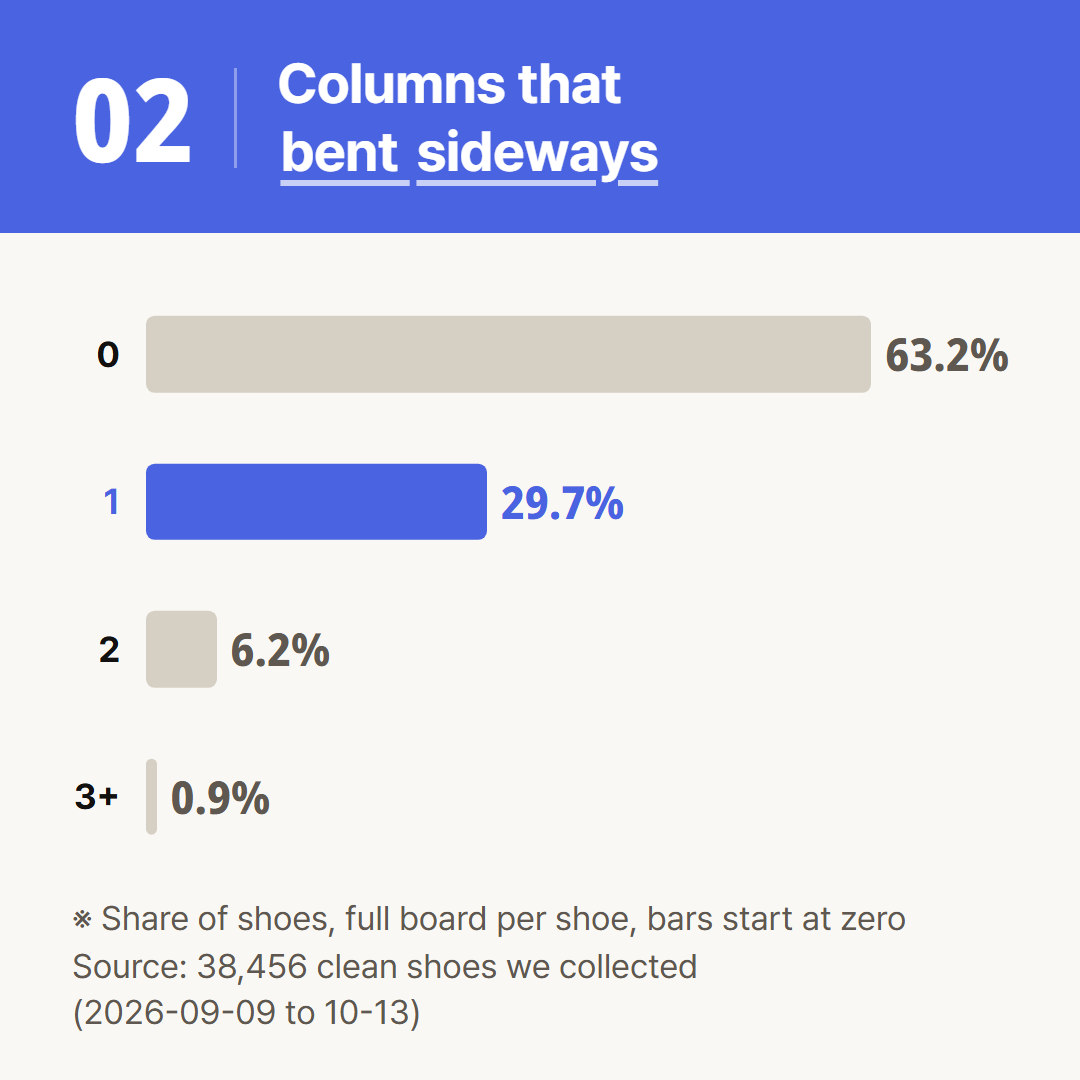
Of the 38,456 clean shoes, 36.8% had at least one bent column. That is about one shoe in three.
By count, 63.2% of shoes had none, 29.7% had one, 6.2% had two and 0.9% had three or more. The most in a single shoe was six.
Shoes with two or more bends add up to 7.1%, about one in fourteen. That is why a board with two dragon tails still turns up now and then when moving between many tables in a lobby.
Most boards have one tail at most.
A single column passing seven cells is rare. But a shoe makes about thirty columns, so at the level of a whole shoe the bent tail is a picture you see often.
The bottom is not the only reason a column bends. If the tail of an earlier column lies sideways underneath, the next column is blocked right above it and turns before reaching six cells.
A column bent by a tail can be shorter than seven hands. The bend alone does not show the run length.
Turns caused by a blocking tail were 958 of 17,264 turns (5.5%). 2.2% of shoes had at least one.
That is roughly once in more than forty shoes, so the first time it looks like a drawing error. It is drawn by the rule.

When a tail is bent, counting the cells from start to end is the accurate way. On a narrow screen the start of the board can be cut off, and then the start of the tail may not be visible.
3.Is a board with far more red than blue rare?
After drawing each full shoe, we counted the gap between red (Banker) and blue (Player) cells. Ties were left out.
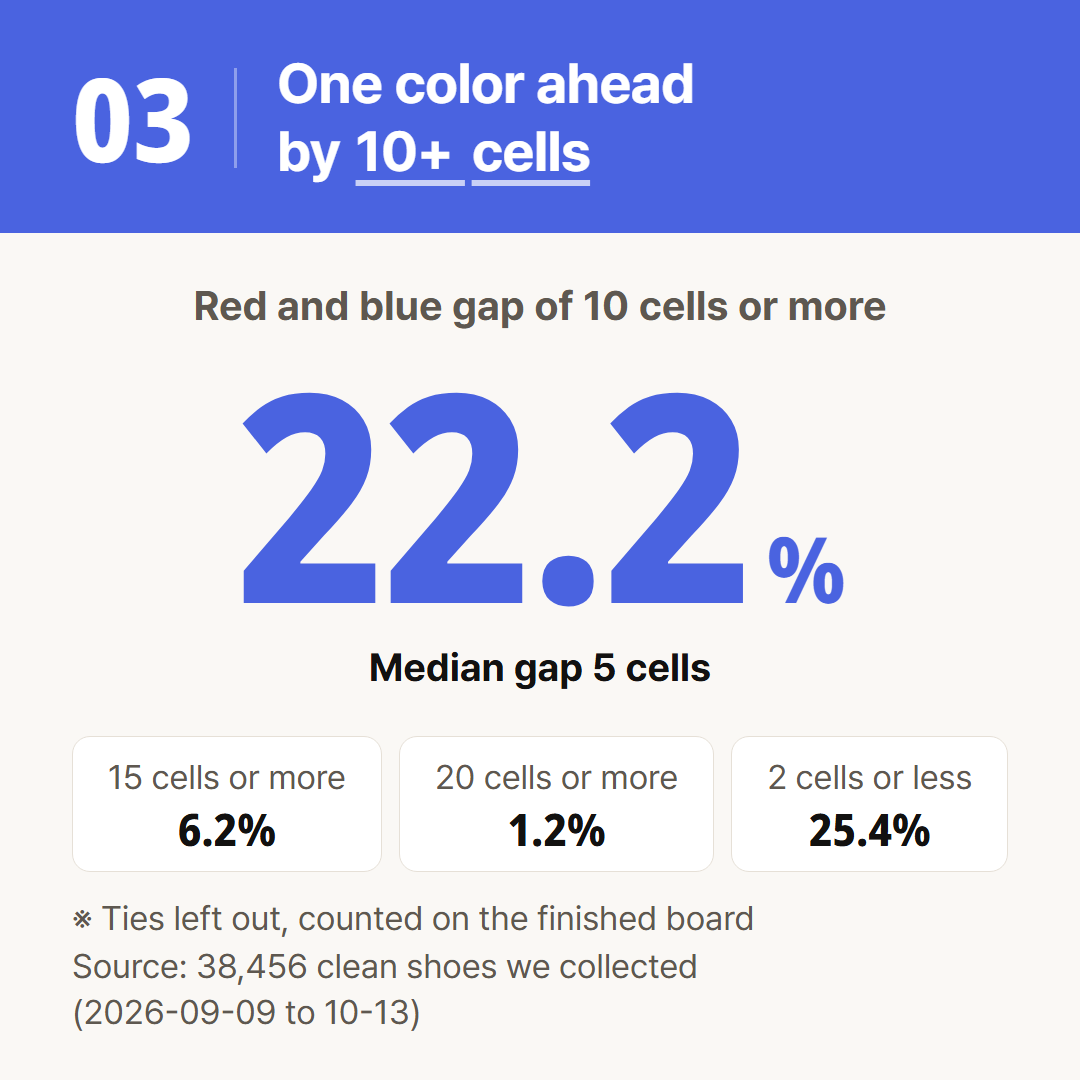
The median gap was 5 cells. Two shoes in ten (22.2%) had one color ahead by 10 cells or more. 15 or more was 6.2%, 20 or more was 1.2%, and the widest gap was 34 cells.
On the other side, 25.4% of shoes were almost even, with a gap of 2 cells or less.
We also checked which color led. Banker led in 51.5% of shoes, Player in 43.4%, and 5.1% were equal. Banker wins slightly more often to begin with (50.68% in clean shoes), so slightly more boards end with more red.
4.Are cells with stacked green tie lines common?
A tie does not take a new cell. It is marked as a green line on the last cell. When ties come back to back, the lines stack on the same cell or a number is added (each screen draws this differently).
40.8% of shoes had a cell with two or more ties on it. Three or more was 4.6%.
Ties in the first two hands of a shoe are sometimes recorded wrongly, so they were left out of this count. How many ties a shoe has is in How often does a baccarat tie happen?.
Stacked green lines show up in four shoes out of ten. Nothing in these numbers gives a reason to guess the next hand from that cell.
3-line summary
- A board holds about 31 columns, and one shoe in three (36.8%) had a column that hit the bottom and bent
- 22.2% of shoes, about two in ten, had one color ahead by 10 cells or more
- 40.8% of shoes had two or more ties stacked on the same cell
Hiddenpick is a Windows program that keeps on its server the betting rules that pick owners do not make public, and runs them as they are on the PC of the person who received them through a referral code. It currently runs on Evolution live baccarat at Stake (stake.com). Whether board shapes can predict the next hand is covered with real numbers in the baccarat prediction guide.
We are recruiting national pickster representatives, and those selected receive benefits worth $12,000, a one-year pass. Apply: https://hiddenpick.my/pickster
- 25,000+ real shoes collected and analysed since September 2026
- 90+ baccarat tables from the lobby on one screen · refreshed every 0.35s · seated 2 to 4 seconds after a click
- Stops by itself at your take-profit and stop-loss · tie several PCs into one team and stop on the total
- No browser extension · your money stays in your own Stake account · 12 languages