Are crypto bots worth it after costs: 150 round trips a month take 3% of capital
2026-10-23

The bot ran overnight, and in the morning the app shows more than ten fill notices. Plenty of buying and selling, yet the balance is about where it was yesterday. It is a morning screen many people see the first time they leave a crypto bot running.
It means money slipped out somewhere between what the bot made and the balance. Are crypto bots worth it once that is counted? We took four downsides that can be put in money and worked them out with Upbit's official numbers.
1.The assumptions behind the numbers
Numbers differ by exchange, so we use one market, the Korean won market on Upbit, a large Korean exchange. Fees come from Upbit's fee page, and tick size and the minimum order come from Upbit's KRW market guide.
- Capital: 10 million won (assumed)
- Size of each trade: 1 million won (assumed)
- Count: 5 buys and sells a day, 150 round trips in 30 days (assumed)
Round trip: buying once and selling the same amount again. A fee is charged on the buy and again on the sell.
2.Downsides 1 and 2: fees, nearly three times apart by order type
The regular order fee on Upbit's KRW market is 0.05%. It is the same for an order resting in the book and an order that fills at once.
One round trip of 1 million won costs 500 won on the buy and 500 won on the sell.
- One round trip: 1,000,000 won x 0.05% x 2 = 1,000 won
- 150 a month: 1,000 won x 150 = 150,000 won
- Against capital: 150,000 ÷ 10,000,000 = 1.5%
That part is well known. The less known part is reserved orders.
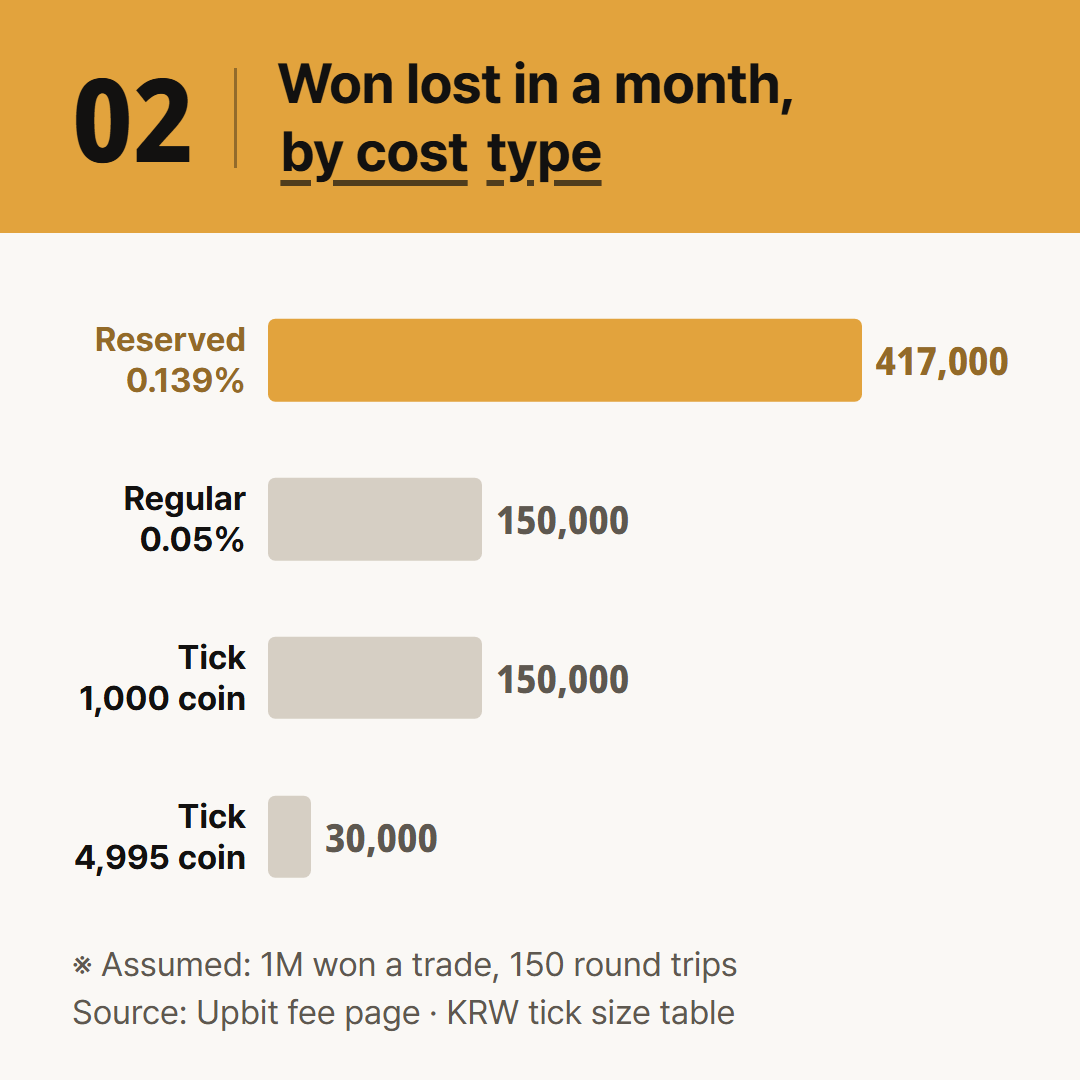
A reserved order runs automatically when the price reaches a trigger price set in advance. It sets off a stop loss or take profit with nobody watching the screen, so many people use it as a stop line next to a bot. On the same fee table, the KRW market reserved order fee is 0.139%, 2.78 times the regular order fee.
- One round trip: 1,000,000 won x 0.139% x 2 = 2,780 won
- 150 a month: 2,780 won x 150 = 417,000 won
- Against capital: 4.17%
Same count, same size, and the gap is 267,000 won a month.
That is why it pays to check first whether the stop line sits on a reserved order or whether the bot watches the price and sells with a regular order. If the manual does not say, divide the fee of one trade by its filled amount in the Upbit trade history and the rate shows up.
The fee page says trading fees may change with events. Look at that day's table again before working it out.
The fee is a rate times the filled amount, so it grows with trade size. The more often a bot trades, the higher this line sits on the profit sheet. How fees eat into a monthly return once compounding is counted is worked out in our trading bot return calculation post.
3.Downside 3: one tick, the gap between 4,995 won and 5,000 won
A market buy fills at the lowest asking price, and a market sell fills at the highest bid. However narrow the gap between the two, it is at least one tick.
So even when the price does not move, one round trip gives back at least one tick.
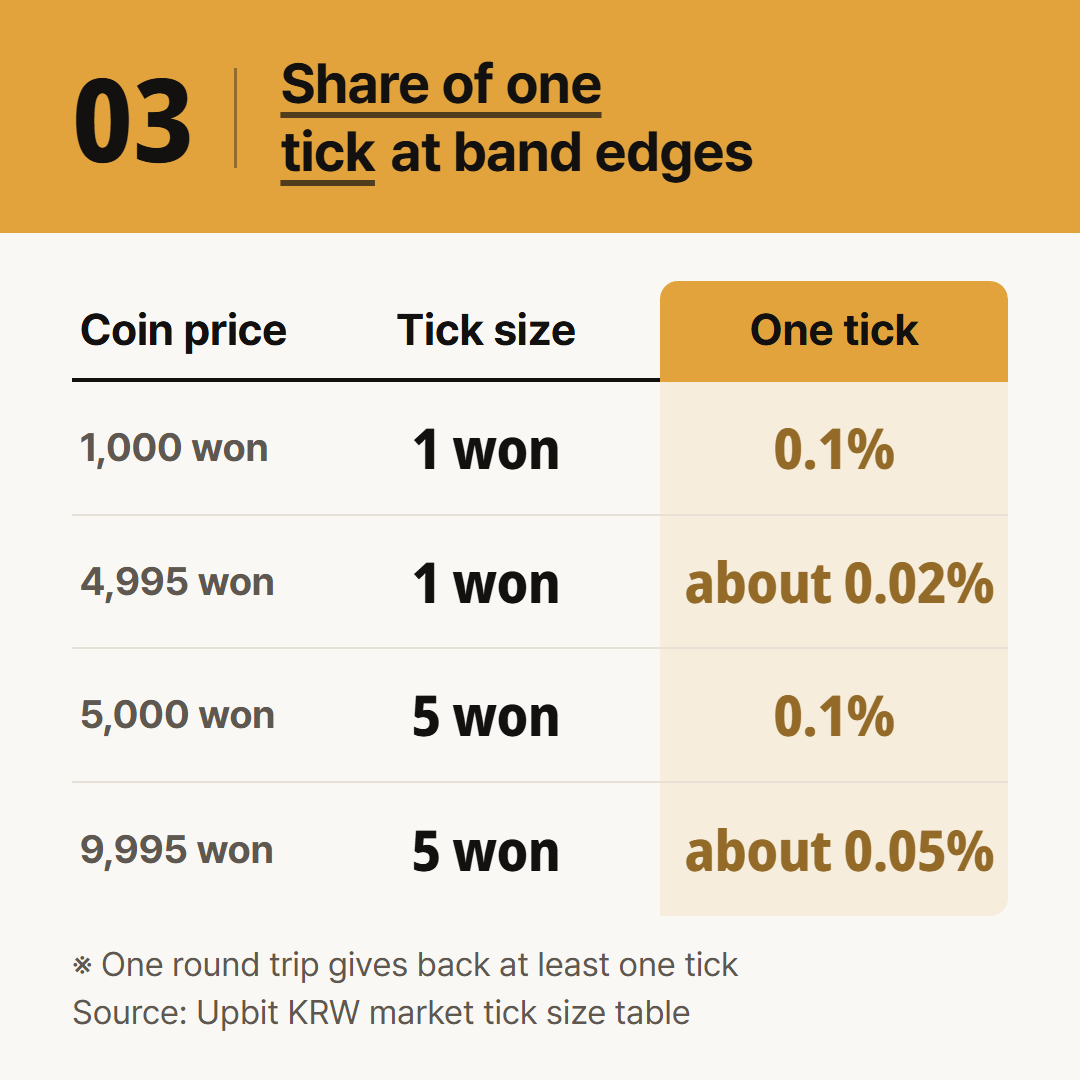
On Upbit's KRW market, the tick is 1 won from 1,000 won to under 5,000 won, and 5 won from 5,000 won to under 10,000 won.
- A 1,000 won coin: 1 ÷ 1,000 = 0.1%
- A 4,995 won coin: 1 ÷ 4,995 = about 0.02%
- A 5,000 won coin: 5 ÷ 5,000 = 0.1%
A 5 won difference in price makes one tick five times larger. 0.1% is the same size as the round trip regular order fee. With a 1,000 won coin, 150 round trips a month lose another 150,000 won to the tick alone (assumed).
4.Downside 4: the 5,000 won minimum sets how many times you can split
The minimum order on the KRW market is 5,000 won. With small capital, this number ties the bot's hands.
With 100,000 won of capital, splitting into 5,000 won orders gives 20 orders at most (assumed). A bot that buys a little more each time the price falls has nothing left to buy with after the 20th.
5.The monthly total and checks before switching on
Under these assumptions, 150,000 won of regular order fees plus 150,000 won of tick cost come to 300,000 won a month, 3% of capital. With reserved orders it is 567,000 won, 5.67%.
The bot has to earn that much first just to keep the balance where it was.

Before switching on a crypto trading bot
- Order type: checked whether stop loss and take profit are regular or reserved orders
- Fee per trade: divided a fee by its filled amount in the trade history
- Price band: checked the coin is not sitting just above a tick size boundary
- Splitting: counted how many orders capital ÷ 5,000 won allows
- Threshold: wrote down monthly fees plus tick cost as a share of capital
Hiddenpick is a Windows program that keeps on its server the betting rules that pick owners do not make public, and runs them as they are on the PC of the person who received them through a referral code. It currently runs on Evolution live baccarat at Stake (stake.com). What the program does for the user and what it cannot do are set out in the baccarat bot guide.
We are recruiting national pickster representatives, and those selected receive benefits worth $12,000, a one-year pass. Apply: https://hiddenpick.my/pickster
- 25,000+ real shoes collected and analysed since September 2026
- 90+ baccarat tables from the lobby on one screen · refreshed every 0.35s · seated 2 to 4 seconds after a click
- Stops by itself at your take-profit and stop-loss · tie several PCs into one team and stop on the total
- No browser extension · your money stays in your own Stake account · 12 languages