Trading bot returns, worked out: 10% a month, a 50% drawdown and 0.1% fees
2026-10-18
If a trading bot ad says "10% a month", what does that come to over a year?
Not 120%. And if the same ad leaves out drawdown and fees, the number that actually stays in the account changes again.
This post does not recommend any program. It takes three numbers that often appear in return claims and works them out with a calculator. Every return and count used as an example is an assumption chosen for the sums.
1.Turning a monthly return into a yearly one
Adding 10% twelve times gives 120%. But a bot keeps trading with what it has made, so the returns multiply instead.
1.1 multiplied by itself twelve times is about 3.14. A steady 10% a month for a year means the money grows 3.14 times, a 214% yearly return.
A number that large is a reason to slow down. Run the same sum on a short record: 5% in one week, stretched over 52 weeks, turns the money into about 12.6 times itself.
Stretching a short-period return over a long period produces figures like these. So when reading a return, check the period before the number.
Compounding: for 10% a month, multiply 1.1 by itself twelve times, then subtract 1.
2.The gain needed to recover a drawdown
The number most often missing from return claims is the maximum drawdown (MDD): how far the account fell from its highest point to its lowest.
Drawdowns matter because the way back is not the same percentage as the way down.
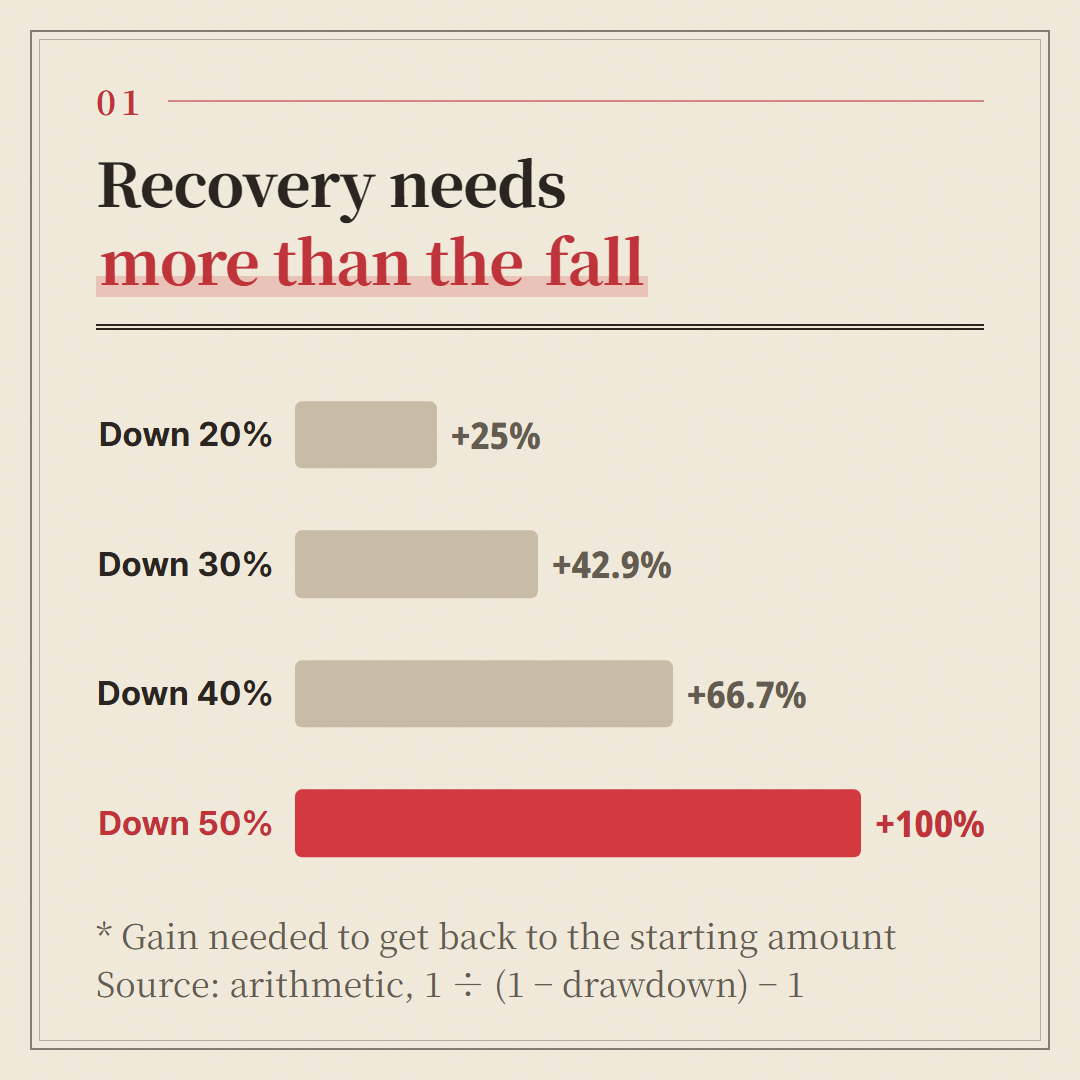
If $1,000 falls 20%, it becomes $800. To get from $800 back to $1,000 takes a 25% gain.
A 30% fall needs 42.9%, and a 40% fall needs 66.7%.
If the account halves, getting back to where it started takes a 100% gain, which means doubling.
Same yearly return, different path
Say two programs both made 30% in a year (an assumption).
One never fell more than 10% along the way. The other dropped 40% at one point and then recovered.
The final number is the same, but the person running the second account spent a while looking at 60% of their money. Stopping at that point would have locked the loss in.
Backtest drawdowns tend to look small
A backtest runs a set of rules over past data. Each change to the rules makes them fit that past data a little better.
The more a rule set is tuned to past data, the smaller its drawdown on that period tends to look compared with live running. So with backtest figures, also check whether they were rerun on data outside the period used to build the rules.
3.How much round-trip fees take in a month
A bot buys and sells far more often than a person does. Even a small fee per trade adds up with the count.
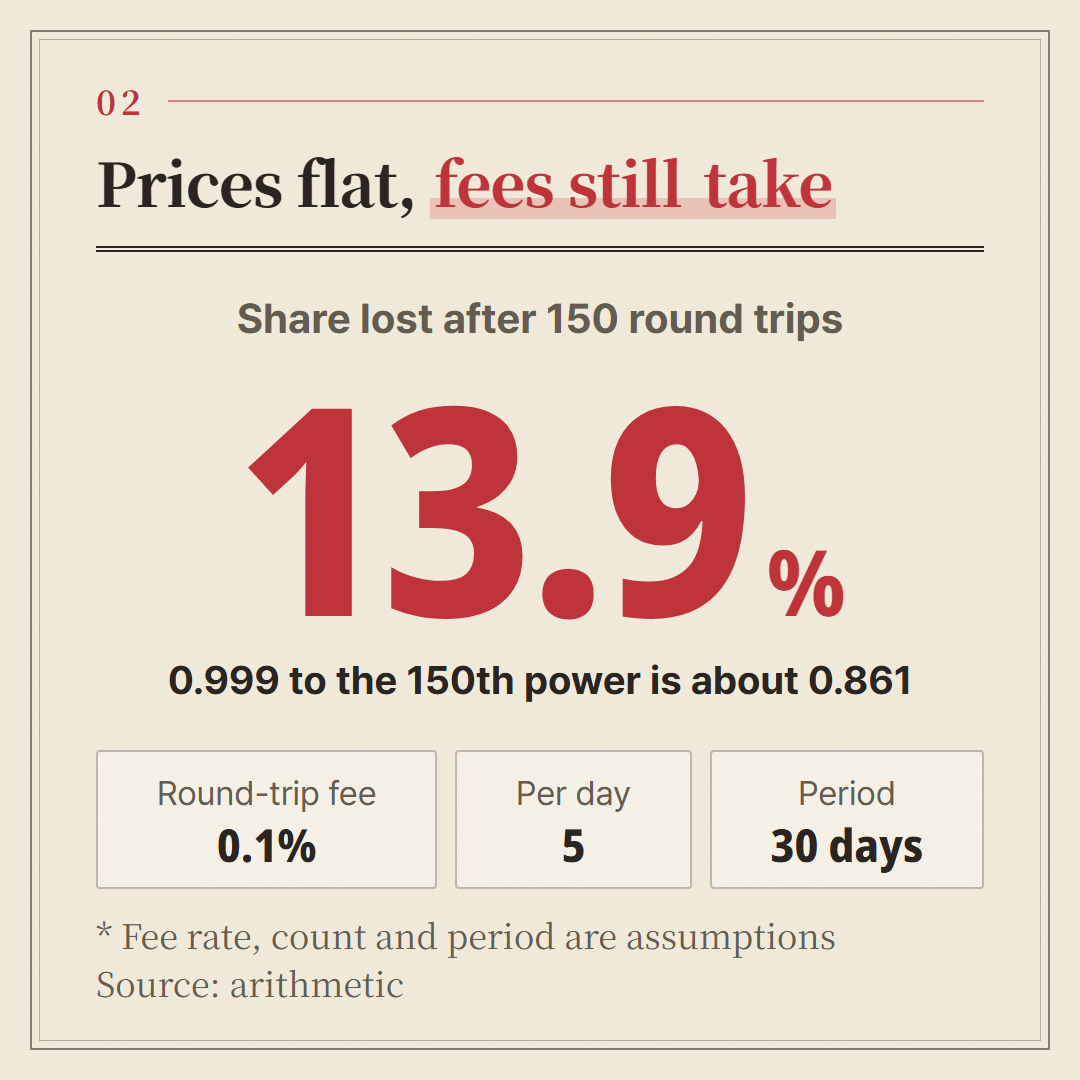
If buying and selling each cost 0.05%, one round trip costs 0.1% (an assumption).
Five round trips a day comes to 150 in 30 days. 0.999 multiplied 150 times is about 0.861, so even with prices flat, fees alone take about 13.9% of the money.
That is why the first question about a return figure is whether fees are already taken out. Rates differ by exchange, so the real sum uses that exchange's fee table.

4.The order for rechecking an advertised return
When an ad shows a return, write down three things in turn.
- Period: how many days or months the figure covers
- Drawdown: the largest share the account fell during that time
- Costs: whether fees and subscription costs are already taken out
If any of the three is blank, treat the return as a number that cannot be worked out.
Summary in three lines
- 10% a month compounds to about 3.14 times in a year, and short-period returns grow unrealistic when stretched
- A 20% drawdown needs 25% to recover, and a 50% drawdown needs 100%
- Paying 0.1% per round trip 150 times a month takes about 13.9% even with flat prices (assumption)
Hiddenpick is a Windows program that keeps on its server the betting rules that pick owners do not make public, and runs them as they are on the PC of the person who received them through a referral code. It currently runs on Evolution live baccarat at Stake (stake.com). How automated betting works in baccarat is in the baccarat bot guide. We are recruiting national pickster representatives, and those selected receive benefits worth $12,000, a one-year pass (apply at hiddenpick.my/pickster).
- 25,000+ real shoes collected and analysed since September 2026
- 90+ baccarat tables from the lobby on one screen · refreshed every 0.35s · seated 2 to 4 seconds after a click
- Stops by itself at your take-profit and stop-loss · tie several PCs into one team and stop on the total
- No browser extension · your money stays in your own Stake account · 12 languages