How to count cards in blackjack with 8 decks, Hi-Lo values for 416 cards and the true count division
2026-11-01
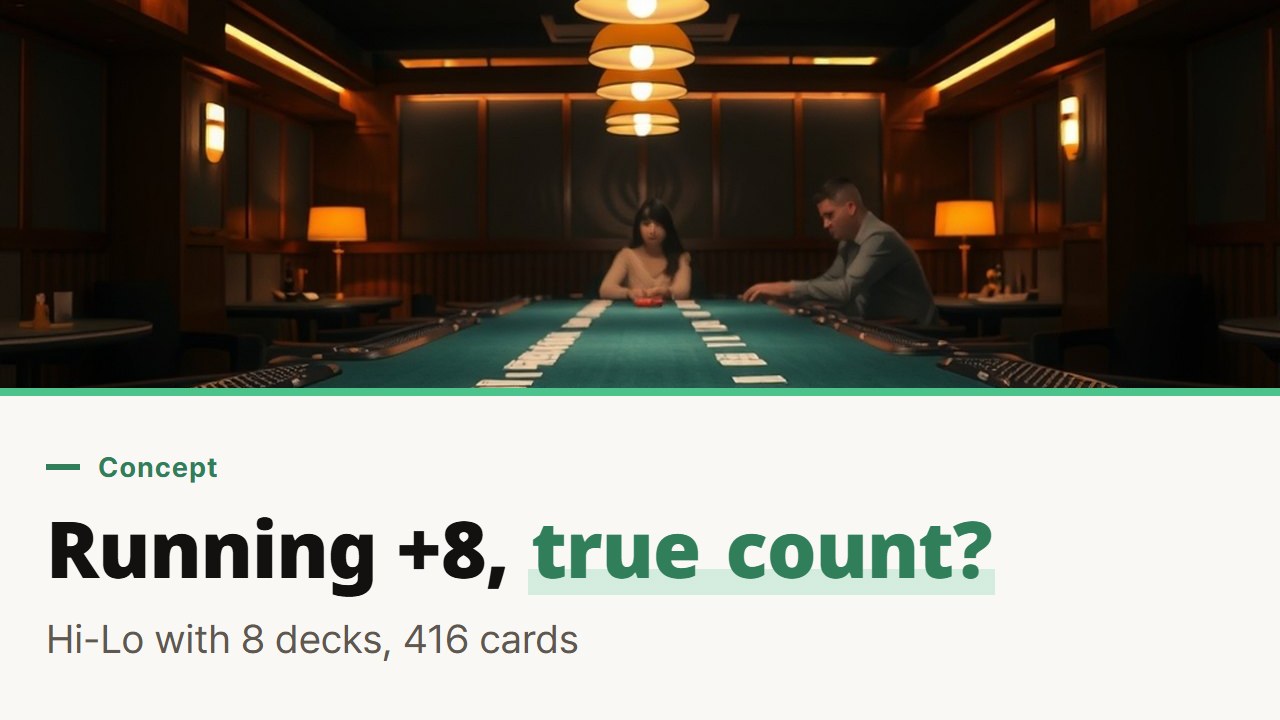
416 cards. That is how many cards an 8-deck shoe holds. Hi-Lo counting gives 160 of them a value of +1, another 160 a value of -1, and the remaining 96 a value of 0.
Most guides on how to count cards in blackjack stop at the card value table. With 8 decks, the confusing part comes next: dividing the count by the decks left. This post works through that division by the number of cards seen.
1.How to count cards in blackjack: three groups of cards
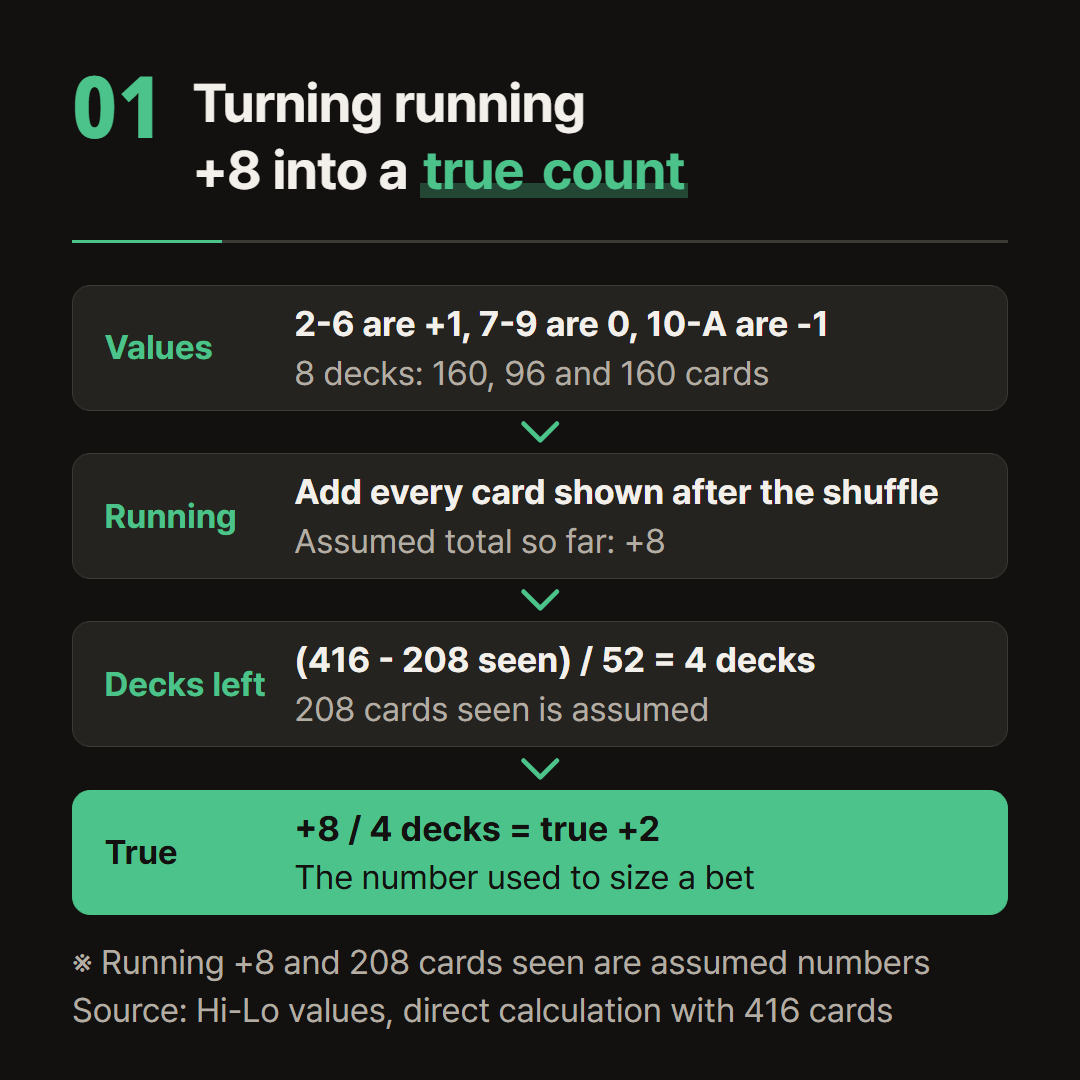
Hi-Lo gives every card one value.
- Low cards: 2, 3, 4, 5 and 6 are +1
- Middle cards: 7, 8 and 9 are 0
- High cards: 10, J, Q, K and A are -1
With 8 decks, 2 to 6 are five ranks of 32 cards each, 160 cards. 10 to A are also 160 cards, and 7 to 9 are three ranks of 32, 96 cards. Add up a whole shuffled shoe and you get 0.
Balanced count: a count where the values of the whole shoe add up to 0. Hi-Lo is one.
When many low cards leave early, the total rises. It means the cards left hold relatively more tens and aces. Blackjacks come a little more often and the dealer busts a little more.
2.Running count: add every card you see after the shuffle
The running count starts at 0 right after the shuffle and keeps adding the value of every card shown on the table. Not only your own cards. Cards at other seats and the dealer's cards all count.
Assume one round shows K, 5, 4, 9, 6, A, 2 in that order. Adding -1, +1, +1, 0, +1, -1, +1 gives +2. The next round carries on from +2.
A running count is useless unless it starts at the shuffle. If you sit down mid-shoe you do not know which cards have gone, so you wait for the next shuffle.
3.Converting to the true count: dividing with 8 decks
The same running +8 means different things early and late in the shoe. The more cards are left, the thinner that +8 spreads among them. That is why counters look at the true count, the running count divided by the decks left.
True count: the running count divided by the decks left, where decks left = (416 minus cards seen) / 52.
Keep running +8 fixed and change only the cards seen. All numbers here are assumptions.
- 104 cards seen: 312 left, 6 decks. True about +1.3
- 208 cards seen: 208 left, 4 decks. True +2
- 312 cards seen: 104 left, 2 decks. True +4
The same +8 ranges from 1.3 to 4 depending on the cards seen. Sizing bets from the running count alone misses this gap.
At an online live table the discard tray is hard to see on screen. Keeping a separate tally of cards seen next to the running count makes the deck estimate easier. Every 52 cards is one deck gone.
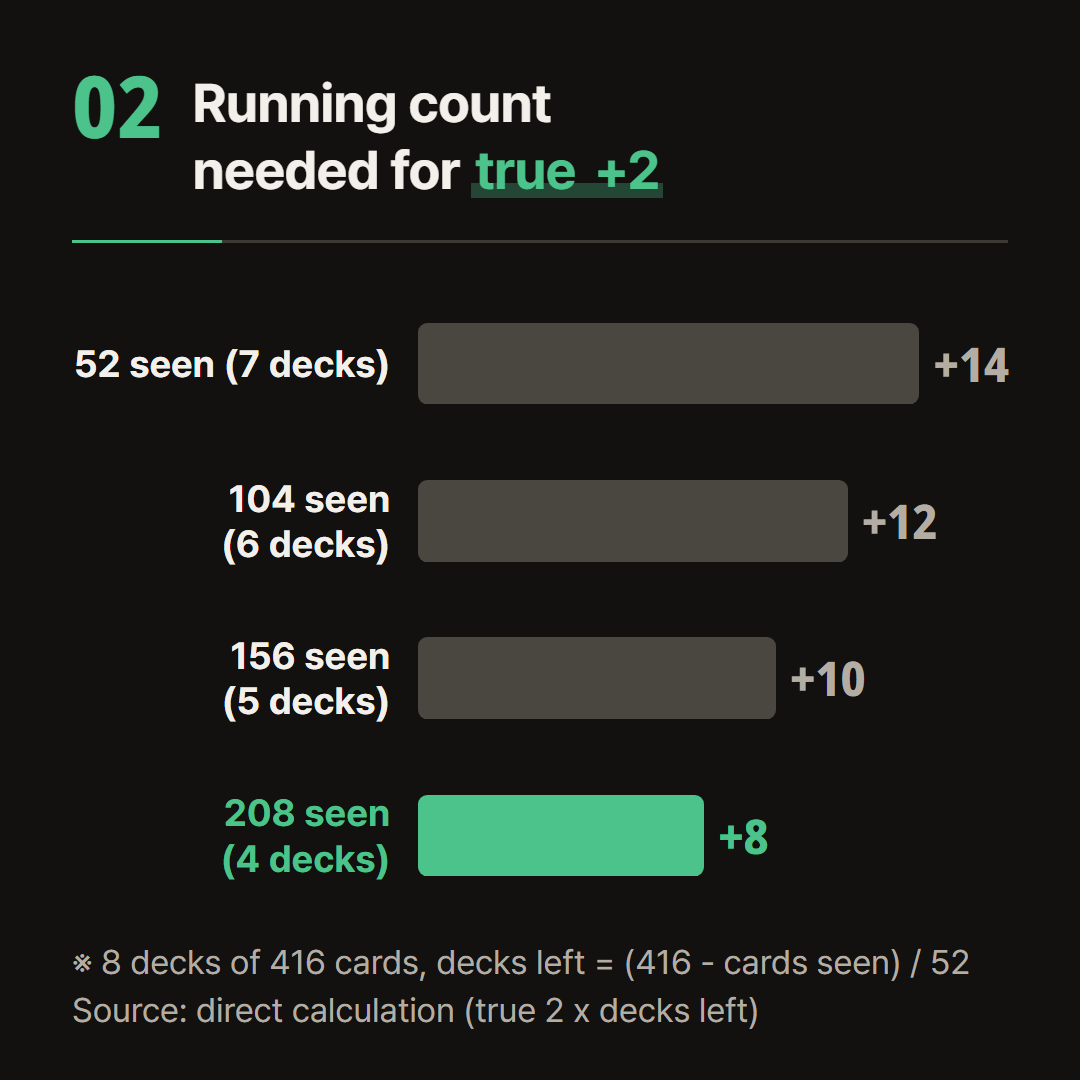
You can also work backward to the running count needed for true +2. With 52 cards seen, 7 decks are left, so +14. With 104 seen it is +12, with 156 seen +10, and with 208 seen +8.
The reason +2 is the usual reference is a common rule of thumb. Each point of true count moves the player's expected value by about 0.5%. Starting from a seven-seat table RTP of 99.29%, a house share of 0.71%, true +1 still favors the casino.
Only past roughly true +2 does it tilt slightly toward the player. A negative true count means the cards left are rich in low cards, and the house share grows above where it started.
4.What the count does in an 8-deck live shoe
A live shoe is not dealt to the last card. The cut card is known to sit around halfway, so a shuffle can come near 208 cards seen. To see true +2 at that point, 8 more low cards than high cards must have left among those 208.
Infinite Blackjack (RTP 99.47%) uses an automatic shuffler, so a count never builds up. The place a count can be followed is the seven-seat table, where the dealer stands on soft 17.

What the count gives you is a reference for whether to raise or lower the next bet. Hit and stand still follow the blackjack basic strategy chart. Keep in mind as well that big swings in bet size can lead the casino to set limits.
Before you start counting
- I started at 0 right after the shuffle
- I count my cards, other seats and the dealer's cards
- I keep a separate tally of cards seen
- I get the decks left by taking cards seen away from 416 and dividing by 52
- I know true +1 still favors the casino
- I do not count at Infinite Blackjack, which uses an automatic shuffler
Hiddenpick is a Windows program that keeps on its server the betting rules that pick owners do not make public, and runs them as they are on the PC of the person who received them through a referral code. It currently runs on Evolution live baccarat and blackjack (21) at Stake (stake.com). Hi-Lo values and the running and true count are laid out on one page in the blackjack card counting guide.
We are recruiting national pickster representatives, and those selected receive benefits worth $12,000, a one-year pass (apply at https://hiddenpick.my/pickster).
- 25,000+ real shoes collected and analysed since September 2026
- 90+ baccarat tables from the lobby on one screen · refreshed every 0.35s · seated 2 to 4 seconds after a click
- Stops by itself at your take-profit and stop-loss · tie several PCs into one team and stop on the total
- No browser extension · your money stays in your own Stake account · 12 languages