Blackjack auto player, the four actions it takes over and the numbers a person still sets, with expected loss per hour at 99.29% RTP
2026-11-04
Sitting down in an open seat at a 7-seat table, pressing hit, stand, double or split by the basic strategy chart every round, showing the count and stopping at the stop-loss line are the actions a blackjack auto player takes over. It cannot remove the house edge or predict the next card, and how much to bet per round and where to stop still have to be set by a person.
The hands leave the screen, but a few numbers stay with the person. We calculated their expected loss per hour, using 99.29% RTP for 7-seat tables and 99.47% for Infinite Blackjack.
1.The four actions a blackjack auto player takes over
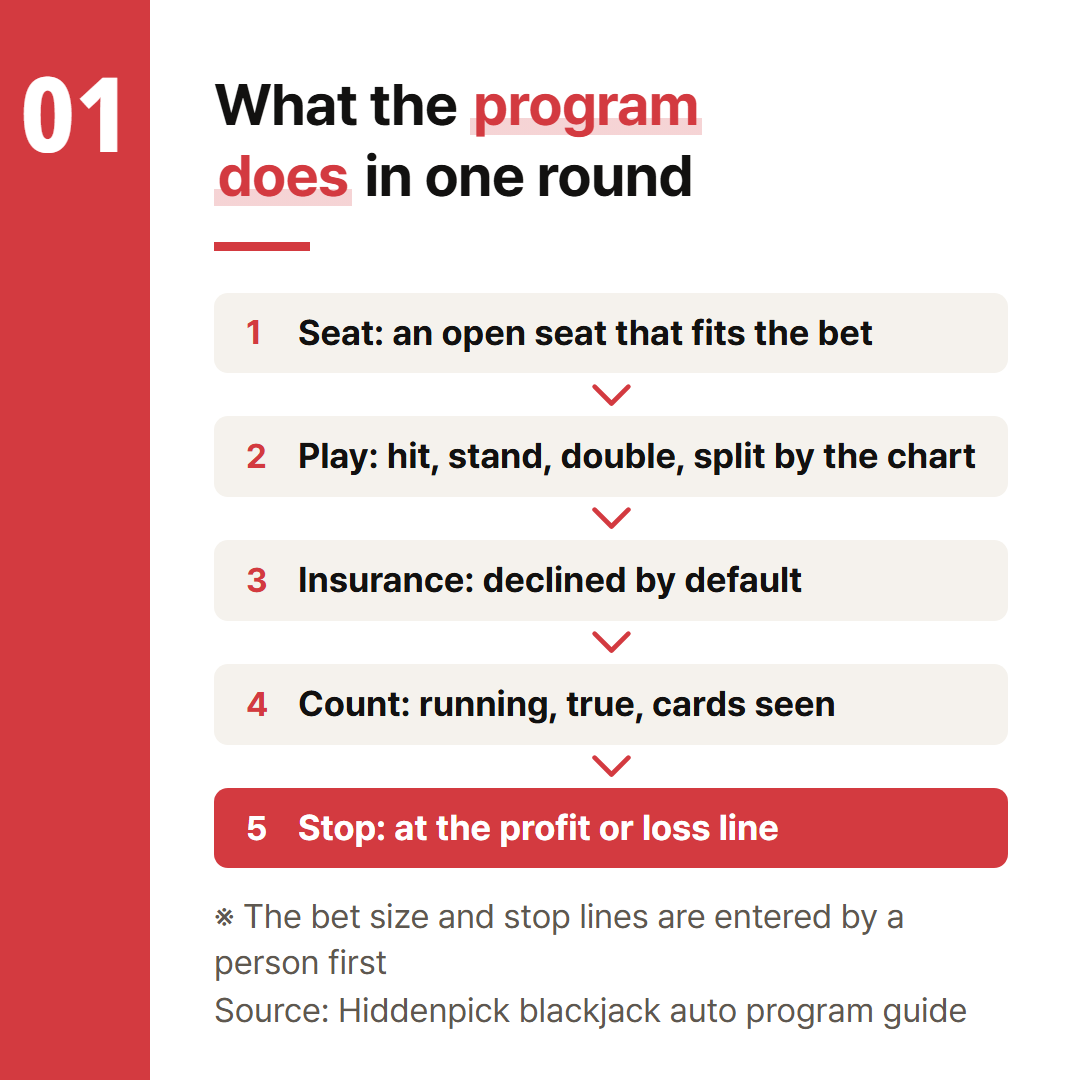
The first is the seat. At 7-seat tables it finds an open seat whose minimum bet fits the amount that was set, and at Infinite Blackjack it goes straight in.
The second is the play in each round, by the basic strategy chart for 8 decks, dealer standing on soft 17, double after split. Insurance is declined by default.
The third is the count. The Hi-Lo running count, true count and cards seen are shown live, and reset to 0 after a shuffle or a table move.
The fourth is stopping. It halts on its own when it reaches take-profit, stop-loss or trailing stop.
None of these four leaves anything for a person to think over. The chart and the rules have already fixed the answer.
2.Expected loss per hour, bet × rounds × (1 - RTP)
An RTP of 99.29% means that over a long run an average of 0.71% of the money wagered goes away. So the amount lost in an hour comes from multiplying the bet by the number of rounds and then by 0.71%.
Expected loss per hour = bet per round × rounds per hour × (1 - RTP)
Rounds per hour depend on the table and how many players sit there, and no figure is published. The calculation here assumes 60 rounds per hour.
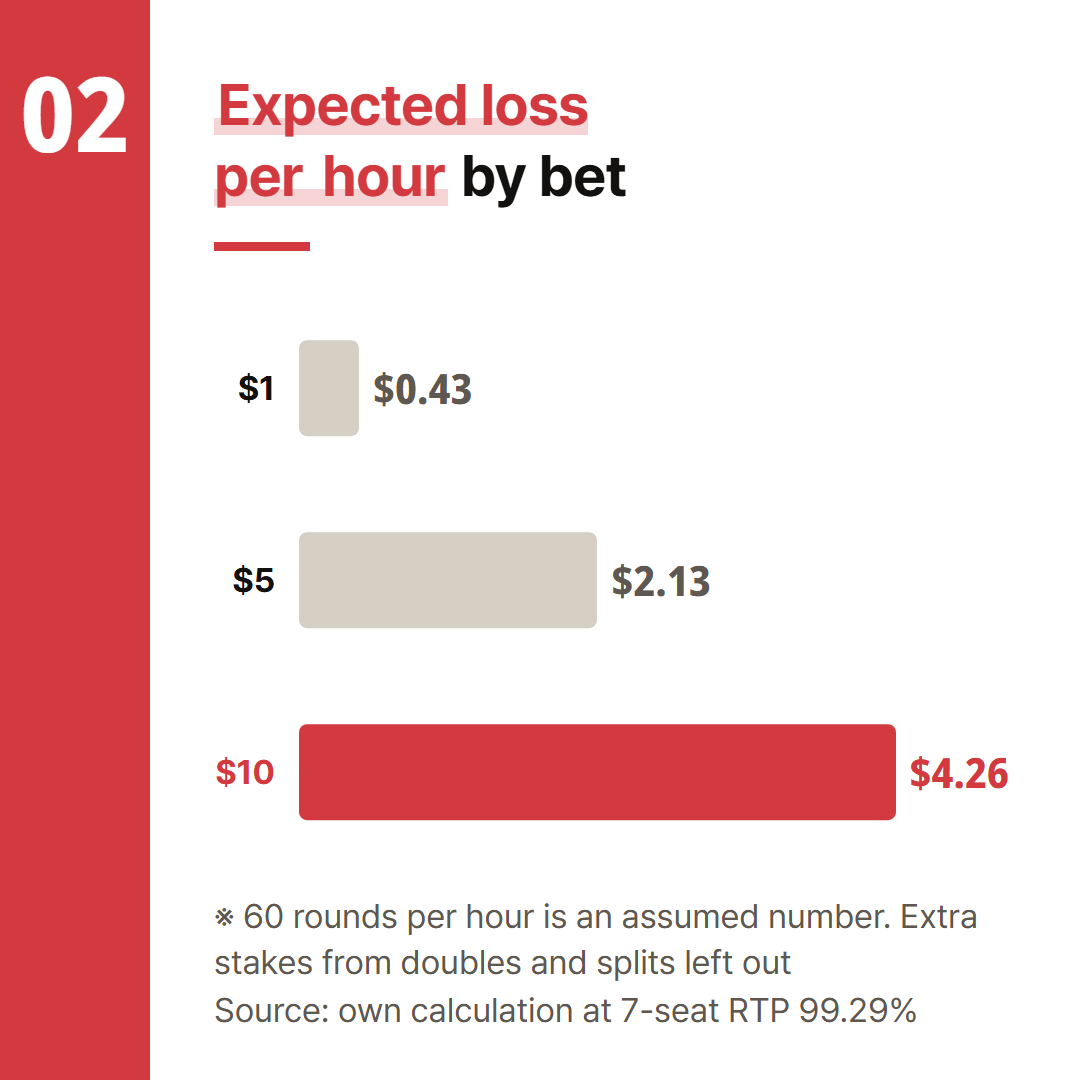
7-seat table, RTP 99.29%
- $1 bet: $60 wagered, about $0.43
- $5 bet: $300 wagered, about $2.13
- $10 bet: $600 wagered, about $4.26
Three hours at $10 a round moves $1,800 and the expected loss is about $12.78. Doubling the bet doubles the expected loss.
Infinite Blackjack, RTP 99.47%
At the same 60 rounds the share lost is 0.53%. A $1 bet loses about $0.32 and a $10 bet about $3.18, roughly a quarter less than at a 7-seat table.
On the other hand, Infinite Blackjack uses an automatic shuffler, so the count is of almost no use. Whether to use the count or the table with slightly higher RTP is the first fork a person has to choose.
What this calculation leaves out
A double or a split puts more money on that round than the original bet. The calculation above only counts the original bet, so the real total wagered is a little larger.
The expected loss is an average. Within one hour the real balance swings much more widely than this value.
Why insurance is declined
Insurance pays twice the stake. When the dealer shows an ace from a fresh 8-deck shoe, 128 of the remaining 415 cards are ten-value cards, about 30.8%.
Winning 128 times returns 256 and losing 287 times costs 287, so on average each unit of insurance returns (256 - 287) ÷ 415 = about -7.5%. Insurance loses more than ten times what the main bet's 0.71% does. That is why the program declines it by default.
3.Five decisions a person has to keep
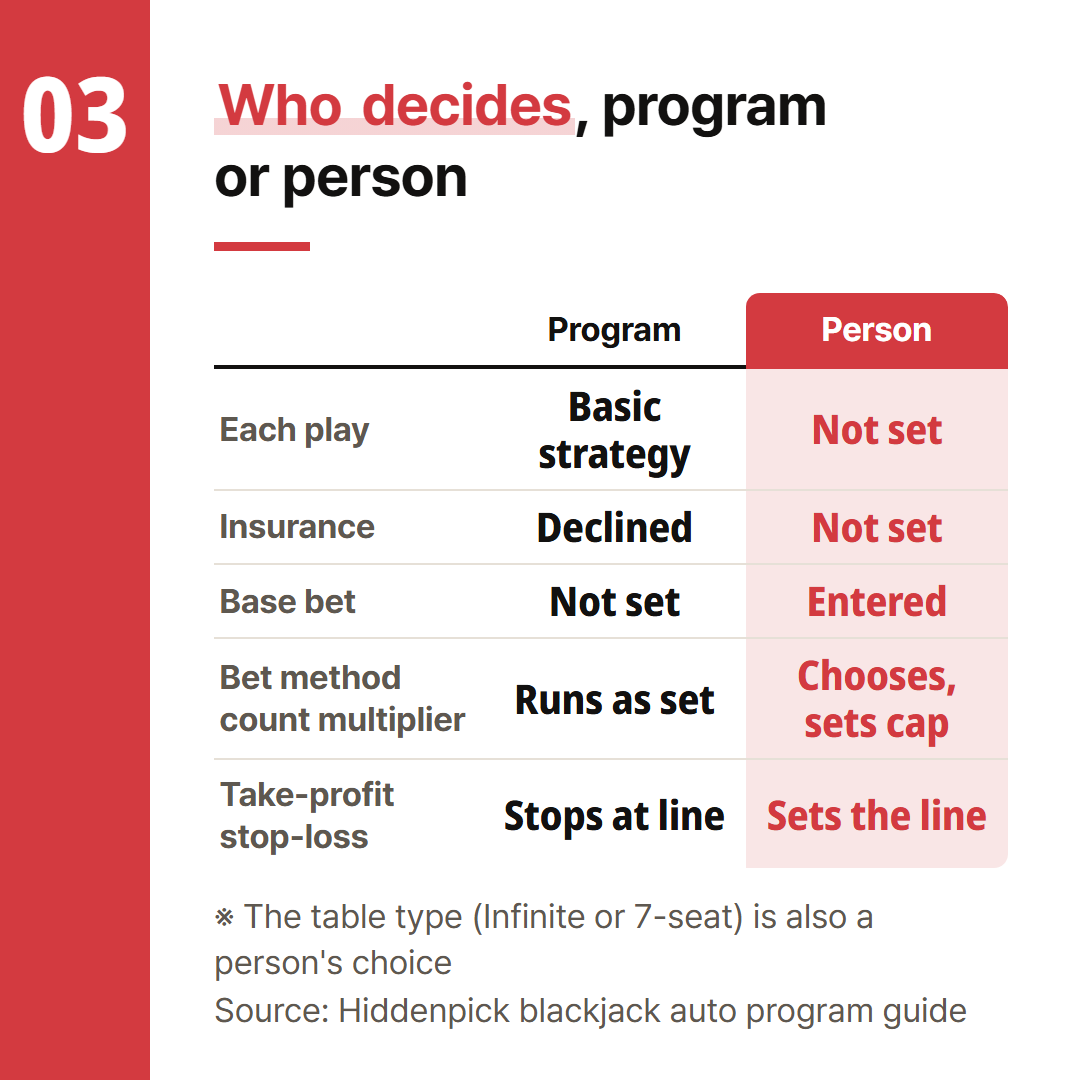
The base bet is set by a person. As the calculation in section 2 shows, the expected loss scales directly with this value.
The betting method is also a person's choice: flat, a bet ladder that steps up after a loss, or Paroli, which adds the winnings after a win.
With a ladder of $1, 2, 4, 8, 16, 32 (assumed), losing all six steps costs $63 in total. Rounds with a double or split put more than that step on the table, so the balance needs more room than that.
The count multiplier table and the max bet per round are also a person's to set. In the guide page example, a $1 base with a 1x, 2x, 4x table gives $1 at true +0.5, $2 at +2.3 and $4 at +3.1. Rounds with a true count above +2 are about 10% of all rounds.
The count only shows whether the current shoe is favorable and lets the bet be adjusted. The higher the multipliers, the more money rides on those few rounds, so a max bet is set at the same time.
The last one is the stop lines. Take-profit and stop-loss as a share of capital, and whether to use a trailing stop, are not decided by the program.
4.What an auto player cannot do
No program predicts the next card. Even with basic strategy followed without a single mistake, the share below the RTP remains, and the edge from counting in an 8-deck shoe is small.
Whether automation tools are allowed depends on the country and the casino's terms, which a person checks first.

5.Frequently asked questions
Q.Once a blackjack auto player is running, does the person have nothing to do?
A.The program finds a seat, plays each round, shows the count and stops. The base bet, betting method, count multiplier, max bet and stop lines are entered by a person first.
Q.How much is lost per hour?
A.Count it as bet × rounds per hour × 0.71% (7-seat table). Assuming 60 rounds per hour, a $10 bet gives about $4.26. Real results swing far more than this average.
Q.Which is better, Infinite Blackjack or a 7-seat table?
A.Infinite Blackjack has 99.47% RTP and no waiting for a seat. A 7-seat table has 99.29%, but every seat's cards are visible, so the count can be followed.
Q.Does it count cards automatically?
A.It shows the Hi-Lo count, and with the multiplier table on it adjusts the bet up to the set cap. The edge in an 8-deck shoe is small.
Hiddenpick is a Windows program that keeps on its server the betting rules that pick owners do not make public, and runs them as they are on the PC of the person who received them through a referral code. It currently runs on Evolution live baccarat and blackjack (21) at Stake (stake.com). What it can and cannot do is laid out in the blackjack auto program guide.
We are recruiting national pickster representatives, and those selected receive benefits worth $12,000, a one-year pass (apply at https://hiddenpick.my/pickster).
- 25,000+ real shoes collected and analysed since September 2026
- 90+ baccarat tables from the lobby on one screen · refreshed every 0.35s · seated 2 to 4 seconds after a click
- Stops by itself at your take-profit and stop-loss · tie several PCs into one team and stop on the total
- No browser extension · your money stays in your own Stake account · 12 languages