Casino reviews, five checks before you trust one: who wrote it, when, and what the rules say
2026-10-26

If a review has no ad label at the top, does that make it a real review?
Not safely. In Korea's 2024 sweep of social media posts, 22,011 were flagged as suspected hidden ads, and 7,095 of them carried no label at all.
This post does not pick a site. It covers only how to read the review itself: the writer's financial interest, the shape of the posting, and what the rules in three countries forbid.
1.The rule that turns a review into an ad
Korea's Fair Trade Commission guideline on endorsements has required paid recommendations to disclose the economic interest since 1 September 2020. Cash, gift vouchers, discounts and sponsorship all count (etoday, 2020-06-23).
The 1 December 2024 revision narrowed it. Text-based media such as blogs must put the label in the title or the first part, and placing it at the end was dropped because readers miss it on long posts (SBS Biz, 2024-11-15).
Even with no money paid up front, a commission earned when readers buy through a link has to be disclosed. A refund of the purchase price after writing the review counts the same way (MTN, 2024-11-28).
Economic interest: cash, goods, discounts or commissions from the advertiser, even if paid later on a condition.
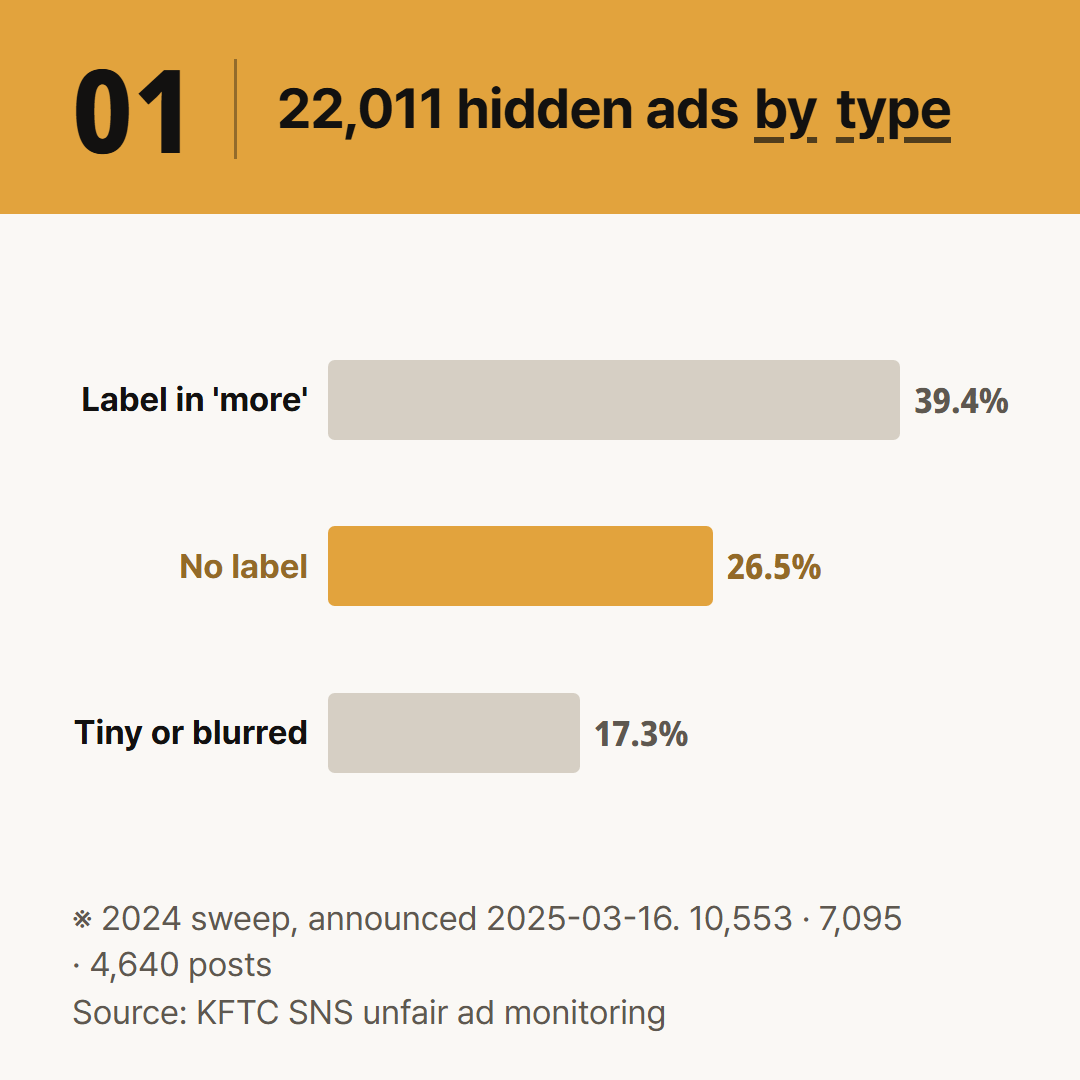
By type, 10,553 posts (39.4%) hid the label in the 'more' section, the description or the comments. Another 7,095 (26.5%) had no label, 4,640 (17.3%) used tiny text or a blurred image, and by platform it was Instagram 10,195, Naver blog 9,423 and YouTube 1,409 (Kukinews, 2025-03-16).
2.Five checks before trusting a review
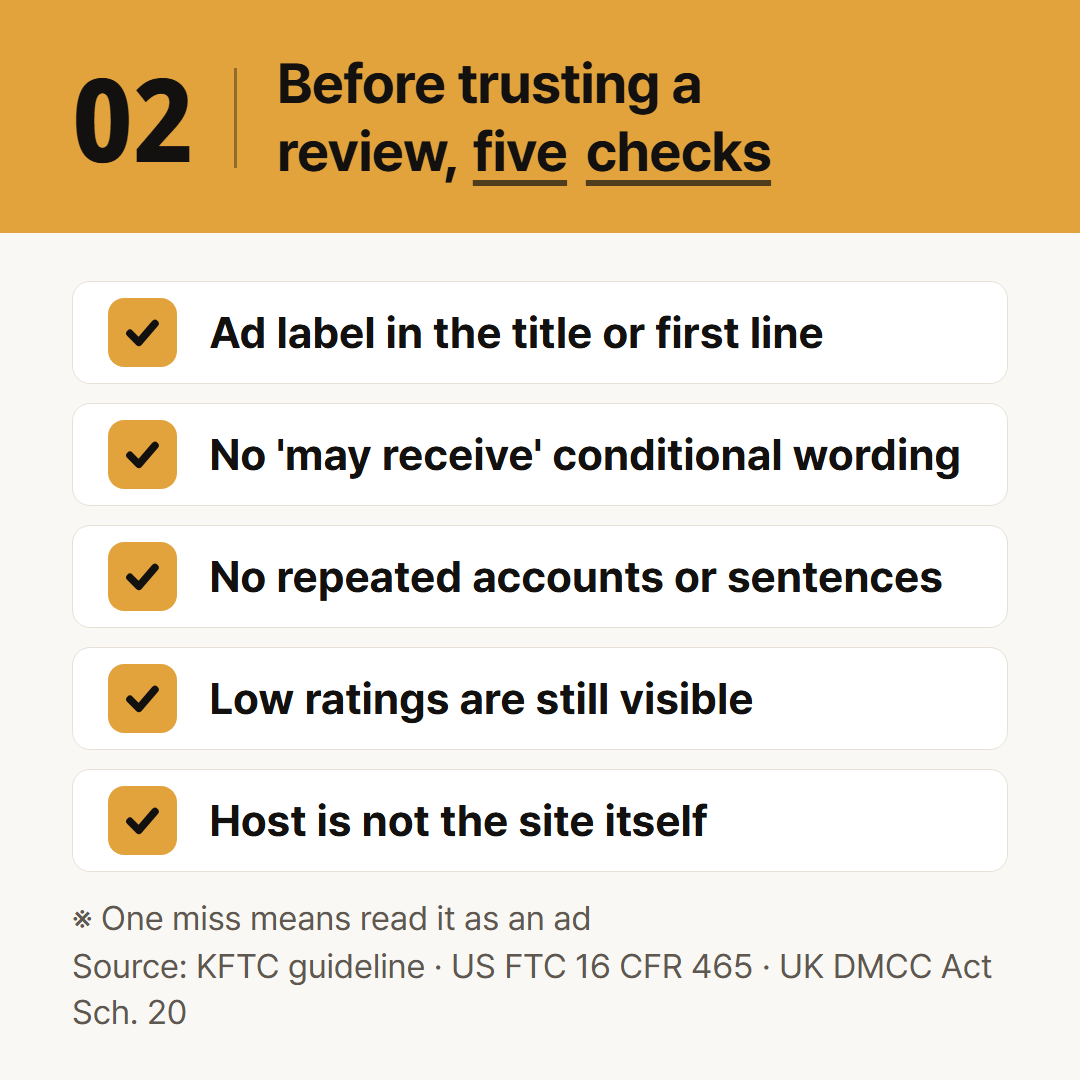
1)Is the ad label in the title or the first line?
The revised guideline accepts the title or the first part. A label only at the end of the body, or inside 'more', is a placement the guideline no longer recognises.
A missing label does not clear the post either. In the sweep, 26.5% had no label at all. So the other four checks follow.
2)Is the wording conditional, like "may receive"?
The revision lists "may receive a small fee" as an example of unclear disclosure (SBS Biz). The reader cannot tell whether money changed hands.
A review with a sign-up link and a referral code but no mention of a commission fails this second check.
3)Do the same accounts or sentences repeat?
Google's policy for user content on Maps bans posts from multiple accounts by or at the request of one person, and says a review should reflect a genuine experience (Google review policy).
The UK's DMCC Act defines a fake review as one that "purports to be, but is not, based on a person's genuine experience" (DMCC Act 2024, Schedule 20). Reviews under different names with matching sentences and dates sit close to that definition.
US FTC rule 465.8 also bans buying or selling followers and views. A subscriber count is no evidence for a review.
4)Are low ratings still visible?
Paragraph 13(2) of Schedule 20 bans publishing reviews in a misleading way. Its examples are withholding or removing negative reviews while publishing positive ones, and giving positive reviews greater prominence.
US rule section 465.7 likewise bans suppressing negative reviews through threats or intimidation (Federal Register, 2024-08-22). A page where every rating is five stars looks exactly like what both rules forbid.
5)Is the host the site itself?
US rule section 465.6 bans presenting a company-controlled review website as independent. If a review aggregator shows no operator and no revenue model, that is the fifth check.
The UK puts a duty on publishers too. They must take reasonable and proportionate steps to prevent and remove fake reviews, and the CMA guide describes those steps as detecting, investigating and acting (CMA guide).
3.Three countries, in the order the rules arrived
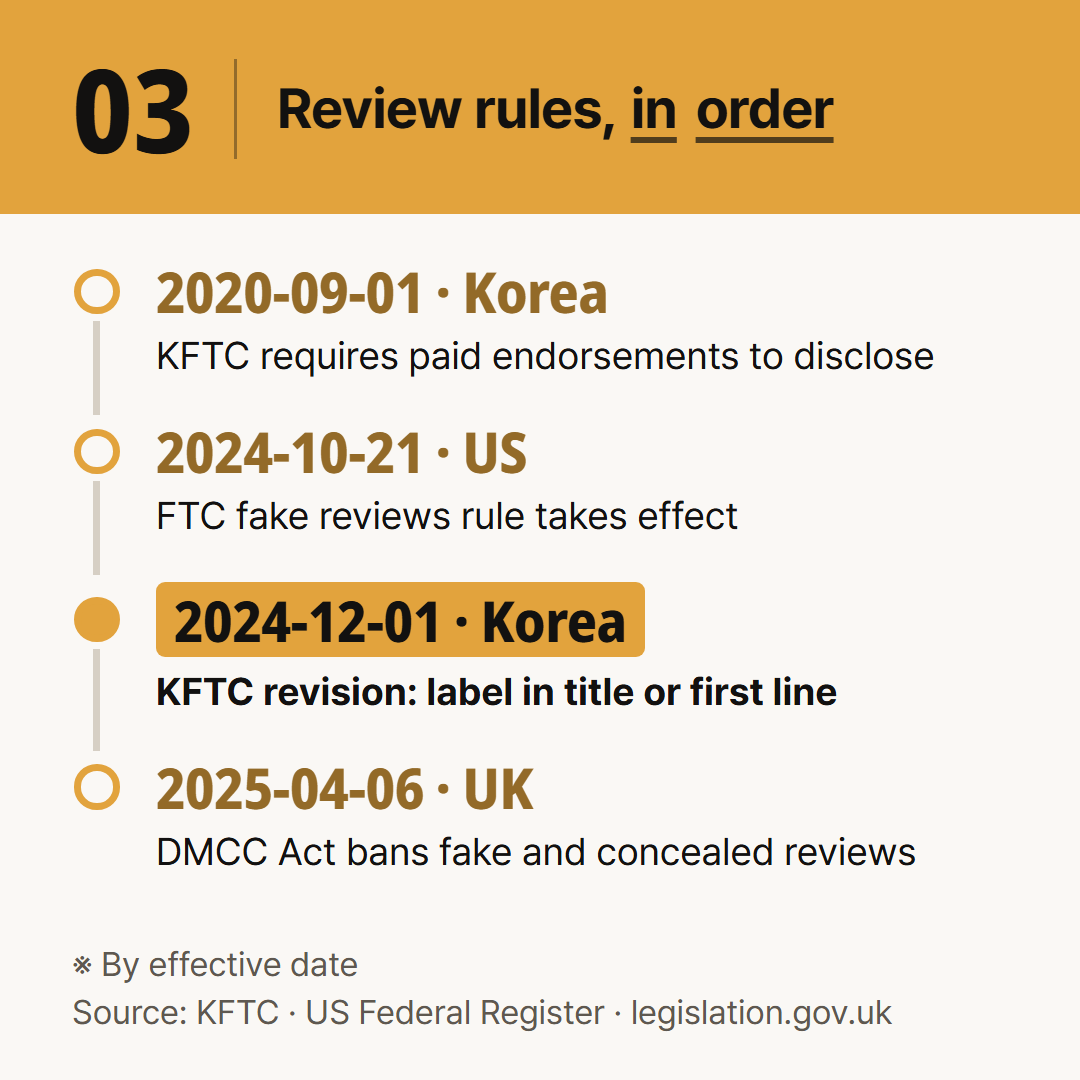
The US FTC announced its rule banning fake reviews on 14 August 2024, and it took effect on 21 October 2024 (FTC press release). Fake reviews, paid positive or negative reviews, undisclosed insider reviews, company-controlled review sites, review suppression and fake influence indicators are the banned items.
Knowing violators face civil penalties. As of the FTC's December 2025 guidance, that is up to $53,088 per violation (FTC blog, 2025-12-22).
The UK brought paragraph 13 of Schedule 20 into force on 6 April 2025. Submitting or commissioning a fake or concealed-incentive review, publishing reviews in a misleading way, and publishing without steps to stop fakes are all banned.
Korea set its disclosure duty earlier, in 2020, and tightened the placement and wording in December 2024. The three sets of rules share one point. A paid post has to show it was paid, and the reader has to be able to see that at once.
4.What a review cannot tell you

A review that passes all five checks still says nothing about whether withdrawals go through or what the terms say. A review is one person's experience, and the rules only ask whether that experience is real and whether the payment was disclosed.
Which lines of the terms to read when a withdrawal is held is covered separately in when you suspect a baccarat site will not pay out.
This post covers how to read reviews. It does not judge the law where you live.
5.Questions that come up
Q.If the review carries an ad label, can I trust it?
A.The label only states that money was involved. Whether the content is accurate is a separate question, so the other four checks still apply.
Q.Does the Korean guideline cover reviews of overseas sites?
A.It applies to advertisers and endorsers in Korea. That is why the US and UK rules are used alongside it.
Q.Are more reviews better?
A.The US rule bans trading in fake influence indicators. Repeated accounts and sentences matter more than the count.
Q.What if there are no low ratings at all?
A.That is the pattern the UK rule gives as an example of misleading publication. Negative reviews may have been removed.
Hiddenpick is a Windows program that keeps on its server the betting rules that pick owners do not make public, and runs them as they are on the PC of the person who received them through a referral code. It currently runs on Evolution live baccarat at Stake (stake.com). The five checks above work just as well on posts about betting programs, and what the program does and does not do is set out in the baccarat betting program guide.
We are recruiting national pickster representatives, and those selected receive benefits worth $12,000, a one-year pass. Apply: https://hiddenpick.my/pickster
- 25,000+ real shoes collected and analysed since September 2026
- 90+ baccarat tables from the lobby on one screen · refreshed every 0.35s · seated 2 to 4 seconds after a click
- Stops by itself at your take-profit and stop-loss · tie several PCs into one team and stop on the total
- No browser extension · your money stays in your own Stake account · 12 languages