Squeeze baccarat tables, what slows a round to 55 or 64 seconds, four questions answered with the official rules and 1,896 real shoes
2026-11-03
Walk into a lobby table named Squeeze and the same baccarat suddenly feels slow. Why does one round take so long there?
Search YouTube for squeeze baccarat and the top results are about the ritual of peeling cards. This post sets that aside and answers four questions with the rules text and measured time only. The timing data comes from shoes we collected between September 9 and October 31, 2026, keeping only shoes recorded from the first round to the last.
1.Whose cards does the dealer squeeze?
Evolution describes Squeeze as a table filmed by more than 15 cameras, with the dealer's slow peel shown in close-ups from several angles (Evolution live baccarat).
Money on the table decides which hand is peeled.
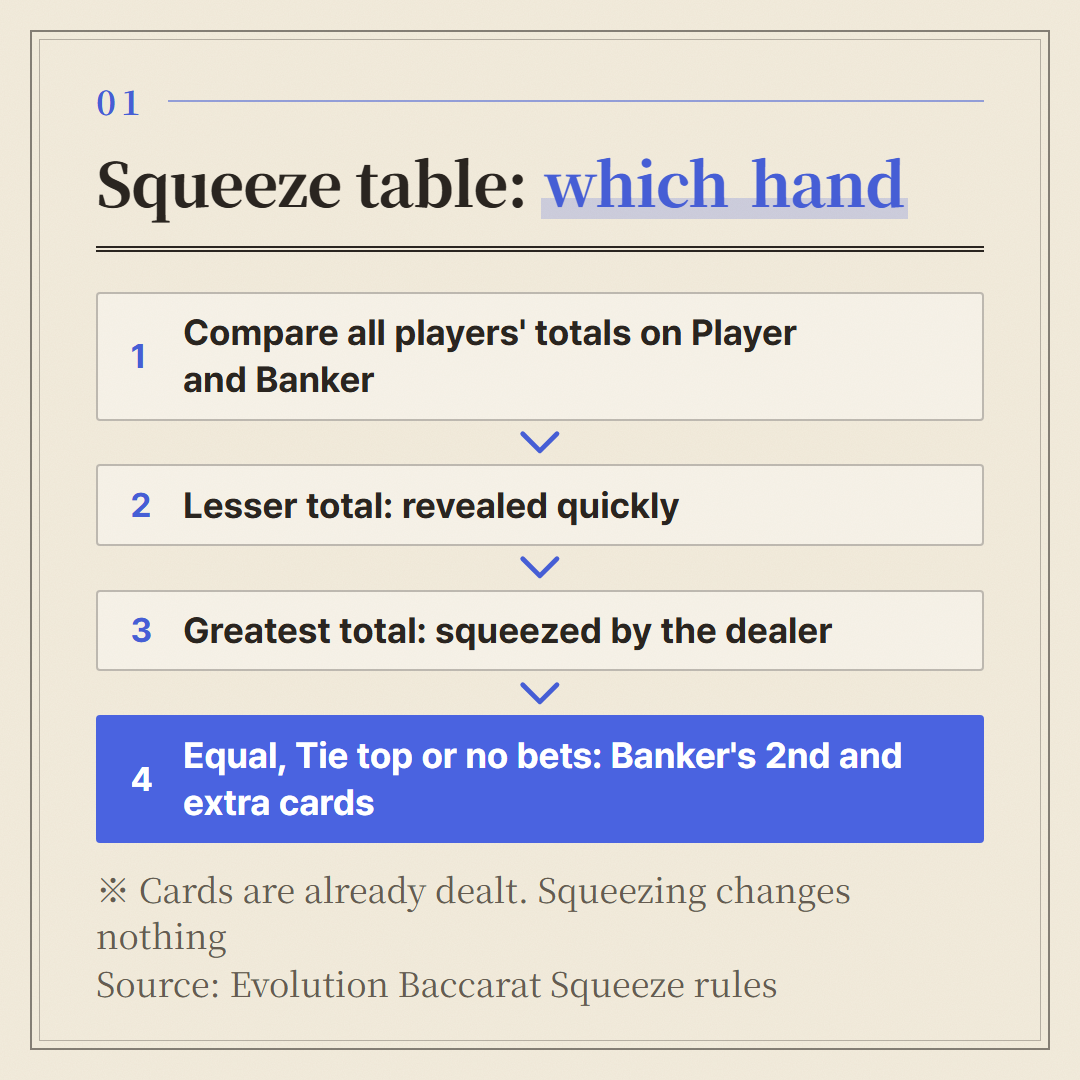
Under the rules, the dealer quickly reveals the hand with the lesser total wager from all players and squeezes the hand with the greatest total wager.
Squeeze: bending a dealt card up from a corner to reveal it slowly. Its value does not change while it is peeled.
The rules also cover rounds where both totals are equal, where Tie holds the largest wager, or where nobody bets. In those rounds the Player cards are revealed quickly and the Banker's second card plus any extra cards for both hands are squeezed (Evolution Baccarat Squeeze rules).
2.How many seconds per round, and how many rounds per hour?
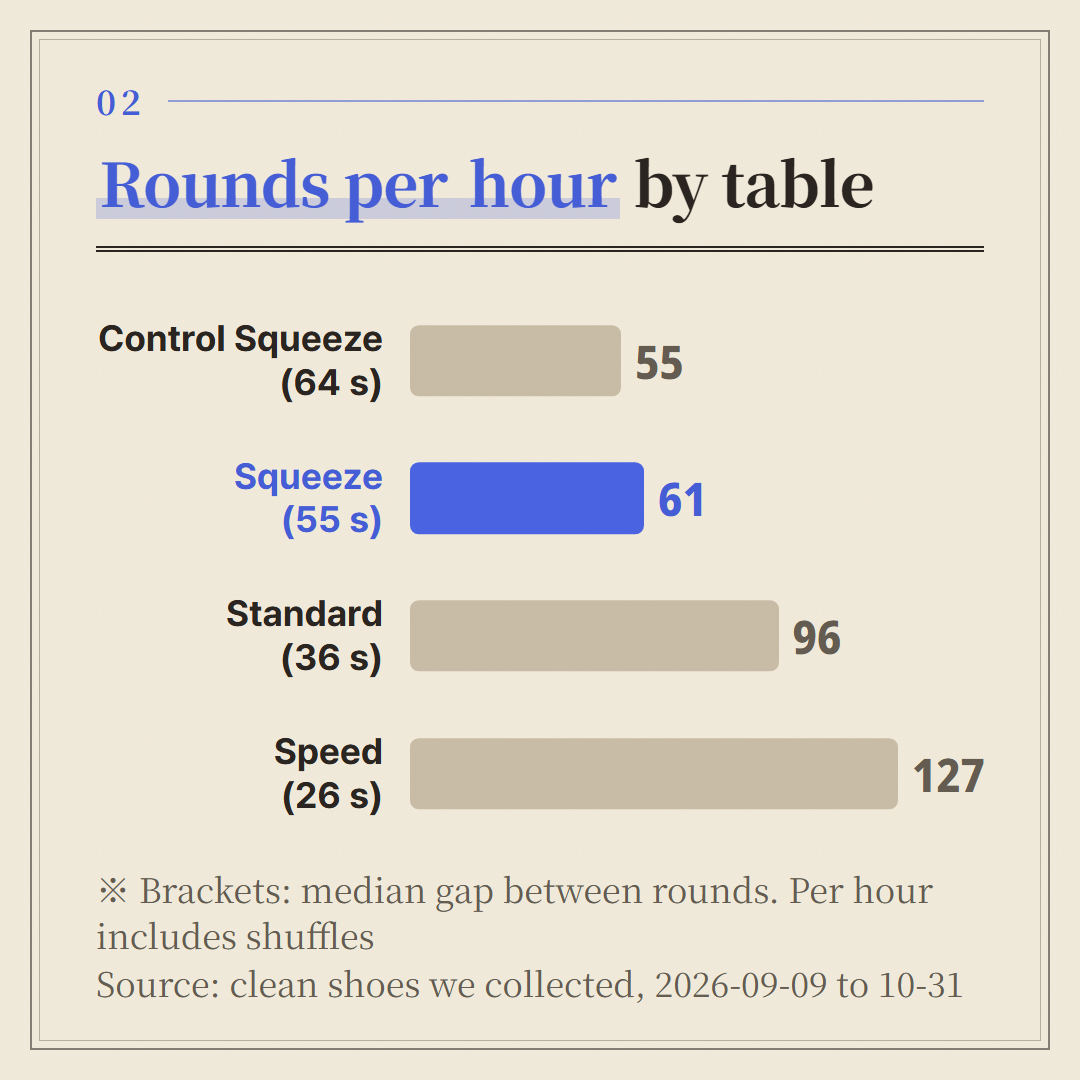
On the Squeeze table, where the dealer peels, the median gap between rounds was 55 seconds. On Control Squeeze, where players peel, it was 64 seconds. Over the same period standard tables ran at 36 seconds and Speed tables at 26.
Evolution says a standard round typically lasts around 48 seconds and a Speed round 27 seconds. Both squeeze tables ran longer than the 48 seconds Evolution gives for a standard round.
The gaps are not even, either.
On the Squeeze table, the shortest 10% of 63,590 gaps were 43 seconds or less and the longest 10% were 74 seconds or more. Speed tables sit between 23 and 30 seconds, a much narrower band.
On Control Squeeze, 59.5% of gaps fell between 60 and 90 seconds. On the dealer-peeled table, 60.2% fell between 40 and 60 seconds. Who peels splits a round by about 10 seconds, and over a 68-round shoe that adds up to more than six minutes, as the list below shows.
To get rounds per hour, we took the time between the first rounds of two back-to-back shoes on the same table and the number of rounds in a shoe.
- Control Squeeze: 68 rounds in 73.7 minutes, 55 rounds an hour
- Squeeze: 68 rounds in 67.2 minutes, 61 rounds an hour
- Standard: 68 rounds in 42.7 minutes, 96 rounds an hour
- Speed: 67 rounds in 31.6 minutes, 127 rounds an hour
A Speed table runs more than twice as many rounds per hour as a Squeeze table. Assume $10 on Banker every round. On clean shoes the expected loss is 1.15% per bet, so about $0.115 a round.
With that assumption the hourly expected loss is about $6.33 on Control Squeeze, $7.02 on Squeeze, $11.04 on a standard table and $14.61 on Speed.
The loss per round is the same.
Put the other way, an hour at a squeeze table builds up less expected loss because fewer rounds are played. The expected value of each round is negative at every table alike.
Over the collection period both squeeze tables logged rounds in every hour from 0 to 23 Korean time. Squeeze had 2,418 to 3,132 rounds per hour slot, so no hour sat empty.
3.If I peel the card myself on Control Squeeze, can the result change?
Evolution explains that cards are dealt face-down onto glass panels in the table, and two cameras under the table send the real card faces to the player's screen. Optical filters and an overlay mask in the interface hide the faces until the mask is peeled back.
Clicking or tapping a corner or edge of a card peels back the mask and shows the value. What the player peels is the screen mask, and the card is already on the table. The page also says new players can practise the squeeze without placing a bet.

4.Are the payouts and RTP the same as a standard table?
The Squeeze rules pay Player 1:1, Banker 0.95:1 (5% commission) and Tie 8:1. The optimal RTP is 98.94% on Banker, the same figure as the standard baccarat rules.
Side bet RTPs are listed too: P Pair and B Pair 89.64%, Perfect Pair 91.95%, Either Pair 86.29%, P Bonus 97.35%, B Bonus 90.63%. Every side bet is listed with a lower RTP than the main bets.
In the shoes we collected, the Banker share excluding ties was 50.57% over 992 Squeeze shoes and 50.43% over 904 Control Squeeze shoes. That is close to the 50.68% for all clean shoes, and with fewer shoes the decimals can move.
How fast each table type runs and what that means when choosing a site is worked out in the baccarat site speed post.
Q.How many seconds is the betting time?
A.The rules give no number of seconds and use traffic lights instead: green means bets are open, yellow means time is nearly up, red means betting is closed.
Q.Are squeeze shoes shorter?
A.No. In the shoes we collected, the median shoe had 68 rounds on both Squeeze and Control Squeeze, the same as standard tables. What grows is the time between rounds.
Q.Are the bet limits the same as standard tables?
A.The rules point to the BET LIMITS panel and say the limits may change from time to time. Check that panel each time you sit down.
Q.Where can I talk to someone about gambling and money problems?
A.In Korea, the Korea Center on Gambling Problems runs the 1336 helpline. Elsewhere, look up the gambling helpline in your country.
Hiddenpick is a Windows program that keeps on its server the betting rules that pick owners do not make public, and runs them as they are on the PC of the person who received them through a referral code. It currently runs on Evolution live baccarat and blackjack (21) at Stake (stake.com). How to read rounds per hour and expected loss is laid out on the how to win at baccarat page.
We are recruiting national pickster representatives, and those selected receive benefits worth $12,000, a one-year pass. Apply: https://hiddenpick.my/pickster
- 25,000+ real shoes collected and analysed since September 2026
- 90+ baccarat tables from the lobby on one screen · refreshed every 0.35s · seated 2 to 4 seconds after a click
- Stops by itself at your take-profit and stop-loss · tie several PCs into one team and stop on the total
- No browser extension · your money stays in your own Stake account · 12 languages