Blackjack double down, 11 vs 6 is +67.9% and 9 vs 2 is better as a hit in an 8-deck expected value calculation
2026-11-03
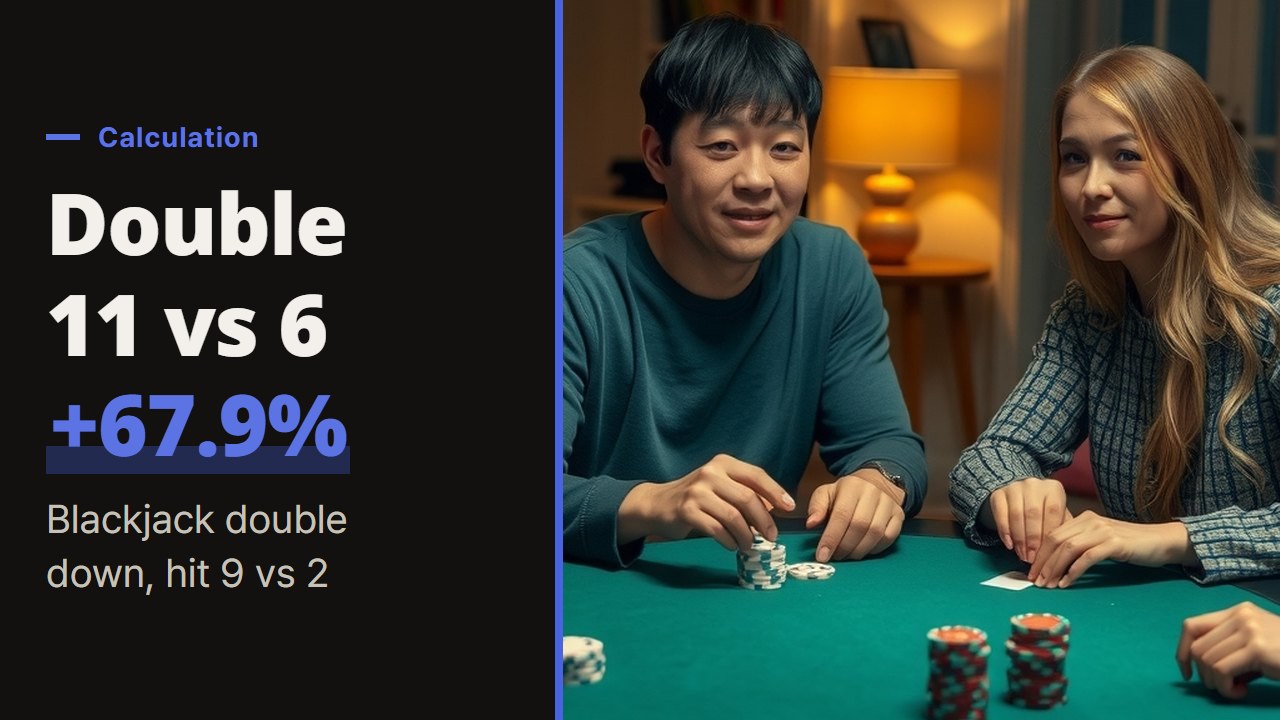
With 11 against a dealer 6, how much better is a blackjack double down than a plain hit? The hand is 6 and 5, the dealer shows a 6. The choice is whether to double the bet and take exactly one more card.
And what about cells where players split into two camps, like 9 against a dealer 2? We calculated the stand, hit and double expected values for typical cells, using 8 decks with the dealer standing on soft 17.
1.What a blackjack double down is and when it is allowed
Double down: after the first two cards, add the same amount to double the bet, take one card, and stand.
The conditions come down to three. It is only possible on the first two cards, the added amount equals the original bet, and no more cards come after the one.
The chart in the blackjack basic strategy guide assumes a table that allows doubling after a split. On that chart, D means double, otherwise hit, and Ds means double, otherwise stand.
Double rules differ between Evolution games. Evolution's own page says Free Bet Blackjack gives a double that costs nothing extra on two-card hard 9, 10 and 11, and that Power Blackjack lets players double, triple or quadruple on the first two cards, even after a split.
One review says Infinite Blackjack does not allow doubling after a split. Before sitting down, check the in-game rules panel for whether doubling after a split is allowed.
2.Blackjack double down expected value, calculated for 11 vs 6 and 10 vs 9
We removed the player's two cards and the dealer upcard from 416 cards (8 decks) and counted every possible outcome to the end. After a hit, the player picks whichever is better, standing or drawing again. Values are per 1 unit of original bet.
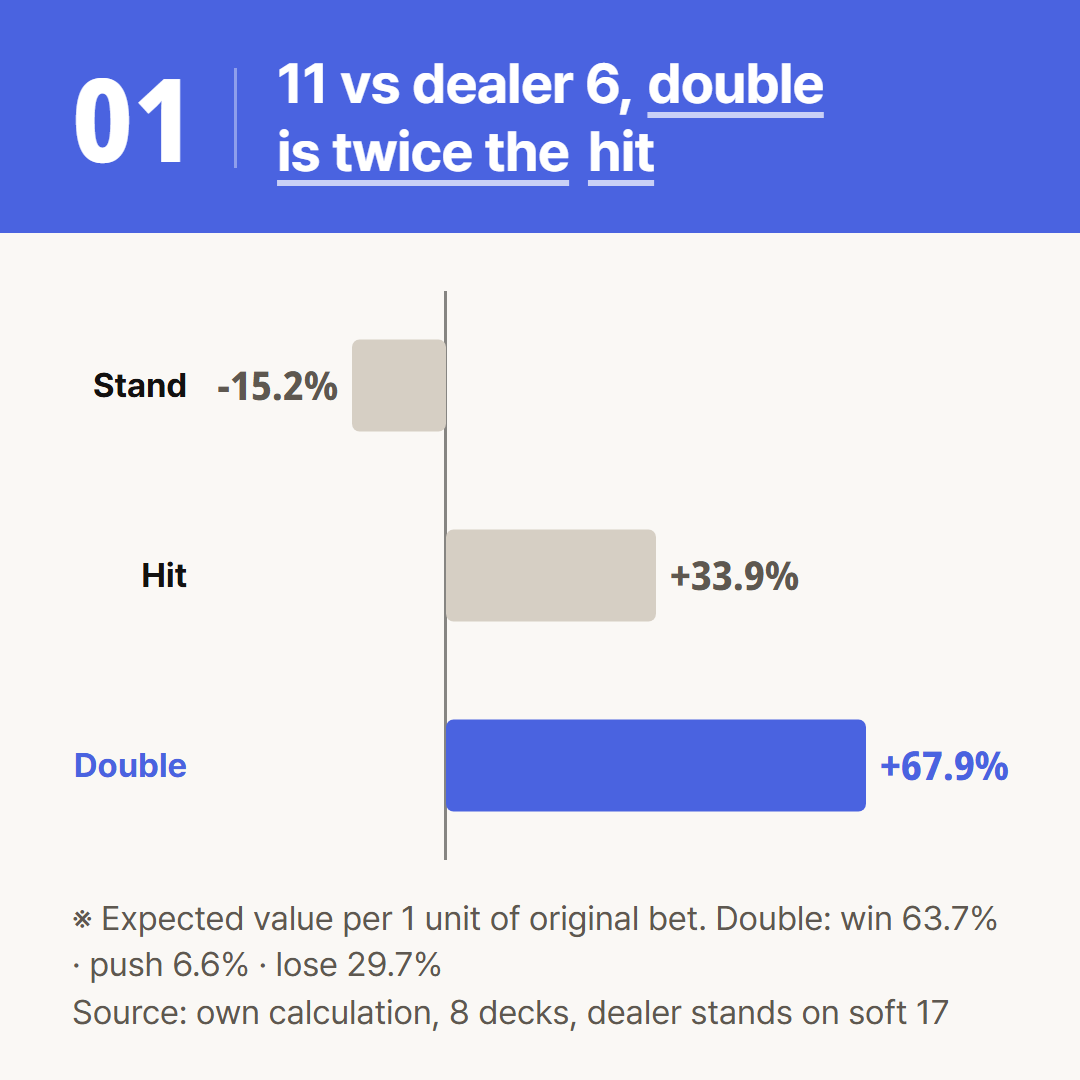
11 vs 6
- Stand: -15.2%
- Hit: +33.9%
- Double: +67.9%
A double ends after one card. With that card the player wins 63.7% of rounds, pushes 6.6% and loses 29.7%. The gap between wins and losses is 33.9%, and with a doubled bet that becomes 67.9%.
Of the 413 cards left, 128 are worth 10, which is 31.0%. That many cards make 21, and a dealer 6 is a card with a high bust risk.
At 11 vs 6, the double returns exactly twice the expected value of the hit. In the calculation, the best path after a hit was always to take one card and stand. Against a dealer 6, once the total reaches 12 or more, drawing again is the worse choice.
So taking only one card costs nothing, and the doubled stake goes straight into the expected value.
11 vs 9 and 10 vs 9
As the dealer card gets stronger the gap narrows. 11 vs 9 is hit +15.8% and double +23.0%. 10 vs 9 is hit +11.7% and double +14.7%, a gap of 3.0 points.
The stake doubles but the expected value does not. That is the price of stopping after one card, since a weak card such as a 2 or 3 cannot be improved. Double still comes out ahead, so the chart doubles in both cells.
Why the dealer 10 and ace are left out
When the dealer shows a 10 or an ace, the hole card can make blackjack. When the dealer checks, and whether the doubled money is lost as well, differs by table, so this calculation covers upcards 2 to 9 only.
3.Close calls between double and hit
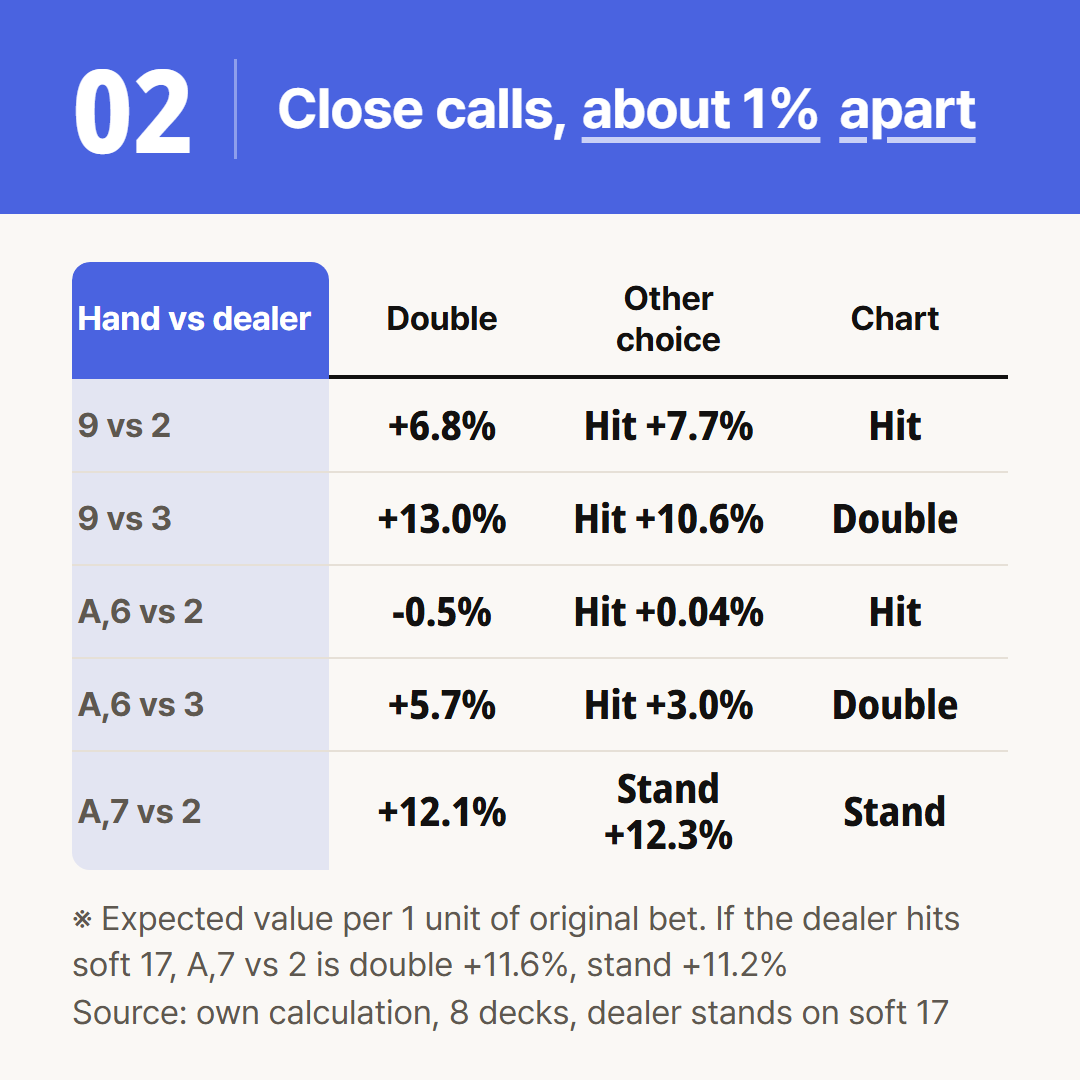
Hard 9 vs a dealer 2 is hit +7.7%, double +6.8%. Against a dealer 3 it flips to hit +10.6%, double +13.0%.
Soft 17 (A,6) vs 2 is hit +0.04%, double -0.47%. Against a 3, double at +5.7% beats hit at +3.0%.
Soft 18 (A,7) stands well, so its rival is the stand. Against a 2, stand is +12.3% and double +12.1%, a gap of 0.3 points. On tables where the dealer hits soft 17, stand is +11.2% and double +11.6%, so the order flips.
Hard 8 has no double cells with 8 decks. 8 vs 5 is hit +7.8%, double +1.8%.
In the close cells the gap is about 1% of the bet, too small to feel in a round or two. That is why it is better to keep the chart nearby and play those cells the same way every time.
4.What a doubled stake means
A double raises the stake in cells with high expected value, but in a lost round it loses twice as much. Even at 11 vs 6, about three rounds in ten are lost.
With a betting ladder or martingale steps, a doubled round puts twice that step's amount on the table. Leave room for it when setting the balance and the stop-loss line.
Playing doubles by the chart still leaves the house share. A 7-seat table with 8 decks and the dealer standing on soft 17 has an RTP of 99.29%. Doubling at the right time moves play toward losing less, and it is not a button that creates profit.
The full chart is covered in the blackjack basic strategy chart post.

At the double button
- I checked that this is still the first two cards
- I checked the rules panel for whether this table allows doubling after a split
- I know whether the dealer stands on soft 17 at this table
- I can tell big-gap cells like 11 vs 6 from 1% cells like 9 vs 2
- My balance plan includes the doubled stake
Hiddenpick is a Windows program that keeps on its server the betting rules that pick owners do not make public, and runs them as they are on the PC of the person who received them through a referral code. It currently runs on Evolution live baccarat and blackjack (21) at Stake (stake.com). Which cells to double is laid out on one page in the blackjack basic strategy guide.
We are recruiting national pickster representatives, and those selected receive benefits worth $12,000, a one-year pass (apply at https://hiddenpick.my/pickster).
- 25,000+ real shoes collected and analysed since September 2026
- 90+ baccarat tables from the lobby on one screen · refreshed every 0.35s · seated 2 to 4 seconds after a click
- Stops by itself at your take-profit and stop-loss · tie several PCs into one team and stop on the total
- No browser extension · your money stays in your own Stake account · 12 languages