Computer side jobs: how much does leaving a PC on 24 hours add to the power bill? Plus health insurance and the 3.3% tax in Korea
2026-10-09
Numbers first
- A computer side job that keeps a 100 W PC on for 30 days adds 72 kWh: ₩8,640 to ₩22,126 in energy charges on Korea's tiered tariff, and more if the base charge moves up a tier
- In Korea, employees pay extra health insurance once non-salary income passes ₩20 million a year
- The 3.3% taken from a payment is tax paid in advance, and it is worked out again in May
1.What comes up when you search for computer side jobs?
On October 7, 2026, Google's suggestions for computer side jobs included 'computer side jobs from home', 'computer part time jobs' and 'computer side hustle jobs'.
The top five YouTube videos for the same words had about 4.07 million views between them. All five titles are numbered lists of 6 to 11 items.
Lists help you choose. This post looks at what comes after.
It answers three questions with official numbers from South Korea: the power bill of a PC left on, health insurance on side income, and the 3.3% taken out of payments. The power math works anywhere once you use your own price per kWh.
2.How much does leaving a PC on 24 hours add to the monthly power bill?
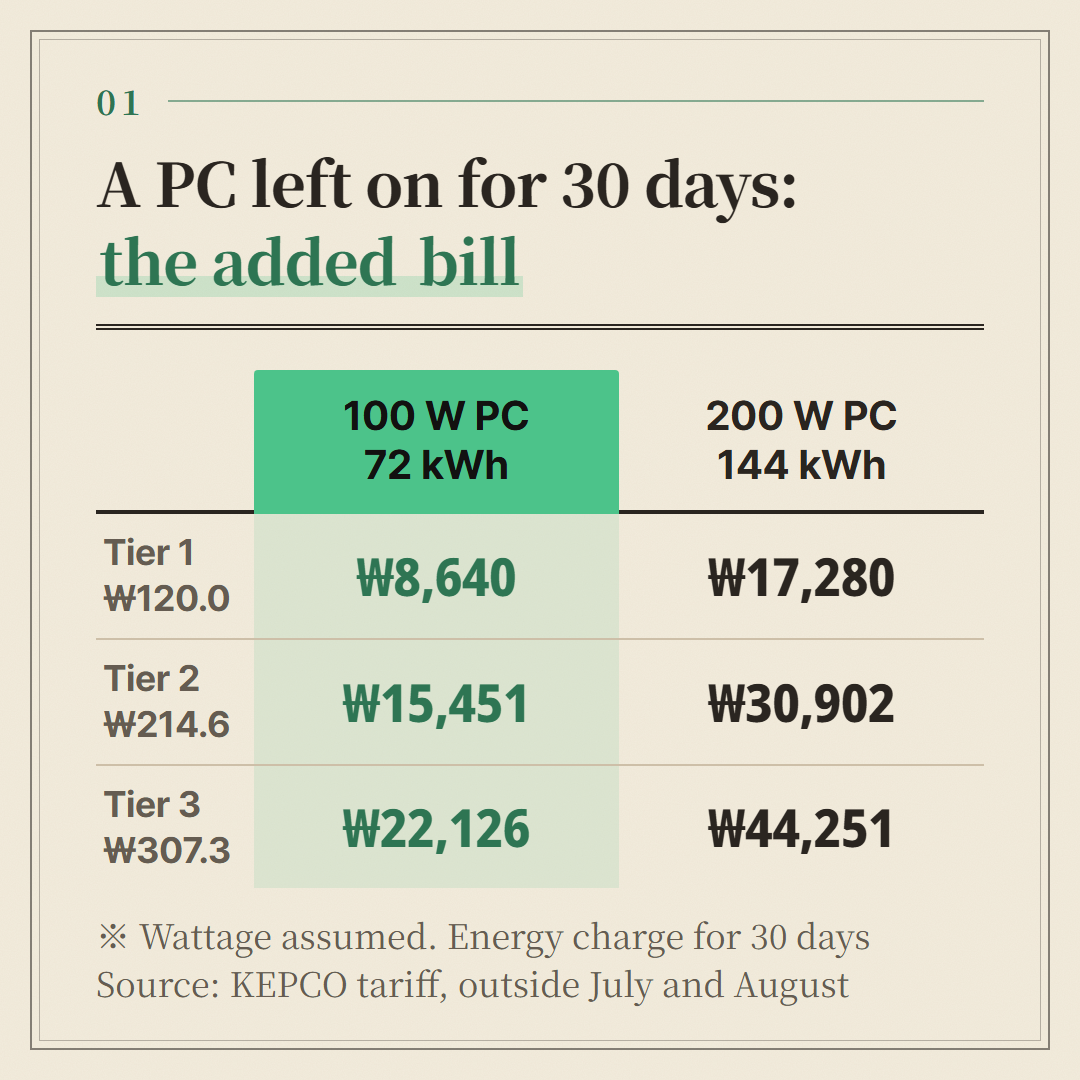
We used KEPCO's residential low-voltage tariff. Outside July and August, the first 200 kWh in a month cost ₩120.0 per kWh, use from 201 to 400 kWh costs ₩214.6, and anything above 400 kWh costs ₩307.3 (KEPCO tariff).
Tiered pricing: each kWh costs more as monthly use grows, and the base charge rises too (₩910, ₩1,600, ₩7,300).
Assume the PC averages 100 W. That is 2.4 kWh a day, or 72 kWh over 30 days. What it adds depends on which tier those 72 kWh land in.
- All within tier 1: 72 kWh × ₩120.0 = ₩8,640
- On top of tier 2: 72 kWh × ₩214.6 = ₩15,451
- On top of tier 3: 72 kWh × ₩307.3 = ₩22,126
Assume 200 W instead and the month comes to 144 kWh, or ₩17,280, ₩30,902 and ₩44,251 in the same three tiers.
The bigger jump comes at a tier line.
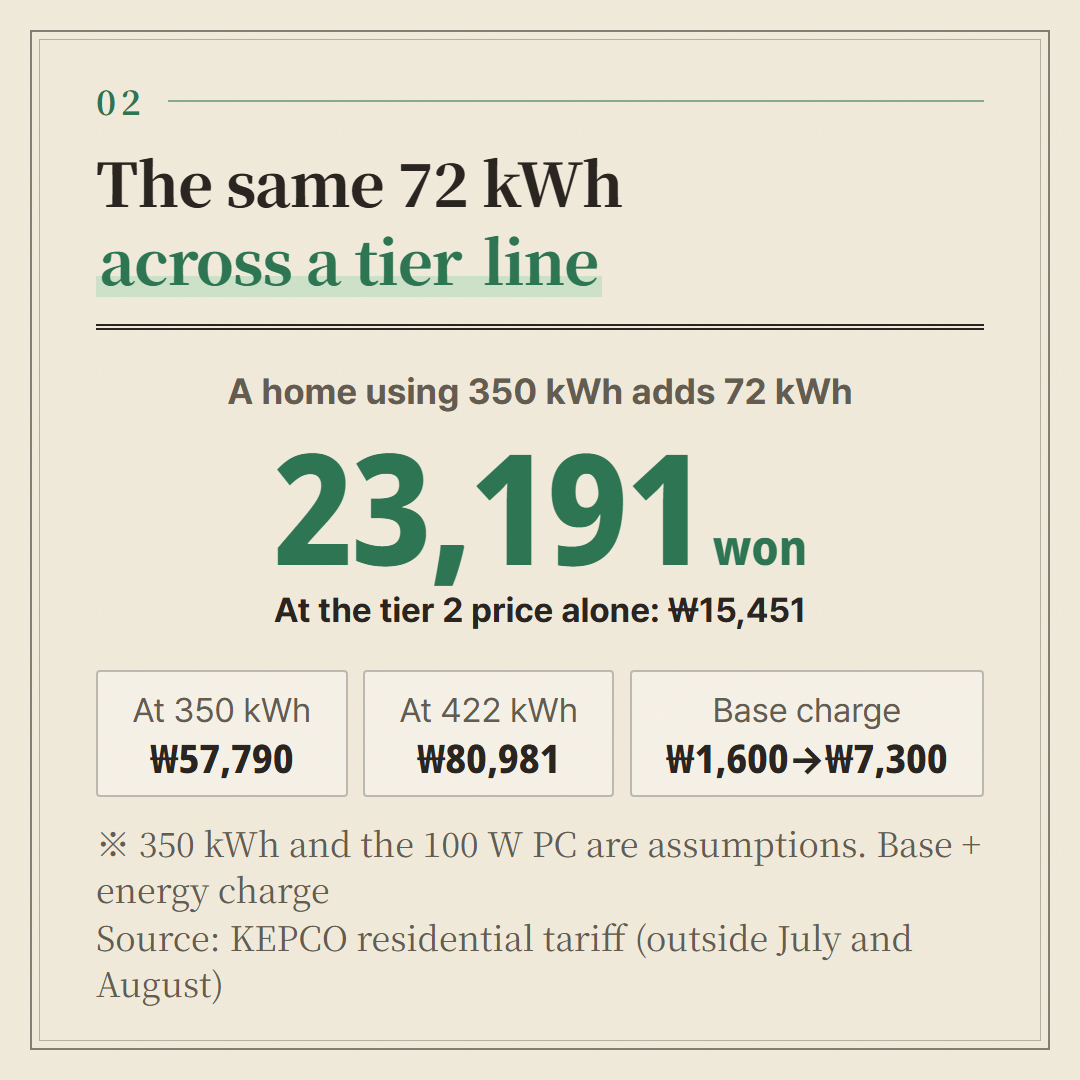
Assume a home that already uses 350 kWh a month. Add 72 kWh and it reaches 422 kWh, which is tier 3. Base charge plus energy charge goes from ₩57,790 to ₩80,981.
The same 72 kWh now adds ₩23,191. The base charge moves from ₩1,600 to ₩7,300, and the 22 kWh above 400 kWh are billed at ₩307.3.
In July and August the tier lines move up to 300 kWh and 450 kWh. A real bill also adds a fuel cost adjustment and VAT.
For comparison, US homes paid an average of 18.31 cents per kWh in July 2026, measured as the EIA's average revenue per kWh (EIA). At that price 72 kWh comes to about $13.18.
Measuring the wattage is more accurate than guessing it. A plug-in power meter between the outlet and the plug shows what the PC really draws.

If a program does the work while you sleep, the night hours cost money too. For a keep-it-running side job, take the power bill out of the monthly income before anything else.
3.Does side income raise health insurance in Korea?
The rules differ for employees and for people listed as dependents on a family member's plan.
An employee whose non-salary income passes ₩20 million a year pays an extra premium on the part above it. The NHIS takes yearly non-salary income, subtracts ₩20 million, divides by 12, and multiplies by an income weight and the premium rate (NHIS guide).
The weight is 100% for business and other income, and the employee pays this premium alone. The 2026 health insurance rate is 7.19% (Ministry of Health and Welfare).
Assume side income of ₩26 million a year after expenses. The ₩6 million above the line, divided by 12, is ₩500,000, and 7.19% of that is ₩35,950 a month. Long-term care insurance comes on top.
A dependent with no business registration loses dependent status once business income passes ₩5 million a year.
The NHIS dependent rules also cap all income combined at ₩20 million a year, and both spouses must meet them if the person is married (NHIS dependent rules).
A dependent doing computer work from home should watch the ₩5 million line first.
4.Why is 3.3% taken out of side job payments?
Korea's National Tax Service says a company paying business income to a freelancer for personal services withholds 3.3% up front. That is 3% business income tax plus 0.3% local income tax.
This income is added to other income and filed in May the following year. If it is not filed on time, no refund is paid (NTS filing guide).
The NTS gives an example.
A tutor earned ₩10 million in 2025 and had ₩330,000 withheld. After expenses and deductions the actual tax was ₩220,000, so filing returns ₩110,000.
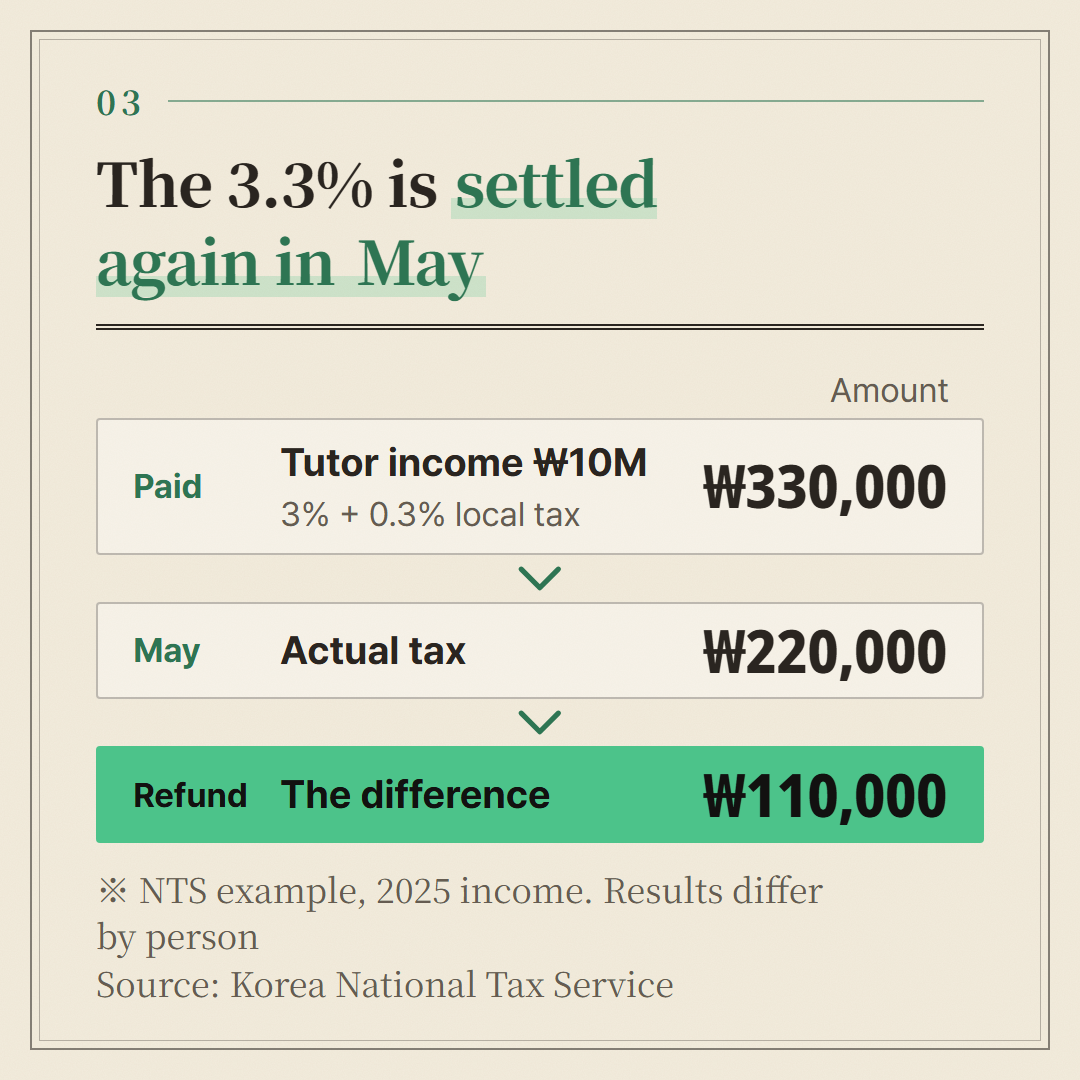
The 3.3% is paid in advance, so the May filing works it out again. Someone with a salary files it together with wage income, so the result may not be a refund.
Money from a one-off job counts as other income. The payer withholds 20% of the other-income amount (the payment minus necessary expenses), plus local income tax of 10% of that tax (NTS on withholding).
5.So what should you work out first?
Work out the monthly power bill from the hours and the wattage, check whether side income passes the ₩5 million (dependent) and ₩20 million (employee) lines, and note that the 3.3% gets settled again in May.
Hiddenpick is a Windows program that keeps on its server the betting rules that pick owners do not make public, and runs them as they are on the PC of the person who received them through a referral code. It currently runs on Evolution live baccarat at Stake (stake.com). It also runs only while the PC is on, so the power math above applies to it too, and the baccarat odds it cannot change are in the baccarat bot guide.
- 25,000+ real shoes collected and analysed since September 2026
- 90+ baccarat tables from the lobby on one screen · refreshed every 0.35s · seated 2 to 4 seconds after a click
- Stops by itself at your take-profit and stop-loss · tie several PCs into one team and stop on the total
- No browser extension · your money stays in your own Stake account · 12 languages