YouTube monetization requirements double from 1 February 2027: where automation channels get stopped, answered from YouTube Help
2026-10-27
If a YouTube automation channel starts today, which monetization requirements will it be judged against when it applies?
Apply before 1 February 2027 and it is today's bar. Apply after that and the bar is twice as high.
YouTube Help says that from that date, channels joining for the first time need 8,000 watch hours or 20 million Shorts views.
Clearing the bar is not the end of it.
Automation channels get stopped in other places too, so this post follows the conditions, the policies and the waiting days using only sentences from YouTube Help. The pages were checked on 25 October 2026.
1.What do YouTube automation videos show first?
On 25 October 2026, the top five YouTube results for "youtube automation channel monetization" had 808,992 views between them. Titles promising a monthly figure or a channel monetized in a few days sat near the top.
In Google autocomplete, "reused content youtube" is followed by words like appeal and solution. Plenty of people are searching after their monetization has already stopped, so this post looks at the rules rather than the income figures.
2.How do the requirements change on 1 February 2027?
Today the YouTube Partner Program (YPP) asks for 1,000 subscribers plus either 4,000 valid public watch hours in the last 12 months or 10 million valid Shorts views in the last 90 days (YPP overview).
From 1 February 2027, new creators need 8,000 qualified watch hours in the last 365 days or 20 million qualified Shorts views in the last 90 days. The 1,000 subscribers stay the same (Changes to YPP).
Both the watch-hour and the Shorts-view thresholds double.
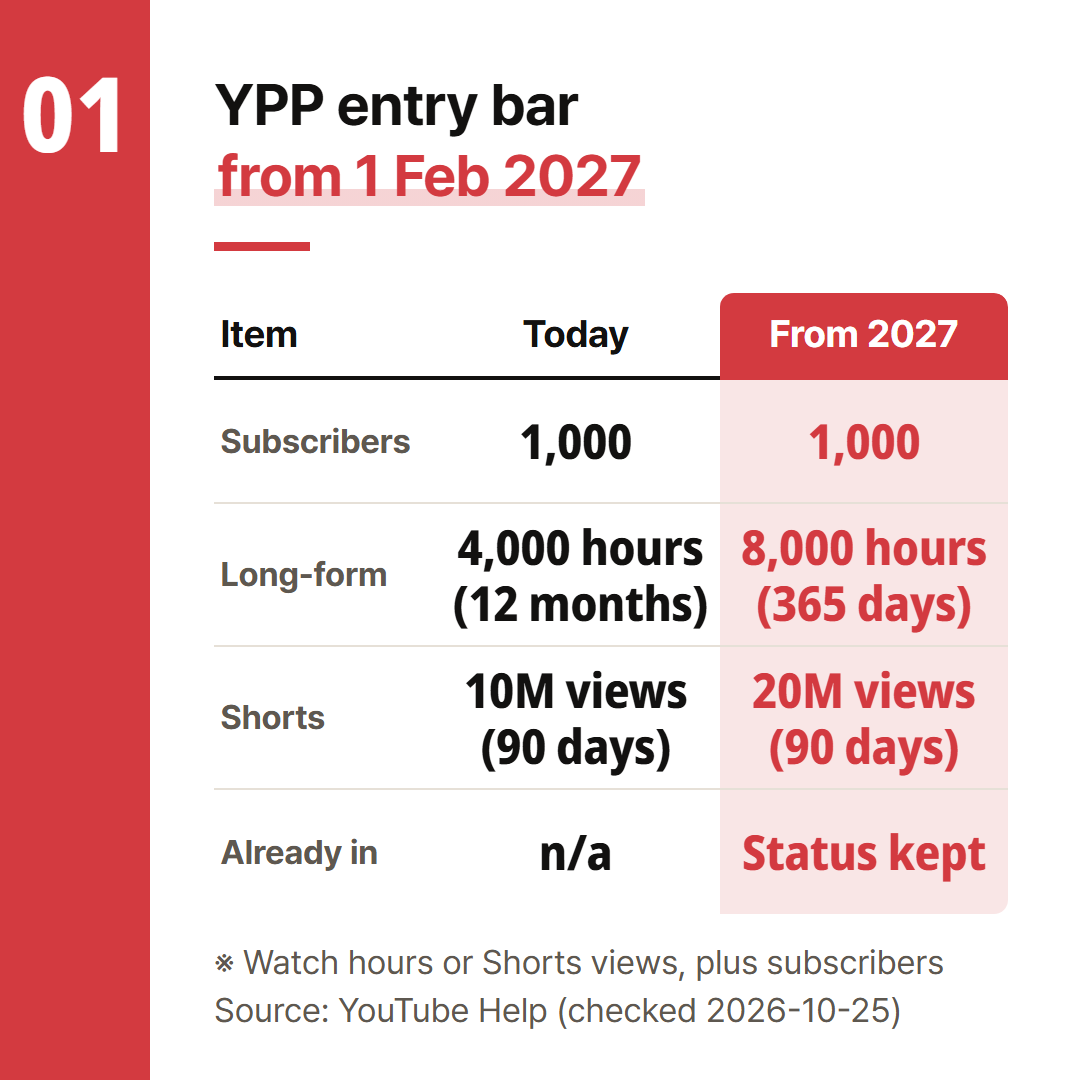
Channels already in YPP keep their status. To keep earning through the related features after 1 February, though, they have to accept the updated terms in YouTube Studio by 31 January 2027.
Shorts get a maintenance condition.
To earn monthly from the Shorts creator pool, a channel has to keep 10 million qualified Shorts views over the last 90 days. Missing it does not remove the channel from YPP; it only loses that month's share of the Shorts pool.
3.Where does an automation channel lose monetization?
The YPP overview says a channel that breaks the channel monetization policies loses eligibility no matter how many subscribers or watch hours it has.
The two items automation channels run into most are reused content and mass-produced content (channel monetization policies).
How far can other people's videos be used?
The policy allows reused content when viewers can see a meaningful difference between the original and the new video. Commentary, reaction videos and edits that add a storyline and commentary are its examples.
What gets blocked is taking someone else's video, changing it very little, and presenting it as original. Clips with little or no commentary, compilations gathered from other social sites, and videos downloaded and uploaded again are the examples the policy gives.
The policy applies even when the original creator has given permission. Copyright permission and the monetization review are separate questions.
What about videos stamped out of one template?
On 15 July 2025 YouTube renamed its repetitious content item to cover mass-produced content. The test is whether the videos are similar enough to be swapped for one another.
A series with the same intro and outro is fine if most of each video is different. On the other side, AI-generated content made from a generic template, with no original insight from the creator and the feel of mass production, is one of the violations the policy names.
Using automation tools and templates is not banned in itself. The policy says the final result still has to show the creator's creative vision.
Does one flagged video stop the whole channel?
The reused content policy applies to the whole channel, and the page says monetization can be removed from the entire channel.
It is not a matter of pulling a few videos.
Content whose authorship cannot be clearly verified can fall under the policy too. Channels that stitch material together with no face and no voice should read that sentence first.
Non-original Shorts, such as unedited film or TV clips, and views pumped up by automated clicks or scrolling bots are not counted for Shorts revenue sharing (Shorts revenue sharing).
4.Do AI voices and AI scripts have to be disclosed?
YouTube asks creators to disclose content that has been altered or generated with AI to the point where it could be mistaken for real (disclosing altered or synthetic content).
Using AI to help with a script, an outline, a thumbnail or a title, or to make captions, does not need disclosure. The page also says that disclosing does not limit a video's audience or affect its eligibility to earn.
The AI label does not affect eligibility. Swappable videos are judged under the mass-produced test in section 3.
5.How long is the wait after a rejection?
A decision usually takes about a month after applying. After a rejection, a channel can appeal within 21 days, or reapply 30 days after the rejection email (what to do after a rejection).
After a second rejection, or if the channel has already reapplied before, the wait grows to 90 days.
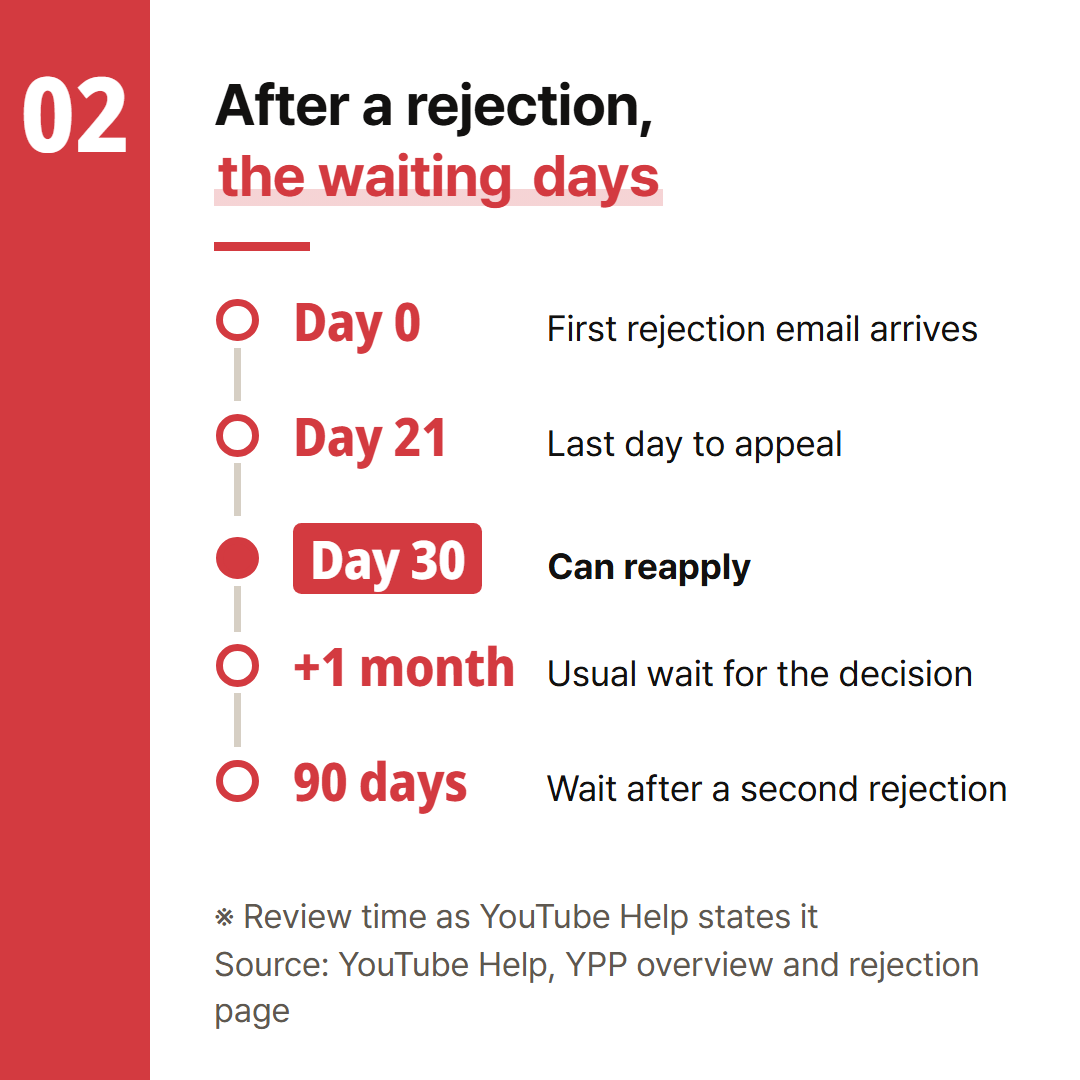
The changes page says only that the new bar applies to creators joining from 1 February 2027. A channel rejected in early January that waits 30 days to reapply lands in February by the calendar.
A channel that posts no videos or posts for six months or more may also have monetization turned off.
6.The short version
Three-line summary
- From 1 February 2027, new channels need 8,000 watch hours or 20M Shorts views
- Reuse with permission and swappable mass-produced videos can both stop monetization for the whole channel
- After a rejection: appeal within 21 days or reapply after 30, and wait 90 days from the second time
Hiddenpick is a Windows program that keeps on its server the betting rules that pick owners do not make public, and runs them as they are on the PC of the person who received them through a referral code. It currently runs on Evolution live baccarat at Stake (stake.com). The program can take over the repeated clicks, but the odds of the game stay the same, as set out in the baccarat betting program guide.
We are recruiting national pickster representatives, and those selected receive benefits worth $12,000, a one-year pass. Apply: https://hiddenpick.my/pickster
- 25,000+ real shoes collected and analysed since September 2026
- 90+ baccarat tables from the lobby on one screen · refreshed every 0.35s · seated 2 to 4 seconds after a click
- Stops by itself at your take-profit and stop-loss · tie several PCs into one team and stop on the total
- No browser extension · your money stays in your own Stake account · 12 languages