Baccarat card counting app, typing in every card of a shoe cuts the expected loss by only a few hundred won
2026-10-15
The short answer
- A counting app adds a score for each card dealt and shows whether Banker or Player loses less
- An 8-deck shoe means typing in about 331 cards, roughly one every 5.7 seconds
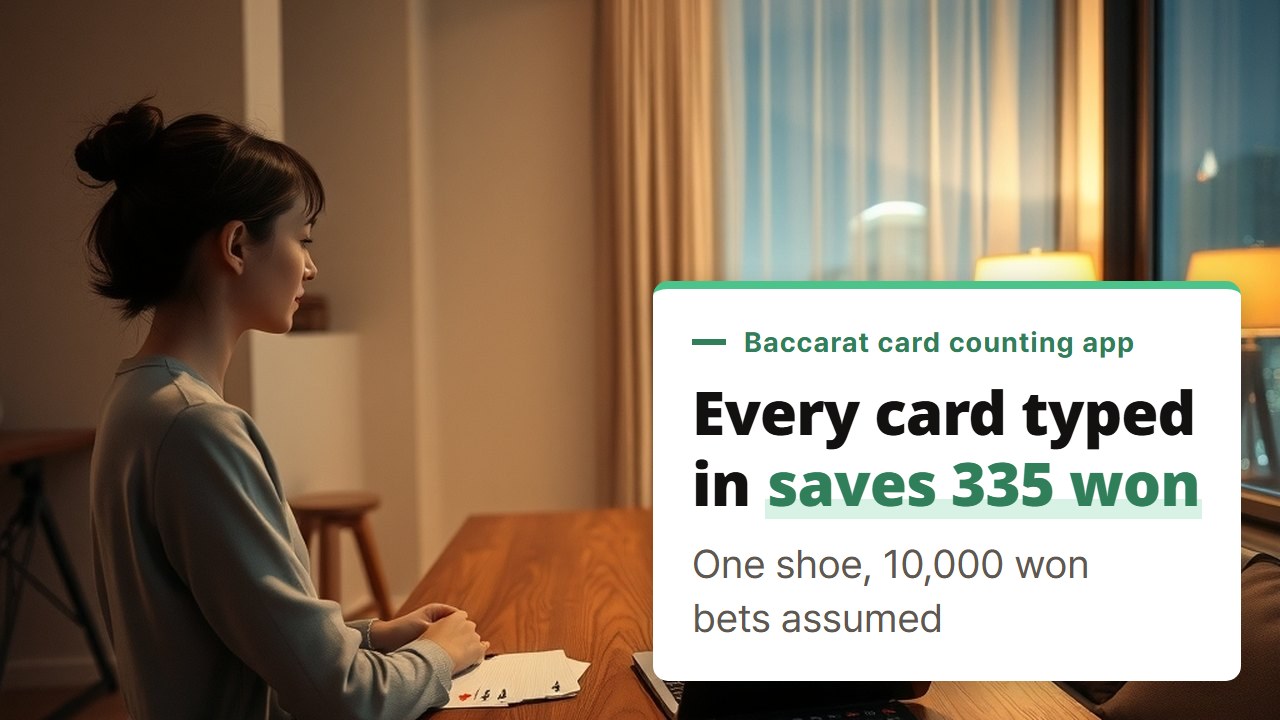
- Even then, the expected loss of a shoe of 10,000 won bets falls only from 7,102 won to 6,767 won, a 335 won difference
Search for a baccarat card counting app and paid counting apps show up next to videos promising that counting cards wins.
The math the app runs behind its screen is simple.
This post follows that math step by step and counts the cards to type in, the time it takes and the loss it removes, in won. The extreme case of pulling out every card of one rank is covered in our baccarat card counting post.
1.What a baccarat card counting app calculates
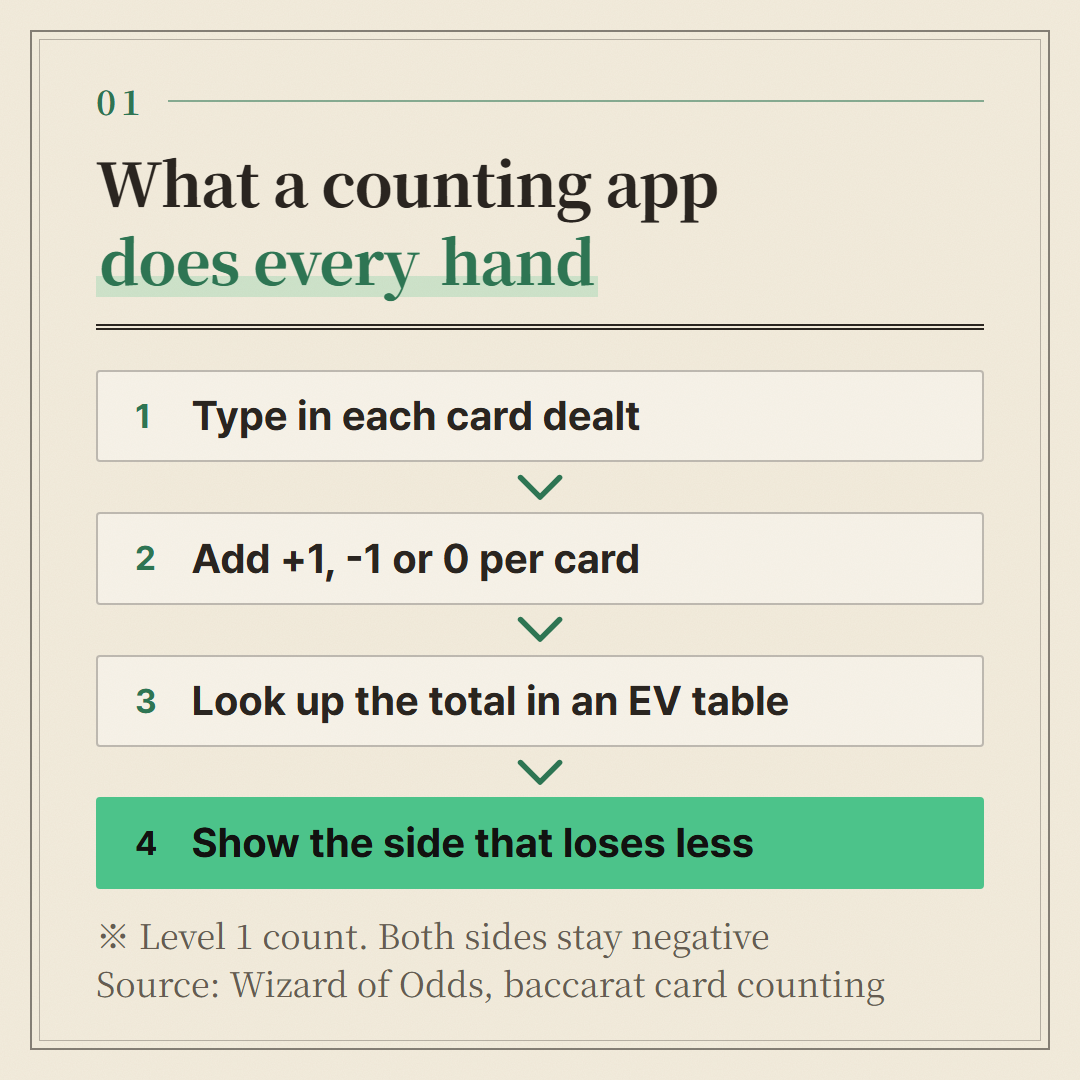
The app does four things. It takes each card as it is dealt, adds that card's score, looks the total up in an expected value table and shows the side that loses less.
Running count: the sum of every card score since the shoe began, used to guess how the remaining cards lean.
The simplest count published by Wizard of Odds (Level 1) adds +1 for 1, 2, 3 and 4, subtracts 1 for 5, 6, 7 and 8, and counts 0 and 9 as zero. When the total drops to -4 or lower it picks Player, otherwise Banker (Wizard of Odds baccarat card counting).
The same page lists finer Level 2 and Level 3 counts. Level 3 gives each rank a score between -6 and +6, and it lowers the house edge only 0.007 percentage points more than Level 1.
2.Cards to type in and time per shoe
We worked out how many cards a hand uses from an 8-deck, 416-card shoe, going through every case of the third card rules.
- 4 cards: 37.9% of hands
- 5 cards: 30.3% of hands
- 6 cards: 31.8% of hands
- Average: 4.94 cards a hand
Across 25,133 shoes we collected, the median shoe ran 67 hands. 67 hands times 4.94 cards is about 331 cards to type in per shoe.
Anyone using the app has to enter 331 cards without missing one for the whole shoe. Miss a single card and every total after it is off.
Now the time. In the same data the median gap between hands at Speed tables was 26 seconds, and a shoe took 31.3 minutes. 331 cards over 31.3 minutes is 10.6 cards a minute, about one every 5.7 seconds.

Those 26 seconds hold the betting window, the deal and the result display. After each hand the cards go in, and the total has to be read and a side picked before the next betting window closes, 67 times in a row.
Then the cards left.
416 minus 331 leaves about 85 cards at the end of the shoe (assuming no burn cards). The fewer cards remain, the more a given total means, and the shoe ends with about 85 still in it.
Now turn it into money.
Assume 10,000 won on Banker every hand.
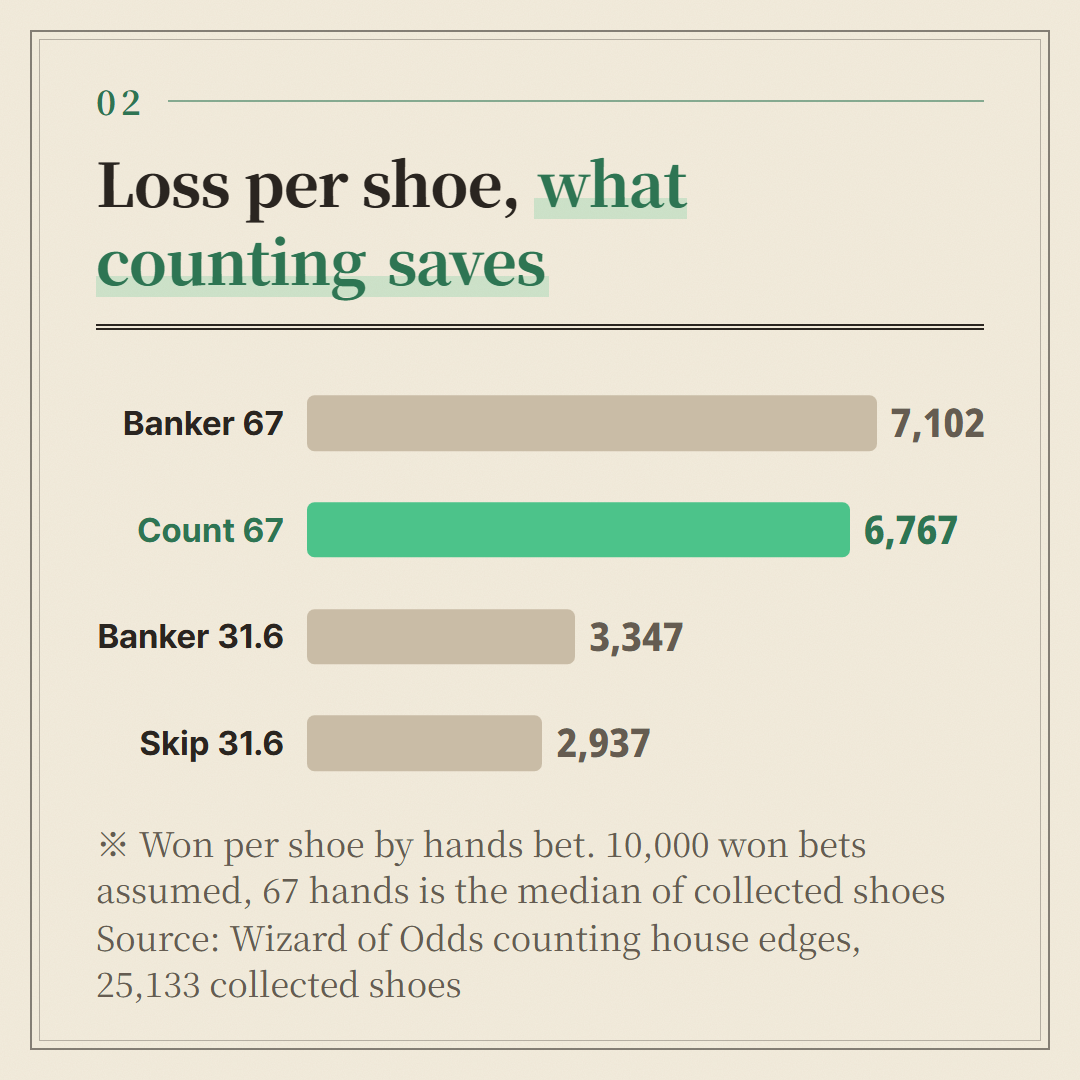
- Banker only, no counting: house edge 1.06%, expected loss over 67 hands 7,102 won
- Level 1 count: house edge 1.01%, expected loss per shoe 6,767 won
The difference is 335 won a shoe, a little over 1 won per card typed in. The 1.01% is the combined figure Wizard of Odds gives for Level 1 picking Banker 71.6% and Player 28.4% of the time.
3.Still negative at extreme counts
However high the "Banker chance" on the app's screen climbs, what it points to is the side that loses less. The Wizard of Odds table by count shows the range.
- Count 0: Banker -1.05%, Player -1.24%
- Count +25: Banker -0.55%
- Count -25: Player -0.83%
Even at the far ends of the table, both sides stay below zero. The most common count is 0, where 7.81% of hands sit.
4.Where the savings from skipping come from
Counting apps also advertise sitting out hands when the count is unclear. In the skipping table on the same page, sitting out at counts from -9 to +1 means betting on 47.13% of hands, at a house edge of 0.93%.
Over one shoe that is 31.6 hands with an expected loss of 2,937 won. Betting Banker on 31.6 hands without counting gives 3,347 won.
Of the 4,165 won drop from 7,102 to 2,937 won, 3,755 won comes from betting less. Compared over the same number of hands, counting saves 410 won.
Other ways of reading the next hand from cards and patterns were checked against real shoes in our baccarat analyzer post.
Before getting a counting app
- Can 331 cards a shoe, about one every 5.7 seconds, be typed in to the end
- Is there a way to fix the total after a missed card
- Has the on-screen chance been turned into expected value, and is it still negative
- Was the saving from fewer hands bet counted separately
- How many shoes at 335 won does the app's price equal
Hiddenpick is a Windows program that keeps on its server the betting rules that pick owners do not make public, and runs them as they are on the PC of the person who received them through a referral code. It currently runs on Evolution live baccarat at Stake (stake.com). Whether the next hand can be called from cards or roads is covered in the reality of baccarat prediction programs. We are recruiting national pickster representatives, and those selected receive benefits worth $12,000, a one-year pass (apply at hiddenpick.my/pickster).
- 25,000+ real shoes collected and analysed since September 2026
- 90+ baccarat tables from the lobby on one screen · refreshed every 0.35s · seated 2 to 4 seconds after a click
- Stops by itself at your take-profit and stop-loss · tie several PCs into one team and stop on the total
- No browser extension · your money stays in your own Stake account · 12 languages