Gambling with credit card payments, the UK ban that covers e-wallets and the cash advance math
2026-10-22
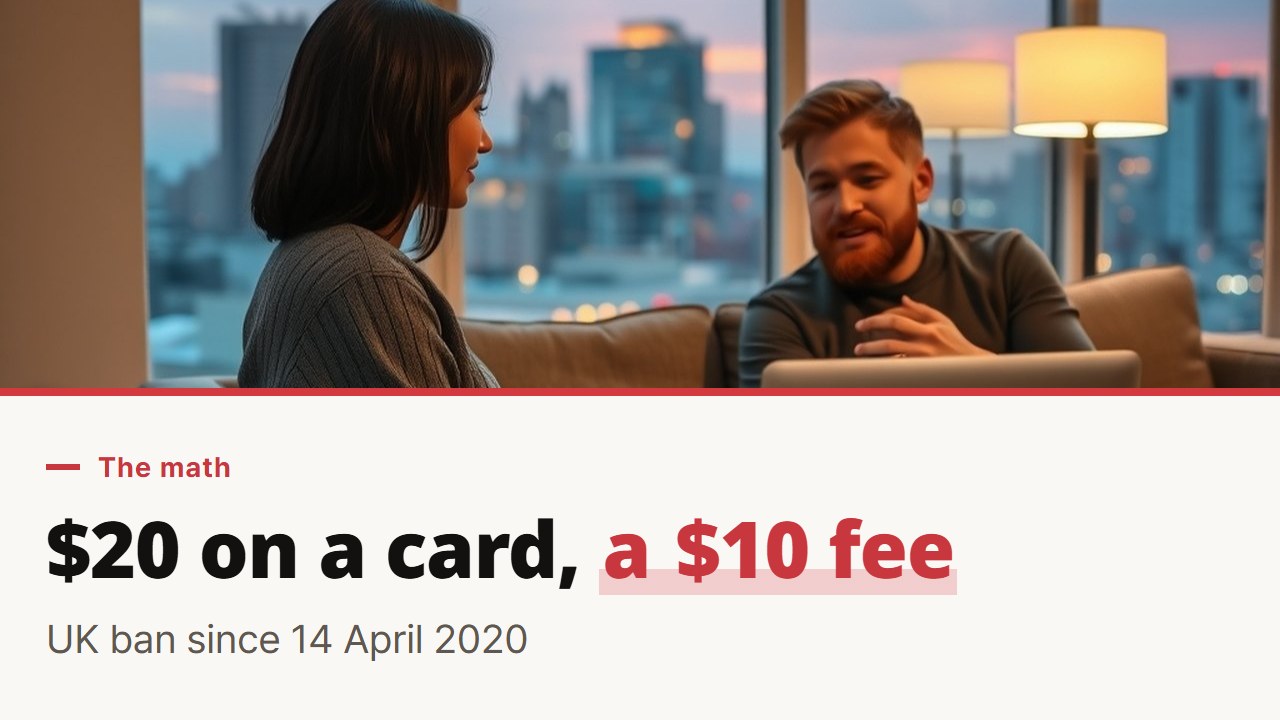
Is a baccarat site that takes a credit card top-up simply the more convenient one? In Great Britain, licensed operators have not been allowed to take that payment since 2020.
Gambling with credit card money raises two questions worth checking. What it says about a site under the regulators' rules, and how the card issuer books the payment. We left out rankings and recommendations and used only numbers that regulators and consumer agencies have published.
1.Britain banned it from 14 April 2020
The UK Gambling Commission announced the ban on 14 January 2020 and it took effect three months later, on 14 April. It covers all online and offline gambling products except lotteries bought in person (UK Gambling Commission announcement).
The announcement gives these numbers.
- Gamblers: 24 million adults in Great Britain gamble, 10.5 million of them online
- Card users: UK Finance estimated that 800,000 people used credit cards to gamble in 2018
- Problem gambling: 22% of online gamblers who use credit cards are classed as problem gamblers
The reason was the risk of gambling with money people do not have. The chief executive also admitted in the same release that people who used cards responsibly would be inconvenienced.
2.Going through an e-wallet does not get around it
What about loading an e-wallet with the card and paying from there? The release on the start date says the ban extends to credit card gambling through e-wallets (start date release).
E-wallet: an online wallet topped up from a card or bank account and used to pay from its balance.
Operators may only accept money from e-wallets that block credit card gambling.
By the British licence standard, a site that keeps credit card top-ups open sits outside that rule.
3.What it costs when it books as a cash advance
When a card payment is classed as gambling, the issuer may book it as a cash advance instead of a purchase.
Cash advance: borrowing cash on a card. A separate fee applies and interest builds from the day of the transaction.
In December 2024 the US Consumer Financial Protection Bureau reviewed the agreements of seven top card issuers. Chase, Discover and American Express list online gambling as a cash advance, and most issuers charge the greater of $10 or 5% of the amount (CFPB).
Run amounts through that formula.
- $20: fee $10, or 50%
- $50: $10, or 20%
- $100: $10, or 10%
- $200 and up: 5%
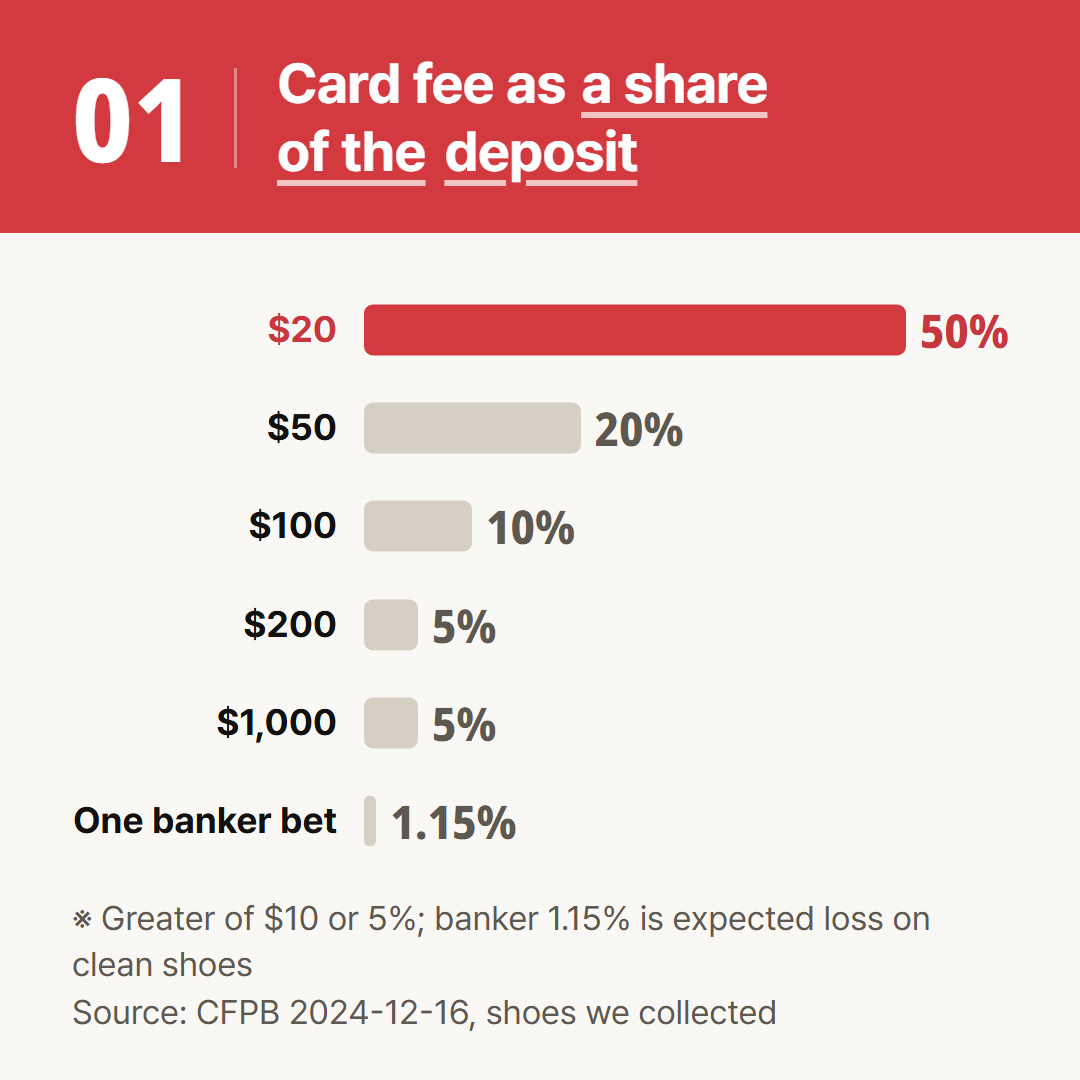
The figure to compare it with is the cost of one bet. On the clean shoes we collected, the expected loss on a banker bet is 1.15% per hand.
Loading $100 by card costs a $10 fee, about the expected loss of 9 banker bets of $100. It leaves before the first hand is dealt.
Interest comes on top. The report names 30% a year as the most common cash advance rate, and interest starts on day one. Using $400 for one month with a $20 fee works out to money at 90% a year, the report calculates.
We ran Korean numbers too. Article 9 of the enforcement decree on credit business caps interest for credit finance companies, card issuers included, at 20% a year (Korean law).
If 1,000,000 won sits at an assumed 18% a year for 30 days, interest is about 14,795 won. At the 20% cap it is about 16,438 won.
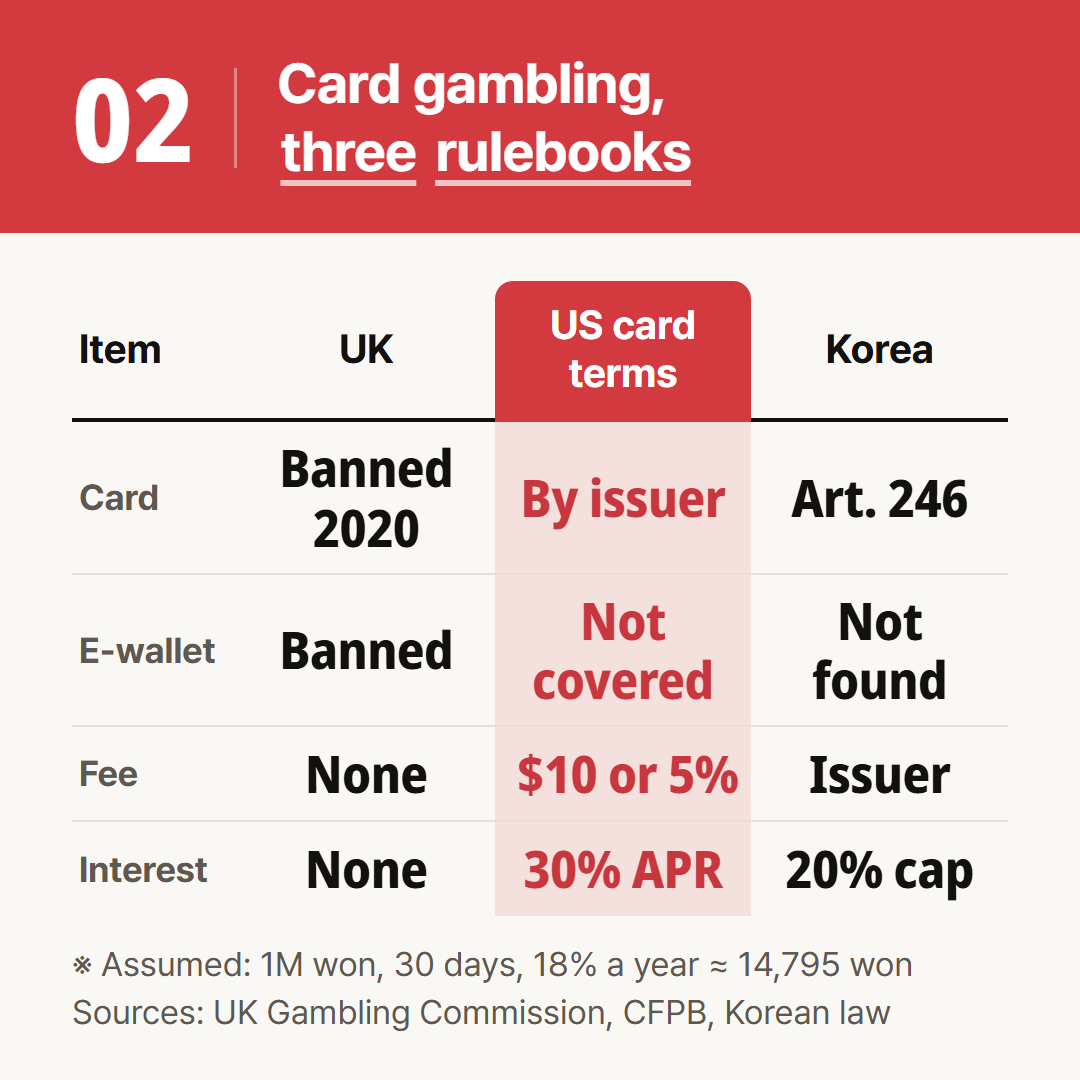
14,795 won is close to the expected loss of 129 banker bets of 10,000 won. How a given issuer actually books these payments differs, so check the card agreement and ask customer service.

4.What to check first
In Korea, Article 246 of the Criminal Act makes gambling an offence (Korean law). The math above assumes the law where the reader lives allows it.
If betting with borrowed money has become a habit, the local regulator's site lists help lines. In Korea, the Korea Center on Gambling Problems answers on 1336.
Before paying by card
- Does the site accept credit cards, or e-wallets loaded from a credit card
- Does the card agreement list gambling as a cash advance
- Is the fee the greater of a flat amount or a percentage
- What is the cash advance rate, and from which day does interest start
- How many times 1.15% per hand is the fee divided by the deposit
Hiddenpick is a Windows program that keeps on its server the betting rules that pick owners do not make public, and runs them as they are on the PC of the person who received them through a referral code. It currently runs on Evolution live baccarat at Stake (stake.com). How far each step of a betting ladder reaches into a bankroll can be checked first with the martingale calculator. We are recruiting national pickster representatives, and those selected receive benefits worth $12,000, a one-year pass (apply at https://hiddenpick.my/pickster).
- 25,000+ real shoes collected and analysed since September 2026
- 90+ baccarat tables from the lobby on one screen · refreshed every 0.35s · seated 2 to 4 seconds after a click
- Stops by itself at your take-profit and stop-loss · tie several PCs into one team and stop on the total
- No browser extension · your money stays in your own Stake account · 12 languages