Gambling winnings tax compared: how Korea, the US and the UK tax what a baccarat player wins
2026-10-25
Is there a gambling winnings tax on what a baccarat player takes off the table? Open the source texts of Korea, the United States and the United Kingdom and you find three different answers written down.
Korea taxes only the games its statute lists. The US treats all gambling winnings as income, and the UK taxes the operator and leaves the winner alone.
This post puts the three side by side and adds nothing the sources do not say.
1.Korea: only the games the statute lists
Article 21(1) of the Income Tax Act lists other income by number. Item 2 is lottery and prize draw winnings, item 4 is refunds on horse racing, cycle racing and sports betting tickets, and item 14 is winnings from slot machines and similar devices (Income Tax Act article 21).
Item 3 reads differently.
It covers gains from taking part in an act defined in the Act on Special Cases concerning Regulation and Punishment of Speculative Acts, and adds in brackets that legality is not considered.
Speculative act: money collected from many people, gain or loss decided by chance (Speculative Acts Act article 2).
The word baccarat appears in none of the items of article 21. Whether a win on an overseas baccarat site falls under item 3 is not settled by the wording alone, and this post does not interpret it.
The rate is in article 129. Other income is withheld at 20 percent, and lottery winnings above 300 million won at 30 percent on the excess (article 129).
Article 103-13 of the Local Tax Act adds local income tax equal to 10 percent of the withheld income tax, which brings the two rates to 22 percent and 33 percent (Local Tax Act article 103-13).
Article 84 says lottery winnings and slot machine winnings of 2 million won or less per event are not taxed (article 84). For a slot machine the only necessary expense is the amount inserted at the time of the win (article 37).
Article 246 of the Criminal Act sets a fine of up to 10 million won for gambling, with momentary amusement excepted (Criminal Act article 246). Article 48 allows confiscation of things obtained through a crime, and collection of their value when confiscation is impossible (article 48).
2.Three countries compared: who pays, how much, on what basis
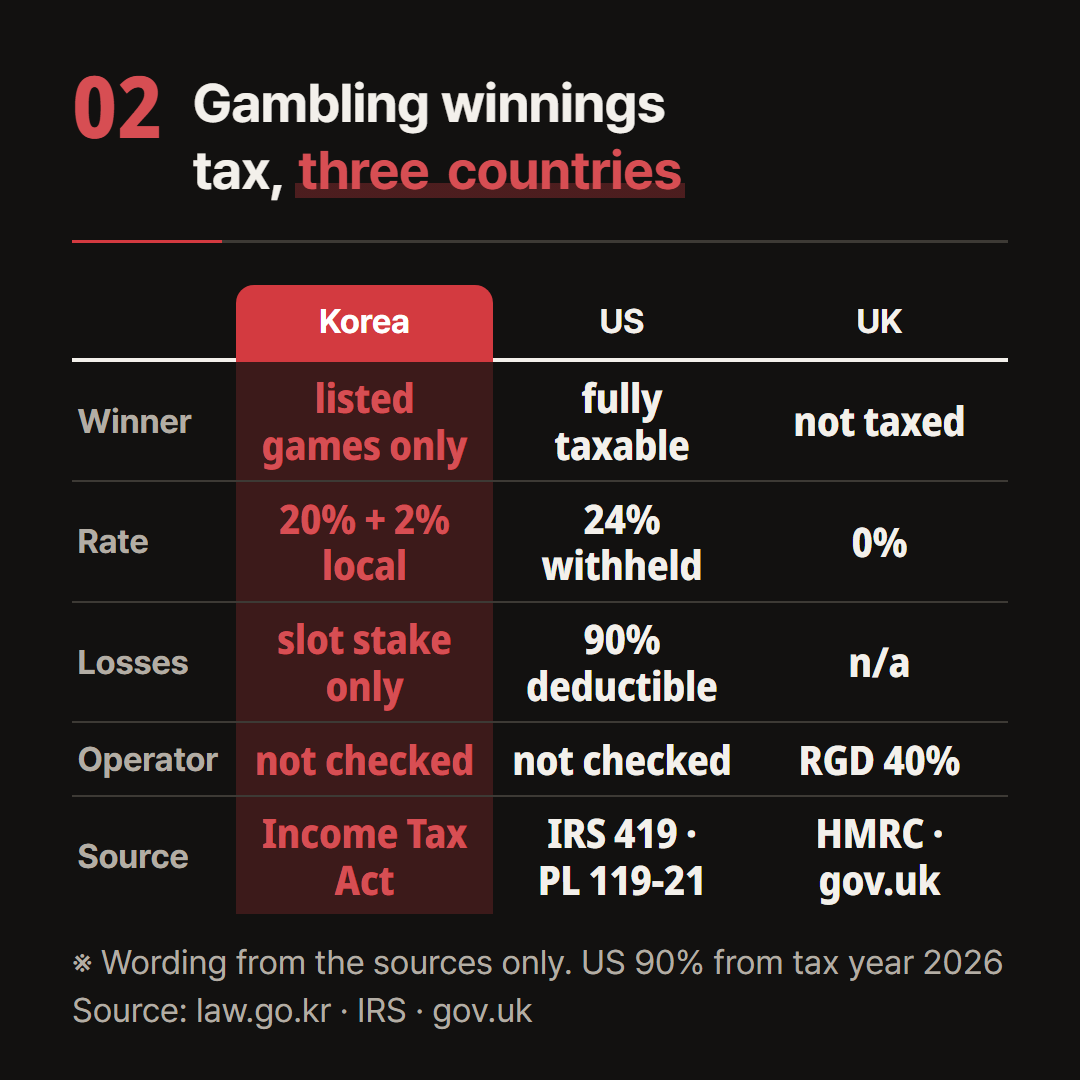
Korea: listed games only
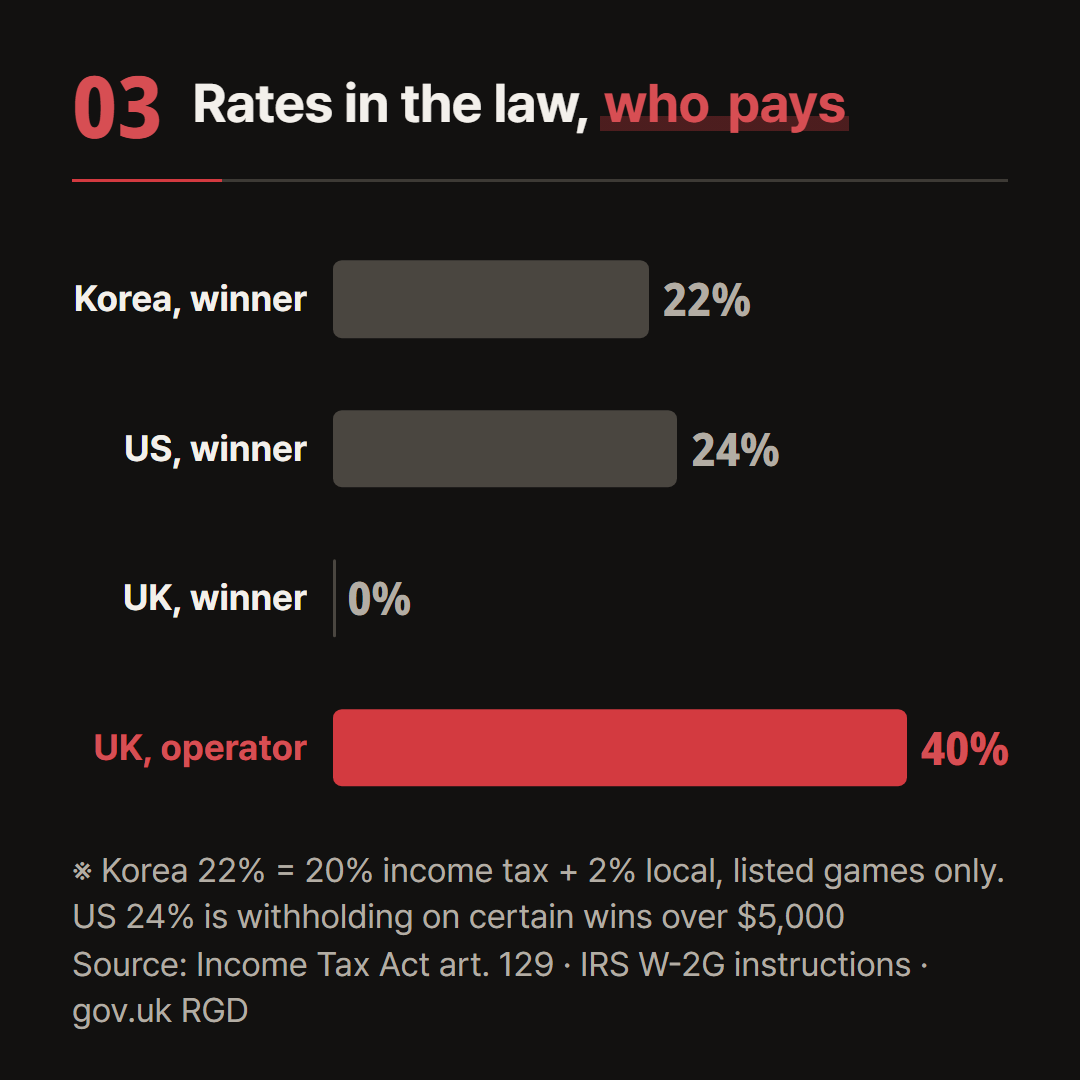
The winner pays, but only for the games written into the statute: lotteries, betting ticket refunds, slot machines. The rate is 22 percent, 33 percent on lottery winnings above 300 million won, and lottery winnings are not added to other income (article 14).
US: fully taxable, losses capped at 90 percent
The IRS says gambling winnings are fully taxable and must be reported on the return. Lotteries, horse races and casinos are all included (IRS Topic 419).
Withholding is 24 percent. The instructions for Form W-2G say to withhold at that rate when, for certain wagers, the winnings minus the wager are more than $5,000, and the minimum reporting threshold for payments made in 2026 is $2,000 (W-2G instructions).
Losses can be deducted only by itemising on Schedule A, and never beyond the gambling income reported. Under section 70114 of Public Law 119-21, from tax years beginning after 31 December 2025 only 90 percent of wagering losses can be deducted (Federal Register proposed rule).
The IRS guidance covers federal tax only. State income tax differs by state and was not checked here.
UK: winner 0 percent, operator 40 percent
HMRC's manual states that betting and gambling, as such, do not constitute trading. The next page adds that having a system for placing bets, or being successful enough to earn a living by gambling, does not make the activity a trade (HMRC BIM22015, BIM22017).
Capital gains tax is the same. Section 51 of the Taxation of Chargeable Gains Act 1992 says winnings from betting, lotteries or games with prizes are not chargeable gains (TCGA 1992 s.51).
The operator pays instead. Remote Gaming Duty is charged on the gaming provider's profits from remote gaming played by customers who usually live in the UK, and the rate is 40 percent from 1 April 2026. It was 21 percent from April 2019 (gov.uk Remote Gaming Duty).
Worked examples, all assumed
Every number below is an assumption. Expenses and other income are set to zero.
- Korea: a single lottery or slot machine win of 5 million won passes the 2 million won line. Income tax of 1 million won and local tax of 100,000 won come off, leaving 3.9 million won.
- US: a win of $10,000 after the wager, in a category subject to withholding, has $2,400 taken first. With $100,000 of wins and $100,000 of losses in a year, from 2026 the taxable income left is $10,000.
- UK: the winner pays no income tax or capital gains tax. The operator pays 40 percent of its profit.
3.Putting a baccarat site win against the table
All three columns describe a resident reading their own country's law. Which law applies is not something this post decides.
That is the first question.
Korea's statute does not name baccarat, the IRS guidance does not distinguish games, and the UK does not ask the winner. The same win is taxed in the hands of a different person in each of the three countries.

Before reading a tax table
- Country: the law being read is the one for the country of residence
- Item: which item of article 21 of Korea's Income Tax Act applies has been checked (baccarat is not listed)
- Line: Korea exempts lottery and slot wins of 2 million won or less per event; US withholding starts above $5,000
- Losses: in the US only 90 percent of losses are deductible from tax year 2026
- Criminal Act: in Korea article 246 makes gambling punishable and article 48 provides for confiscation
Hiddenpick is a Windows program that keeps on its server the betting rules that pick owners do not make public, and runs them as they are on the PC of the person who received them through a referral code. It currently runs on Evolution live baccarat at Stake (stake.com). The program does no tax calculation, and what it does and does not do is set out in the baccarat bot guide.
We are recruiting national pickster representatives, and those selected receive benefits worth $12,000, a one-year pass. Apply: https://hiddenpick.my/pickster
- 25,000+ real shoes collected and analysed since September 2026
- 90+ baccarat tables from the lobby on one screen · refreshed every 0.35s · seated 2 to 4 seconds after a click
- Stops by itself at your take-profit and stop-loss · tie several PCs into one team and stop on the total
- No browser extension · your money stays in your own Stake account · 12 languages