Baccarat multi table play: 4 tables mean 4 times the expected loss and twice the swing
2026-10-10
If you open two or four tables and bet on all of them at once, how does an hour of results change? Baccarat multi table play is a common question, and Google suggests it first when you type it.
This post works out, with real numbers, how hands, expected loss and swing each grow when the same amount goes on several tables. The short answer: expected loss grows with the number of tables, and swing grows with its square root.
1.What is baccarat multi table play?
Multi table play: betting on two or more open tables at the same time, each one separately.
At one table you wait between hands. In the shoes we collected, the median gap between hands was 26 seconds at speed tables and 37 seconds at regular tables.
Playing nonstop at one speed table gives about 138 hands an hour, and about 125 banker bets that are settled once ties are left out. Open four tables and the same hour settles about 500.
Only the hands per hour change.
2.Do results at different tables move separately?
How swing changes with more tables depends on how alike the tables are.
So we counted that first.
The data is 60,407 shoes with no breaks in the middle, collected from 96 tables between September 9 and October 8, 2026. Pairing results (ties left out) from two different tables within the same 10 seconds gave 33.9 million pairs.
Both tables landed on the same side 50.015% of the time. Treating the tables as unrelated and using the banker share gives 50.016%, and the correlation was -0.00001, which is zero for practical purposes.
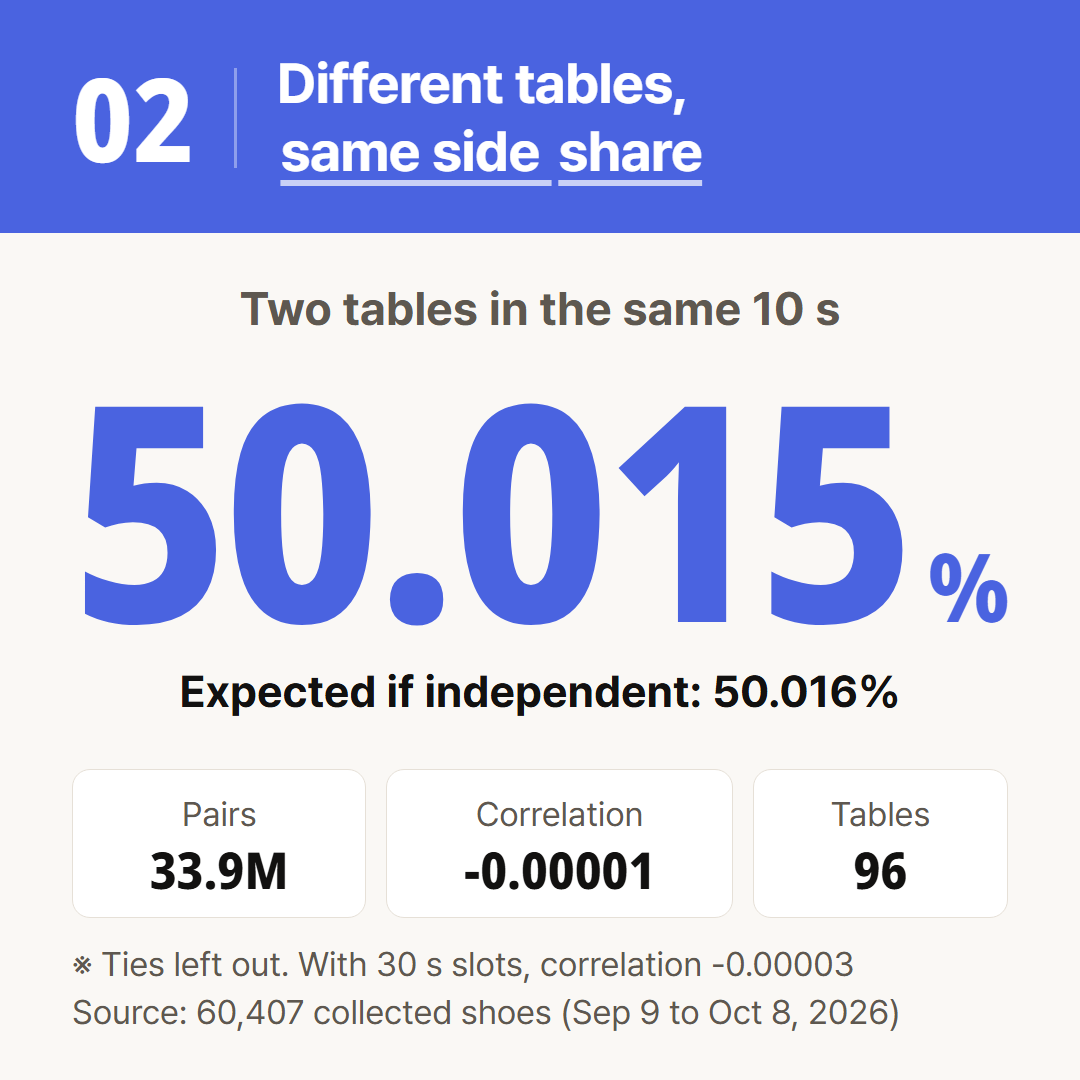
One table's result tells you nothing about the table next to it. The math below rests on that independence.
3.How do expected loss and swing grow with more tables?
The baseline is $10 on banker every hand ($10 and never skipping a hand are assumptions). In clean shoes, banker wins 50.68% of hands without ties, and each unit bet loses 1.15% on average.
The 8-deck theory values are banker 45.86%, player 44.62% and tie 9.52%. Take out ties and banker is 50.68% here too, so the collected shoes and the theory sit in the same place.
At one table for an hour, 125 × $10 × 1.15% means about $14 lost on average. The typical swing (standard deviation) is about $110. These are the same numbers as in our baccarat daily profit math.
Add tables and the two numbers move at different speeds.
- 2 tables: $2,500 bet in an hour, average -$29, swing $154
- 4 tables: $5,000 bet, average -$58, swing $218
- 8 tables: $10,000 bet, average -$115, swing $308
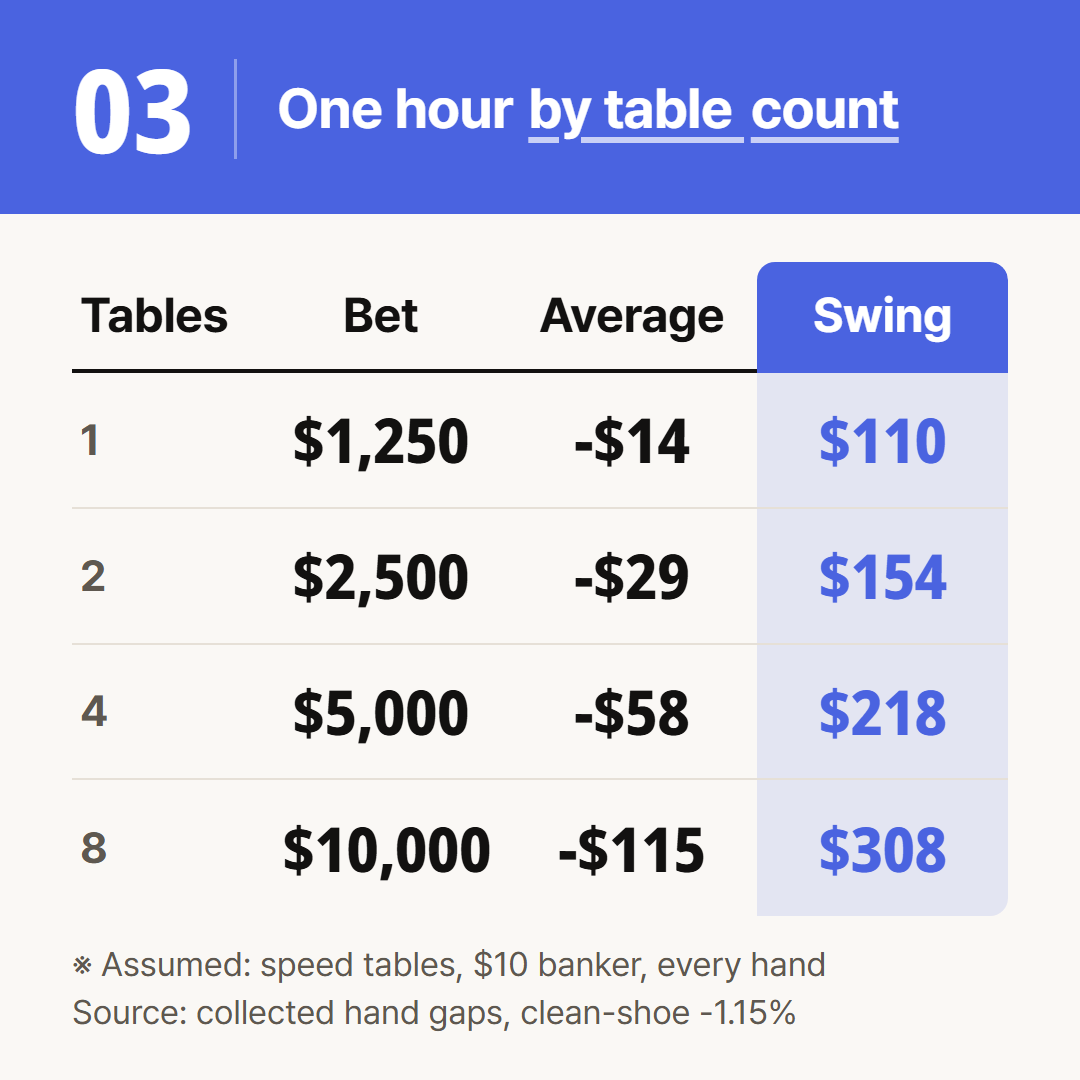
The average loss is directly proportional to the number of tables. Because results are independent, the swing grows only with the square root. Four tables mean four times the average and twice the swing.
Real shoes agree: in 25,133 shoes collected from September 9 to 24, the standard deviation of one shoe's result with a flat banker bet was 7.63 units. Adding two different shoes together gave 10.85 units. That is almost exactly 7.63 times √2, which is 10.79.
The average grows with the table count and the swing with its square root, so the more tables, the more the average drives the result. Using a normal approximation, the chance of being ahead after one hour looks like this.
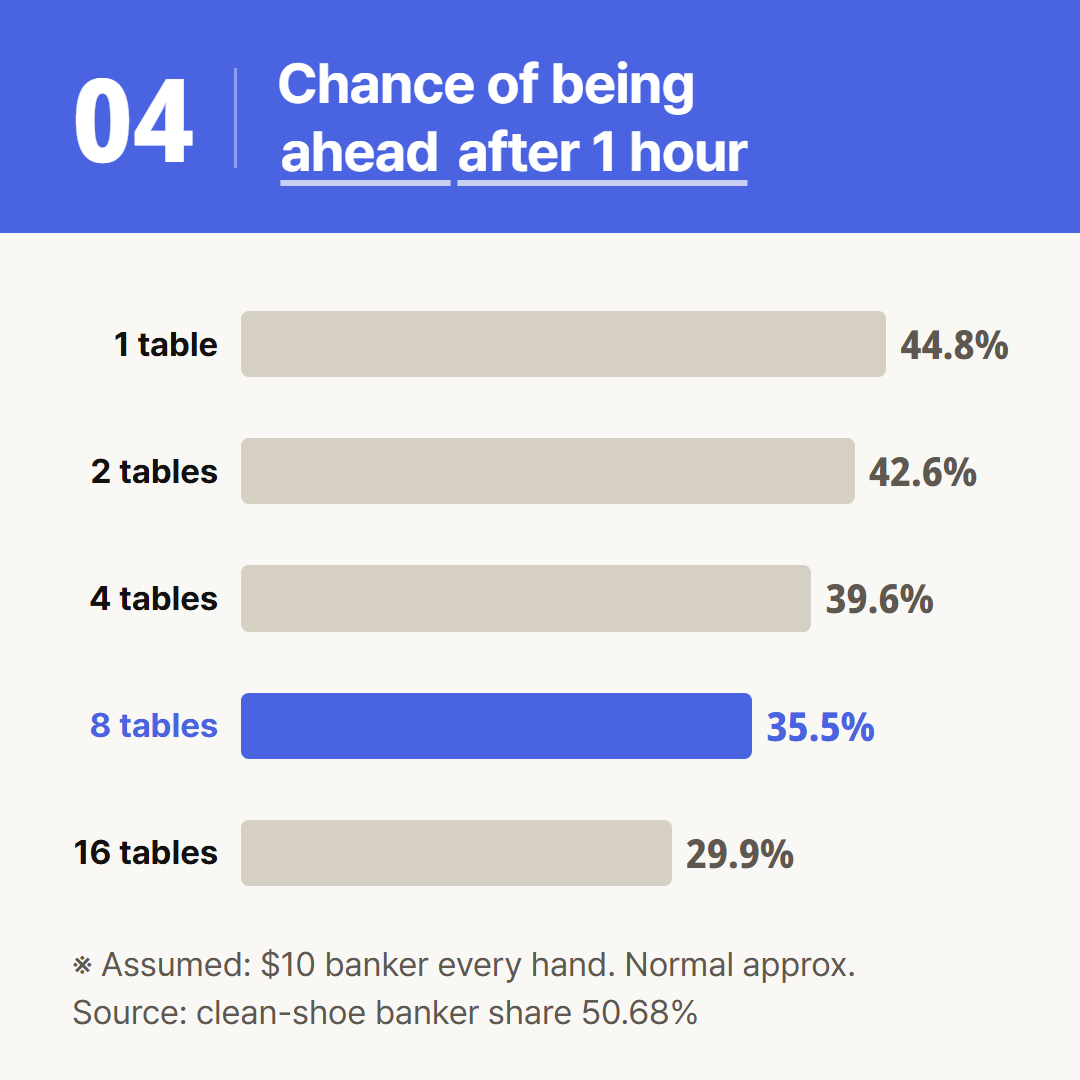
An hour at four tables is 500 settled bets, the same as four hours at one table. It delivers four hours of results inside one hour.

4.What if you split the same money across tables?
Another option is to add tables and lower the bet per hand.
Split $10 into $2.50 on each of four tables and an hour's total bet is $1,250, the same as $10 a hand at one table.
The average loss stays at about $14, and the swing halves to about $55. With the same total bet, the expected loss is the same; splitting only makes it swing less.
Each table has a minimum bet, so splitting has a limit. And if your hands cannot keep up and you skip hands, the real hands per hour fall below the math.
5.What to check before adding tables
Before multi table play
- Work out the total bet per hour first (tables × hands × amount)
- Count on losing about 1.15% of that total on average
- Build the square-root growth in swing into the stop loss line
- Reset the take profit and stop loss set for one table to fit the number of tables
- Do not use the run at the next table as a reason to bet at this one
Hiddenpick is a Windows program that keeps on its server the betting rules that pick owners do not make public, and runs them as they are on the PC of the person who received them through a referral code. It currently runs on Evolution live baccarat at Stake (stake.com). The bankroll needed when you change the table count and bet size can be checked first in the baccarat martingale calculator. We are recruiting national pickster representatives, and those selected receive benefits worth $12,000, a one-year pass (apply at hiddenpick.my/pickster).
- 25,000+ real shoes collected and analysed since September 2026
- 90+ baccarat tables from the lobby on one screen · refreshed every 0.35s · seated 2 to 4 seconds after a click
- Stops by itself at your take-profit and stop-loss · tie several PCs into one team and stop on the total
- No browser extension · your money stays in your own Stake account · 12 languages