Crypto trading bot taxes in Korea: how will South Korea tax bot profits from 2027? The Income Tax Act, article by article
2026-10-26

The short answer
- Income from transferring or lending coins is virtual asset income under Article 21(1)27 of Korea's Income Tax Act, and the statute never asks whether a person or a program placed the order
- The tax is 20% of the year's virtual asset income above 2.5 million won, plus a 2% local income tax
- The start date set by the transitional provisions is 1 January 2027, and it applies to transfers and loans made on or after that day
Ask how crypto trading bot taxes work in Korea and most answers stop at one number, 22%.
We went to the statute text to see which article produces that 22%, how a bot's hundreds of trades a year are counted, and when the rule starts.
Nothing beyond the wording of the law is added.
1.What kind of income is a bot's profit?
Article 21(1)27 of the Income Tax Act calls income from transferring or lending a virtual asset, as defined in the Virtual Asset User Protection Act, virtual asset income, and files it under other income (Income Tax Act Art. 21).
Who placed the order is not in the text.
Even when a program buys and sells on its own, the tax law sees only the fact of a transfer.
Virtual asset income: income from transferring or lending a virtual asset, the name used in Article 21(1)27.
Article 14(3)8(c) keeps this income out of the global income tax base as separately taxed other income (Income Tax Act Art. 14). It is computed on its own instead of being stacked on salary or business income under the progressive scale.
2.Why nothing in 2026, and 2027 onward?
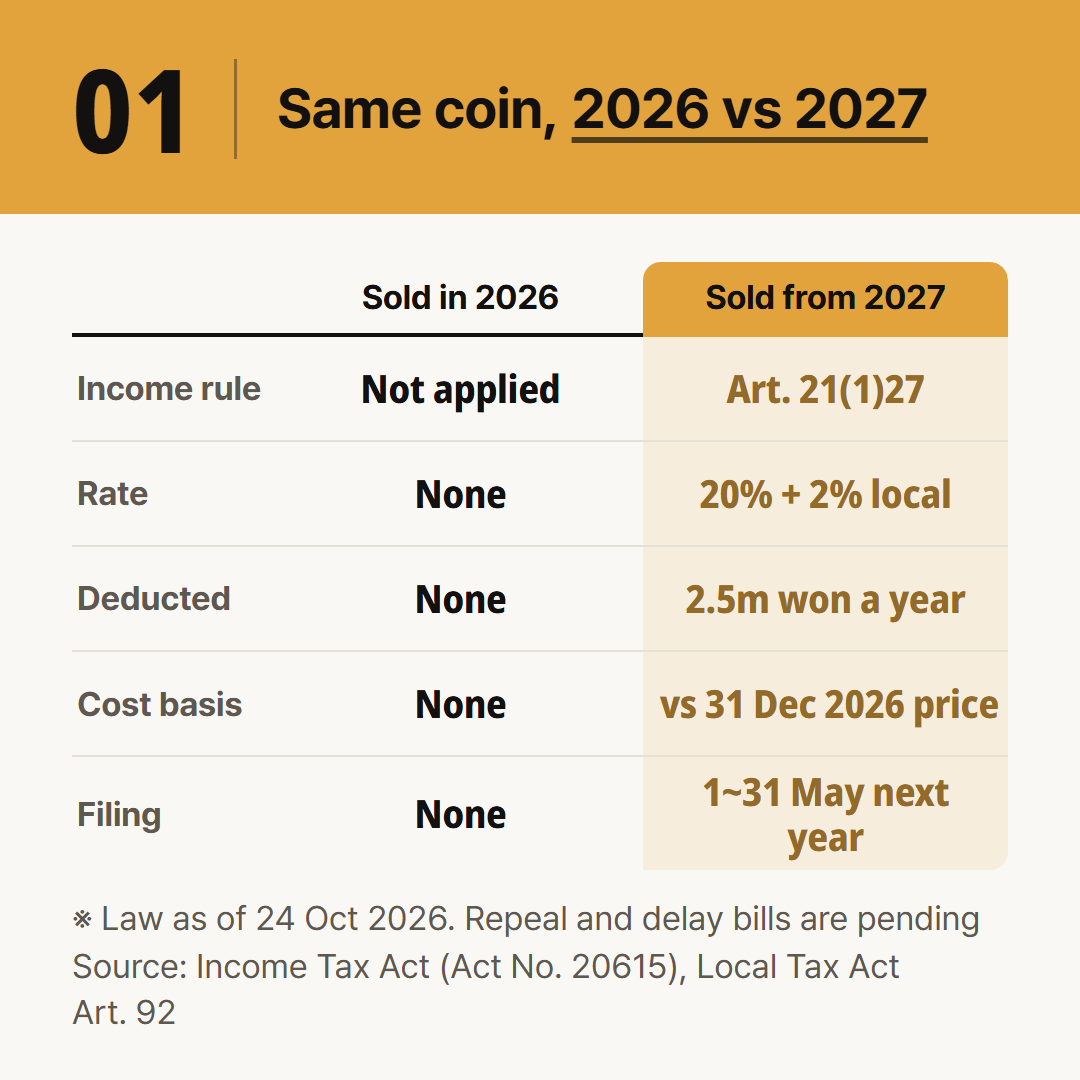
The virtual asset clause entered the Act on 29 December 2020 as Act 17757. Its Addenda Article 1(2) gave the virtual asset amendments, Article 21(1)27 together with Articles 37, 64-3 and 84, their own start date, and amendments on 8 December 2021, 31 December 2022 and 31 December 2024 pushed that date back.
The date now written in is 1 January 2027.
The Addenda of Act 20615 of 31 December 2024 replaced 1 January 2025 with 1 January 2027 (Income Tax Act, Act 20615 version). The point of application is in the Addenda too.
Addenda Article 5(1) of Act 17757 applies the rule to virtual assets transferred or lent on or after 1 January 2027. Coins sold within 2026 are outside this clause.
Bills to delete the clause or delay it to 2030 are pending; the government holds to 2027 (Financial News, 11 Aug 2026).
3.How much, and why hundreds of bot trades are one calculation
Income: proceeds minus cost and incidental costs
The other income amount is gross receipts minus necessary expenses (Article 21(3)). For virtual assets, Article 37(1)3 defines those expenses: the actual acquisition price of the asset transferred, plus the incidental costs of acquiring, transferring or lending it (Income Tax Act Art. 37, 2027 version).
Assume a bot bought and sold 300 times in a year: the year's virtual asset income is the sum of 300 sale prices minus 300 acquisition prices and incidental costs, with no tax paid trade by trade. The unit the statute counts is the tax period, which is one year.
Winning and losing trades offset each other within the same year. When a whole year ends in a loss, however, the text has no wording that carries that loss into the next year.
The 31 December 2026 price line
Coins held before 2027 get a separate cost basis. Article 37(5) sets the acquisition price of a virtual asset already held before 1 January 2027 at the larger of its market price on 31 December 2026 and its actual acquisition price.
If a bot bought a coin for 1 million won in 2026 and it stands at 3 million won on 31 December, the cost basis is 3 million won (assumed). For coins bought from 2027 whose actual cost is hard to confirm, paragraph 6 allows a ratio set by Presidential Decree, within 50% of total proceeds, as the expense, and incidental costs are not added on top.
Subtract 2.5 million won, then 20%, then 2%
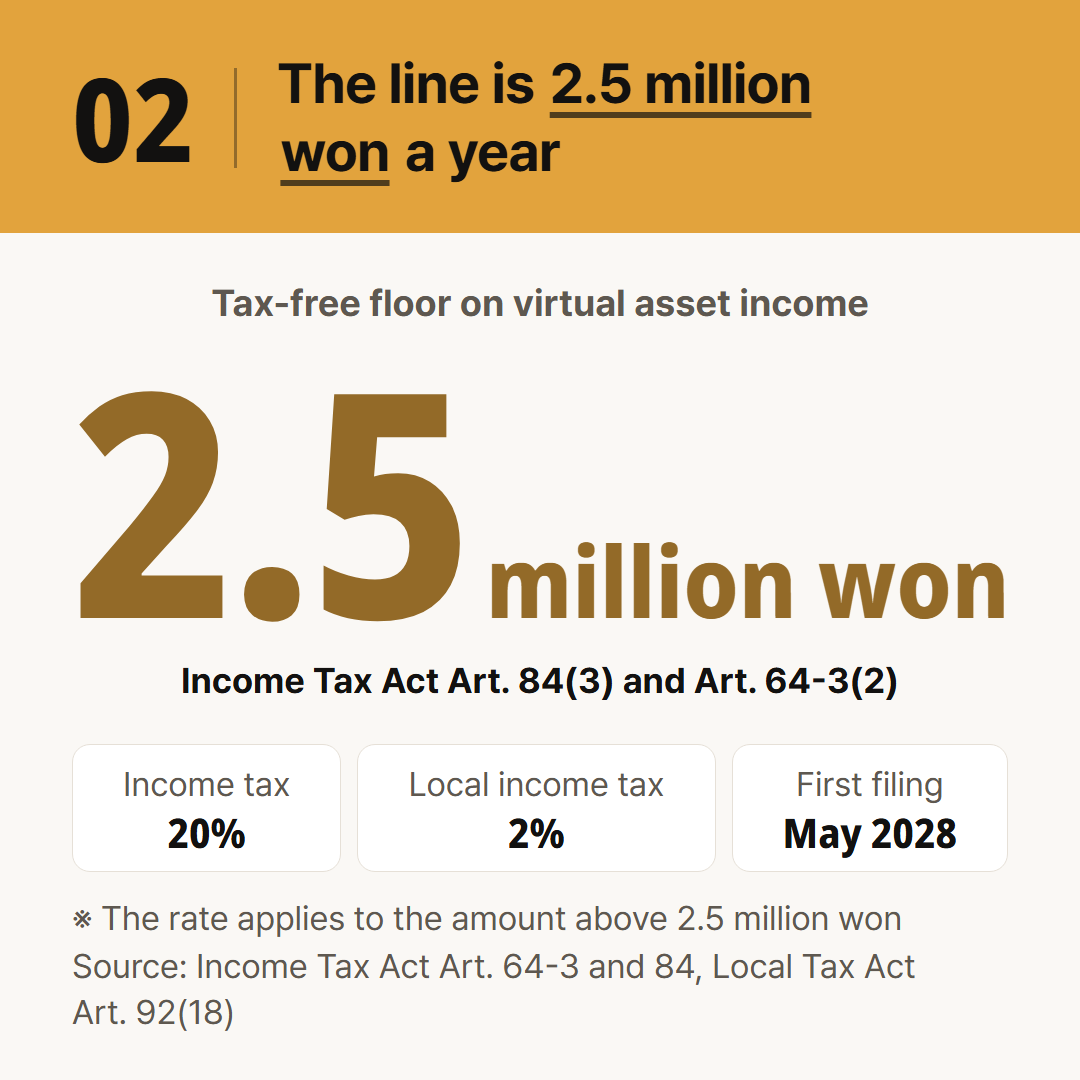
Article 84(3) says no income tax is charged when virtual asset income for the tax period is 2.5 million won or less (Income Tax Act Art. 84). Above that, Article 64-3(2) sets the tax: the virtual asset income amount minus 2.5 million won, multiplied by 20/100.
The local income tax sits in Article 92(18) of the Local Tax Act. The same income minus 2.5 million won is multiplied by 20/1000 (Local Tax Act, 2027 version).
Together that is 22%.
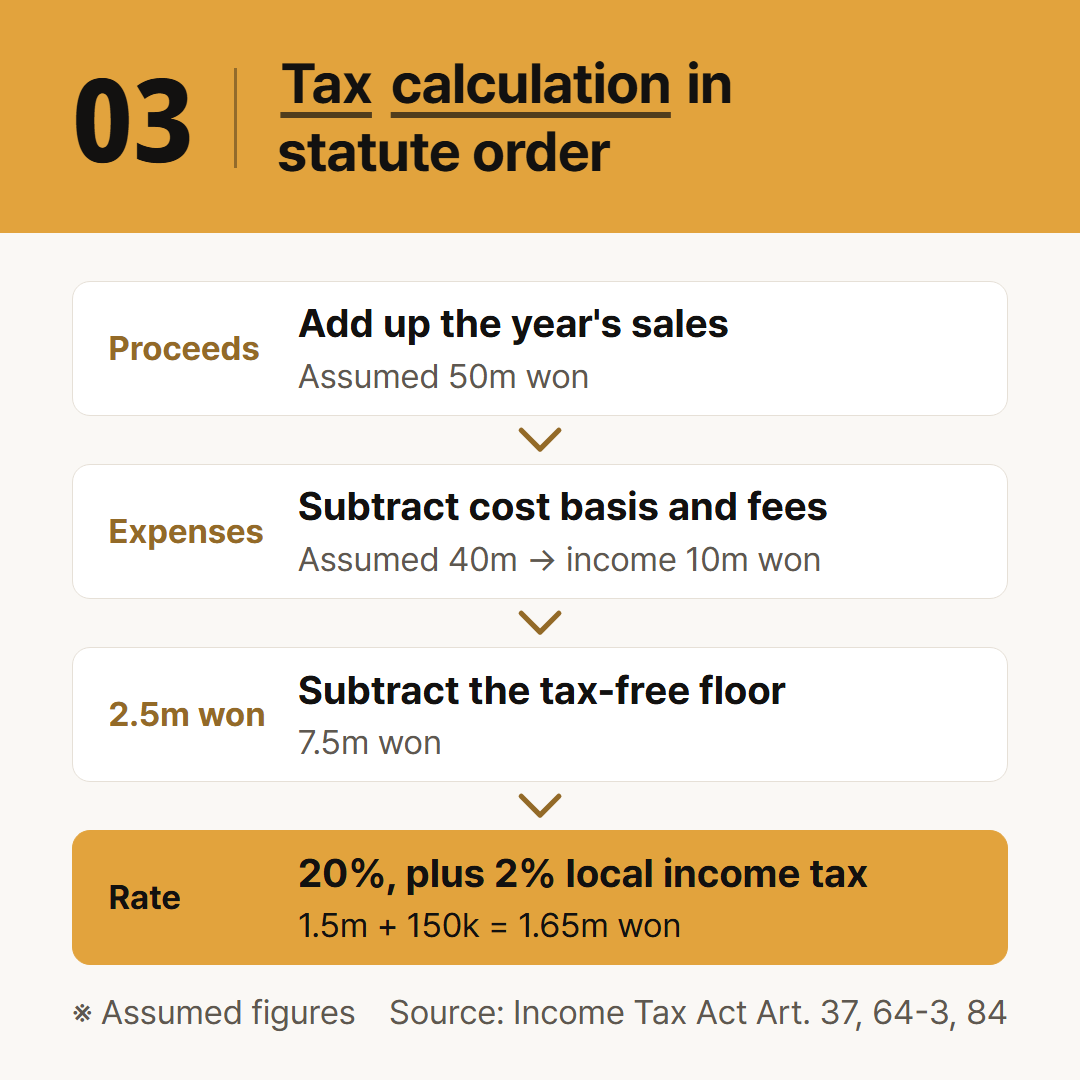
An assumed calculation. If a bot's sales in 2027 total 50 million won and its acquisition prices and incidental costs total 40 million won, virtual asset income is 10 million won. Minus 2.5 million won leaves 7.5 million won, and the bill is 1.5 million won of income tax plus 150,000 won of local income tax, 1.65 million won in all.
On the same assumptions, income of exactly 2.5 million won gives zero for both taxes. How far exchange fees count as incidental costs is left to the Presidential Decree, so this post does not settle it.
4.Who files, and when?

Article 70(1) has residents with global income file between 1 May and 31 May of the following year, and paragraph 2 applies paragraph 1 where there is income under Article 21(1)27 (Income Tax Act Art. 70). 2027 income is filed in May 2028 by the person who earned it.
The National Tax Service has given the same timetable. In April 2026 the head of its individual taxation bureau said it was preparing to take returns from the May 2028 global income tax filing, and reports said it would collect data from the exchanges (edaily, 29 Apr 2026).
No article hands the filing duty to an exchange or to the program. If a bot moved across several exchanges, the records that match acquisition prices to sale prices have to be in the owner's hands.
5.Questions that come up
Q.The bot did the trading, so is it business income?
A.Article 21(1)27 calls income from transfers and loans virtual asset income and does not ask who placed the order. We found no article treating it as another income type.
Q.Does money made in 2026 get filed in 2027?
A.Addenda Article 5 applies the rule to transfers and loans on or after 1 January 2027. 2026 transfers are outside this clause.
Q.What if the coins are just held?
A.The clause attaches to income from transferring or lending. There is no wording that taxes holding itself.
Q.Is the 2.5 million won per trade?
A.It is per tax period, that is, per year of virtual asset income. The number of trades does not matter.
Hiddenpick is a Windows program that keeps on its server the betting rules that pick owners do not make public, and runs them as they are on the PC of the person who received them through a referral code. It currently runs on Evolution live baccarat at Stake (stake.com). A crypto trading bot and an automated baccarat bettor are different programs, and what Hiddenpick does and does not do is set out in the baccarat betting bot guide.
We are recruiting national pickster representatives, and those selected receive benefits worth $12,000, a one-year pass. Apply: https://hiddenpick.my/pickster
- 25,000+ real shoes collected and analysed since September 2026
- 90+ baccarat tables from the lobby on one screen · refreshed every 0.35s · seated 2 to 4 seconds after a click
- Stops by itself at your take-profit and stop-loss · tie several PCs into one team and stop on the total
- No browser extension · your money stays in your own Stake account · 12 languages