Crypto Trading Bot Strategy: 5 Checks Before You Turn On an Averaging-Down Bot
2026-10-09
$255,000. That is what a crypto trading bot strategy that doubles every buy spends by its eighth order, if it starts with $1,000 and buys at every 5% below the first price. The same eight buys at $1,000 each cost $8,000, and both figures are assumed.
A search for crypto trading bot strategy brings up DCA bots and grid trading bots first. They buy in pieces as the price falls. A few numbers you type into the settings decide how much money the bot will use.
This post turns those numbers into five checks to make before you switch one on. Every price and amount here is an assumption for the math. It is not a recommendation of any coin or bot.
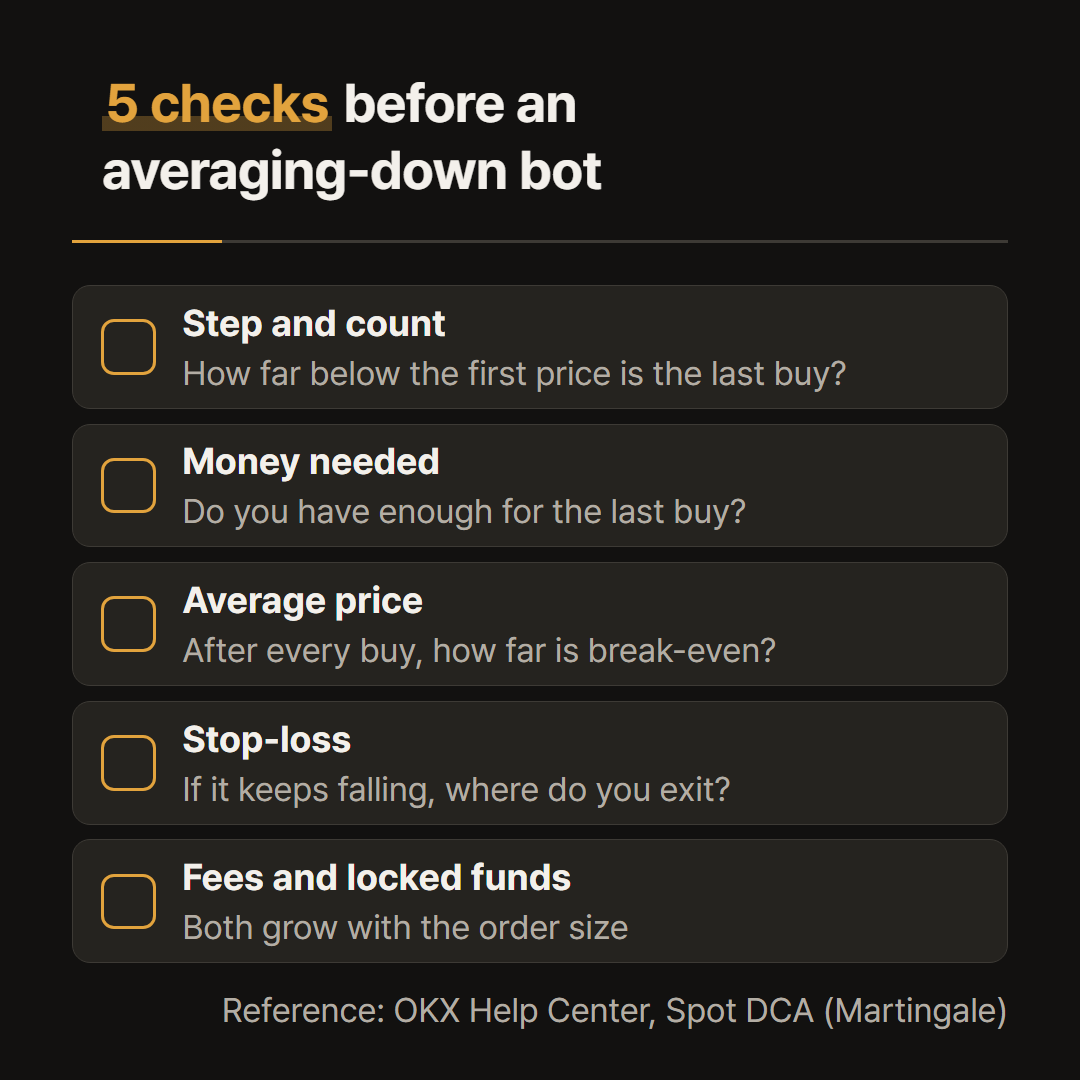
1.How far down does it buy, and how many times?
The OKX Help Center explains this kind of bot under the name "Spot DCA (Martingale)" and says Martingale is one form of DCA (OKX Help Center).
Three of its settings tie directly to money.
- Price steps: the percentage gap between two consecutive safety orders
- Max safety orders: the most extra buys allowed in one cycle
- Amount multiplier: applied to the size of the next safety order. With 2, the orders go 100, 200, 400 USDT
This post assumes one buy at 5%, 10%, 15% and so on below the first price, eight buys in all including the first. The eighth buy sits 35% below the starting price. Below that, the bot buys nothing more.
2.Money needed for the last buy: same size or double size
Same steps, same eight buys, yet one multiplier puts the two totals far apart. Both start with a $1,000 first buy.
- Same size: $1,000 eight times, $8,000 in total
- Double size: $1,000, $2,000, $4,000 and up, $128,000 for the eighth buy alone, $255,000 in total
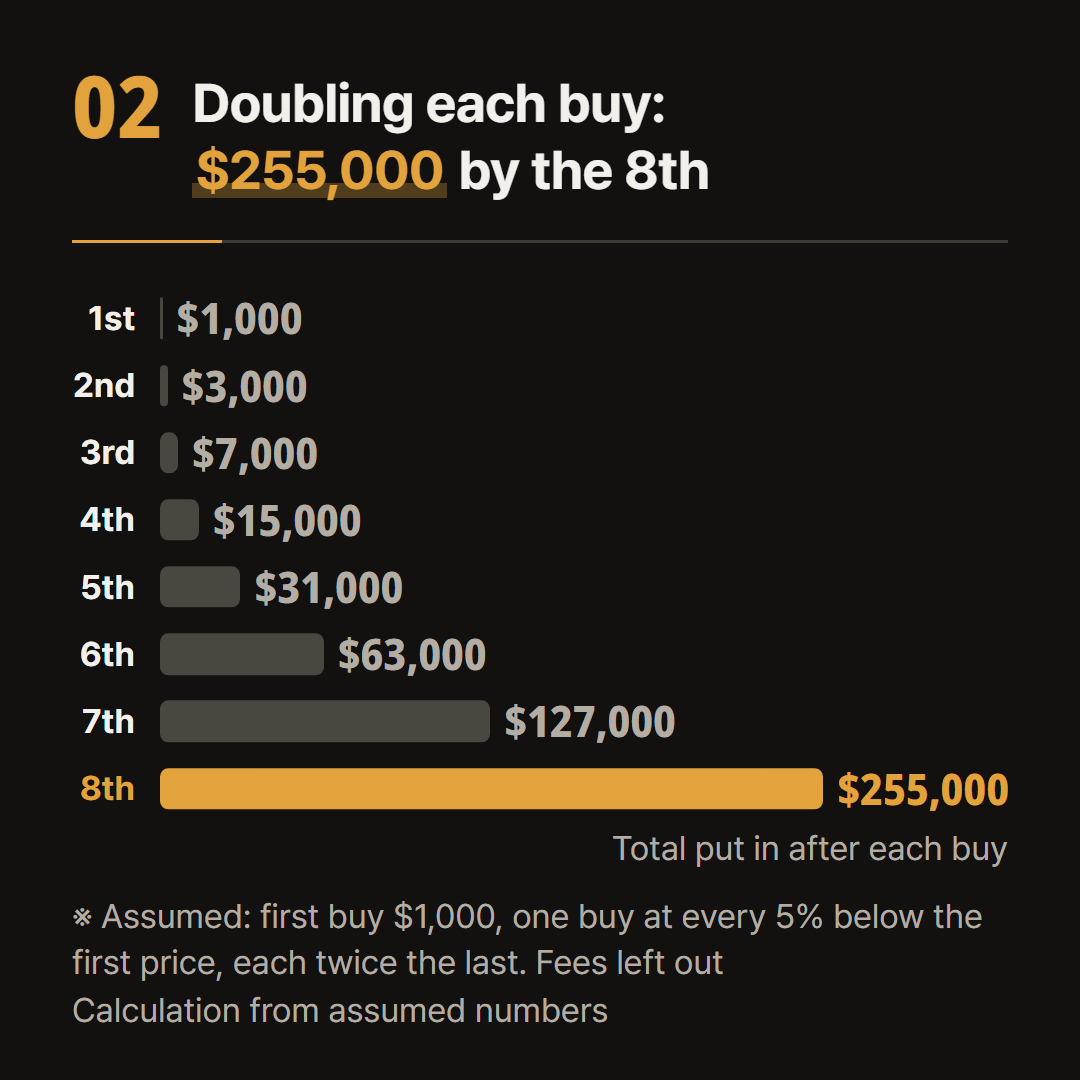
When every order doubles, the next buy costs more than everything spent before it. Seven buys add up to $127,000, then the eighth one asks for $128,000 on its own.
Short of money, the bot cannot finish its planned buys. The OKX page itself notes that the number of safety orders actually placed may depend on your margin.
Say you have $10,000.
- Same size: $8,000 covers all eight buys. The last one is at a price of 65
- Double size: three buys use $7,000. The fourth needs $8,000 more, so its last buy is at 90
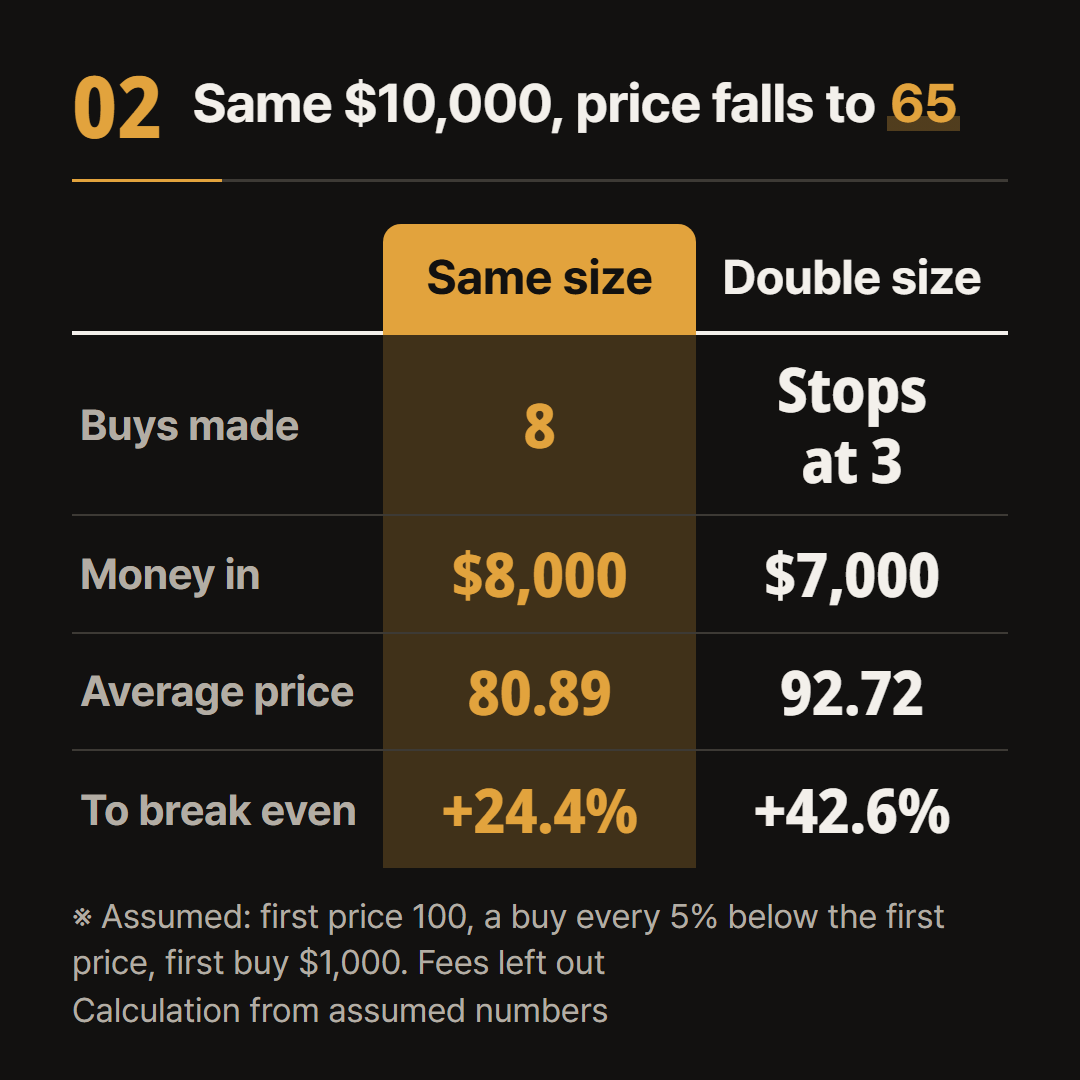
At 65, the same-size side has an average price of 80.89 and needs a 24.4% rise to break even. The double-size side ran out of money, so its average stays at 92.72 and it needs a 42.6% rise.
If you can fund all eight doubled buys, the average falls to 69.30 and a 6.6% rise gets you back to even. Getting there takes $255,000, which is 255 times the first buy.
OKX's own risk note says the amount spent with this strategy can grow fast after just a few trades, and that a long decline makes it worse.
The Martingale in baccarat is the same doubling idea, so we ran a banker-only version that doubles after each loss over 25,133 real shoes we collected. Eight losses in a row, which costs 255 times the first bet, came up 9.2 times per 100 shoes. With six steps, each wipe-out shrinks to 63 times the first bet and the count rises to 39.1.
3.How far does the average price come down?
Here is the same-size bot, buy by buy.
- 2nd buy: price 95, average 97.44, 2.6% to break even
- 4th buy: price 85, average 92.16, 8.4% to break even
- 8th buy: price 65, average 80.89, 24.4% to break even
The price drops 5 points per buy while the average drops less than 3. So the gap to break-even widens with every buy. Writing that gap next to the average price on the bot screen makes the picture clearer.
4.If it keeps falling after the last buy, where do you exit?
Once the max number of buys is used up, the bot stops buying. From there, the stop-loss is what cuts the loss. OKX warns that an asset can fall to zero and take the whole holding with it, and suggests setting stop-loss orders.

Now assume the price falls to 50, half the start.
- Same size, $8,000 in: paper loss $3,055, or 38.2%
- Double size, $255,000 in: paper loss $71,010, or 27.8%
The doubling side loses a smaller share but 23 times the money. Set the stop-loss before launch with that dollar figure in view.
Per the OKX page, stopping the bot cancels open orders and sells your crypto at market price.
5.Fees and money locked in the bot
Fees grow with the order size too. At the 0.1% spot fee Binance lists for a regular user, the doubled eight buys pay $255 on the buy side alone, against $8 for the same-size bot (Binance fee schedule).
On OKX, the money you put into a bot is isolated from your trading account and used only for bot trading. It returns to the trading account only after you stop the bot and the coins are sold.
Three lines
- One multiplier decides whether eight buys need $8,000 or $255,000 (assumed)
- A doubling bot without enough money misses its planned buys and lowers the average less
- Write down the stop-loss and the fees before you switch it on
Hiddenpick is a Windows program that keeps on its server the betting rules that pick owners do not make public, and runs them as they are on the PC of the person who received them through a referral code. It currently runs on Evolution live baccarat at Stake (stake.com). The money each doubling step needs in baccarat is laid out in the baccarat Martingale calculator.
- 25,000+ real shoes collected and analysed since September 2026
- 90+ baccarat tables from the lobby on one screen · refreshed every 0.35s · seated 2 to 4 seconds after a click
- Stops by itself at your take-profit and stop-loss · tie several PCs into one team and stop on the total
- No browser extension · your money stays in your own Stake account · 12 languages