Astrology side hustle with AI: a 30,000 won reading sold on Kmong leaves 23,499 won, with fees, confirmation and registration in Q&A
2026-10-12
If you make saju readings (Korean four pillars fortune-telling) with AI, list one on Kmong for 30,000 won and sell it, how much do you keep? Following Kmong's own help center notice, the answer is 23,499 won.
The other 6,501 won is the service fee, the payment network fee and VAT. Here we follow one sale until it is withdrawn, as questions and answers, using only official notices.
1.What do saju automation side hustle videos show first?
On October 10, 2026, searching YouTube in Korean for the saju automation side hustle, three of the top five videos put a daily or monthly amount in the title. Their views add up to 25,821.
Typing saju side hustle into Google Korea brings up "saju side hustle reviews", and typing saju Kmong brings up "Kmong saju" first. Plenty of people think of Kmong, a Korean freelance marketplace, as the place to sell.
The amount in a video title is revenue.
The platform's cut and the day money reaches a bank account are written down separately, in help center documents. Once both are taken out, the same revenue leaves a different amount in hand, and the gap grows as the number of sales grows.
2.How much comes off a single sale on Kmong?
For orders from July 1, 2024, Kmong takes its sales fee in three parts: a service fee on the sale amount split into tiers, a payment network fee of 3.3% of the sale, and 10% VAT on the two added together (Kmong service fee notice).
- Tier 1: up to 700,000 won, 16.4%
- Tier 2: above 700,000 up to 2 million won, 9.4%
- Tier 3: the part above 2 million won, 4.4%
Tiered fee: each band of a sale gets its own rate, so a 3.5M won sale still pays 16.4% on its first 700,000 won.
A 30,000 won saju reading stays inside tier 1. The service fee is 4,920 won, the payment network fee 990 won and VAT 591 won, leaving 23,499 won.
Any sale of 700,000 won or less loses 21.67%, whatever the amount.
A 50,000 won reading and a 500,000 won one lose the same share.
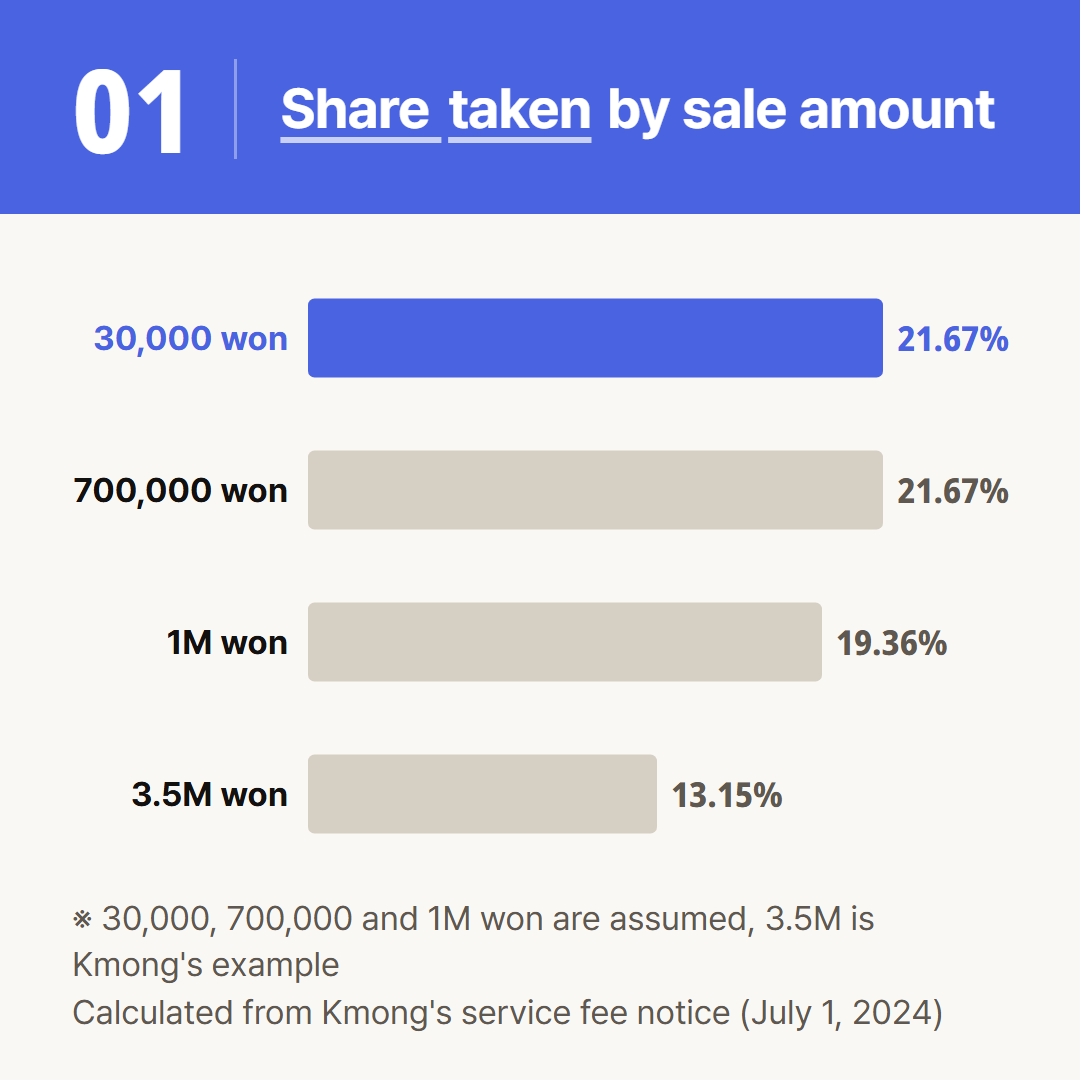
The share only falls when a single sale gets bigger. In the notice's example, a 3.5 million won sale loses 460,350 won and pays out 3,039,650 won, so the cut shrinks to 13.15%.
Automation mostly raises the number of sales. The notice applies the tiers to the amount of one sale, so selling ten 30,000 won readings a day still loses 21.67% on each one.
The notice also says whether and how the fee applies can differ by category. The amount actually paid is best checked again on the earnings screen in My Kmong.
Buyers pay their own fee too. Kmong raised its buyer fee from June 1, 2025, and says it is added automatically to the service price once per payment (buyer fee notice).
The total a buyer sees at checkout is larger than the listed price. Look at that checkout total when setting a price.
3.When can the money from a sale be withdrawn?
Kmong's seller guide says that once the client checks the delivery and confirms the purchase, the amount minus fees is settled as earnings (new seller guide).
If the client does not respond at all, the purchase is confirmed automatically after 7 days. Even with no reply after a reading is delivered, it turns into earnings within a week.
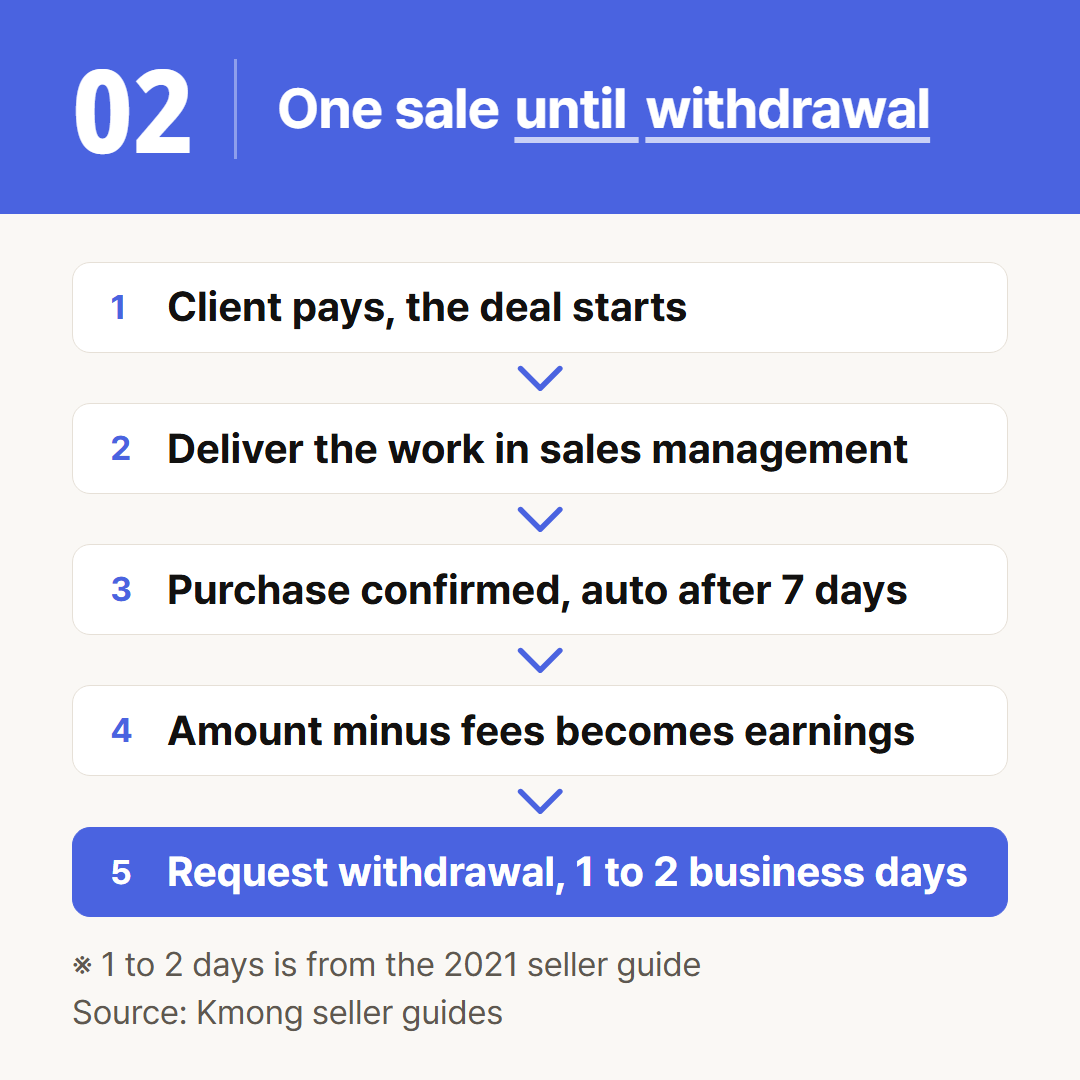
Settled earnings are withdrawn by requesting it under earnings in sales management. Kmong's 2021 seller guide says the money goes to the verified account within 1 to 2 business days of the request (Kmong seller guide).

4.Does a seller need to register as a mail-order business?
Kmong's notice says selling services on Kmong counts as mail-order business under Korea's e-commerce consumer protection act. Sellers who meet the conditions must register before selling (Kmong mail-order notice).
A seller is exempt if either of these applies.
- Transactions: fewer than 50 mail-order transactions in the previous year (cancelled ones not counted)
- Tax type: a simplified VAT taxpayer under the VAT act
One sale a week for a year makes 52.
One sale a day reaches 50 on day 50.
5.Where does selling AI-made readings run into trouble?
Kmong's list of services that cannot be sold has no fortune-telling item (Kmong banned services). The trouble is in how sales get boosted.
The same list bans services that write purchase reviews by faking a real deal, and services that write reviews without disclosing a financial tie. Paying for a first review runs straight into that list.
Contacting buyers outside Kmong, or anything that could lead to direct payment, is also banned. The seller guide says sales can be stopped without warning or use restricted for up to 365 days.
Kmong does not hold the money in a deal paid directly outside it, so it cannot help in a dispute.
6.So what should be calculated first?
Take 21.67% off the price of each sale first, and decide on mail-order registration before sales reach 50.
Hiddenpick is a Windows program that keeps on its server the betting rules that pick owners do not make public, and runs them as they are on the PC of the person who received them through a referral code. It currently runs on Evolution live baccarat at Stake (stake.com). That a program running on its own still cannot change the odds of the game is explained in the baccarat auto betting program guide. We are recruiting national pickster representatives, and those selected receive benefits worth $12,000, a one-year pass (apply at hiddenpick.my/pickster).
- 25,000+ real shoes collected and analysed since September 2026
- 90+ baccarat tables from the lobby on one screen · refreshed every 0.35s · seated 2 to 4 seconds after a click
- Stops by itself at your take-profit and stop-loss · tie several PCs into one team and stop on the total
- No browser extension · your money stays in your own Stake account · 12 languages