Baccarat odds chart, the full-shoe calculation and real collected shoes side by side in one table
2026-10-24
The short answer
- Running every card order in an 8-deck shoe gives Banker 45.86%, Player 44.62% and Tie 9.52%
- With payouts added, the loss per bet spreads out to Banker -1.06%, Player -1.24% and Tie -14.36%
- Counts from 54,628 real clean shoes came out at Banker 45.86%, Player 44.63% and Tie 9.52%, the same as the calculation
Search for baccarat odds and most pages stop at three house-edge lines.
Where those numbers come from, and whether real hands actually land there, is left blank. So we put two things in one table: the values we calculated ourselves from the 8-deck rules, and the values we counted in 54,628 real shoes we collected.
1.The baccarat odds chart, one page
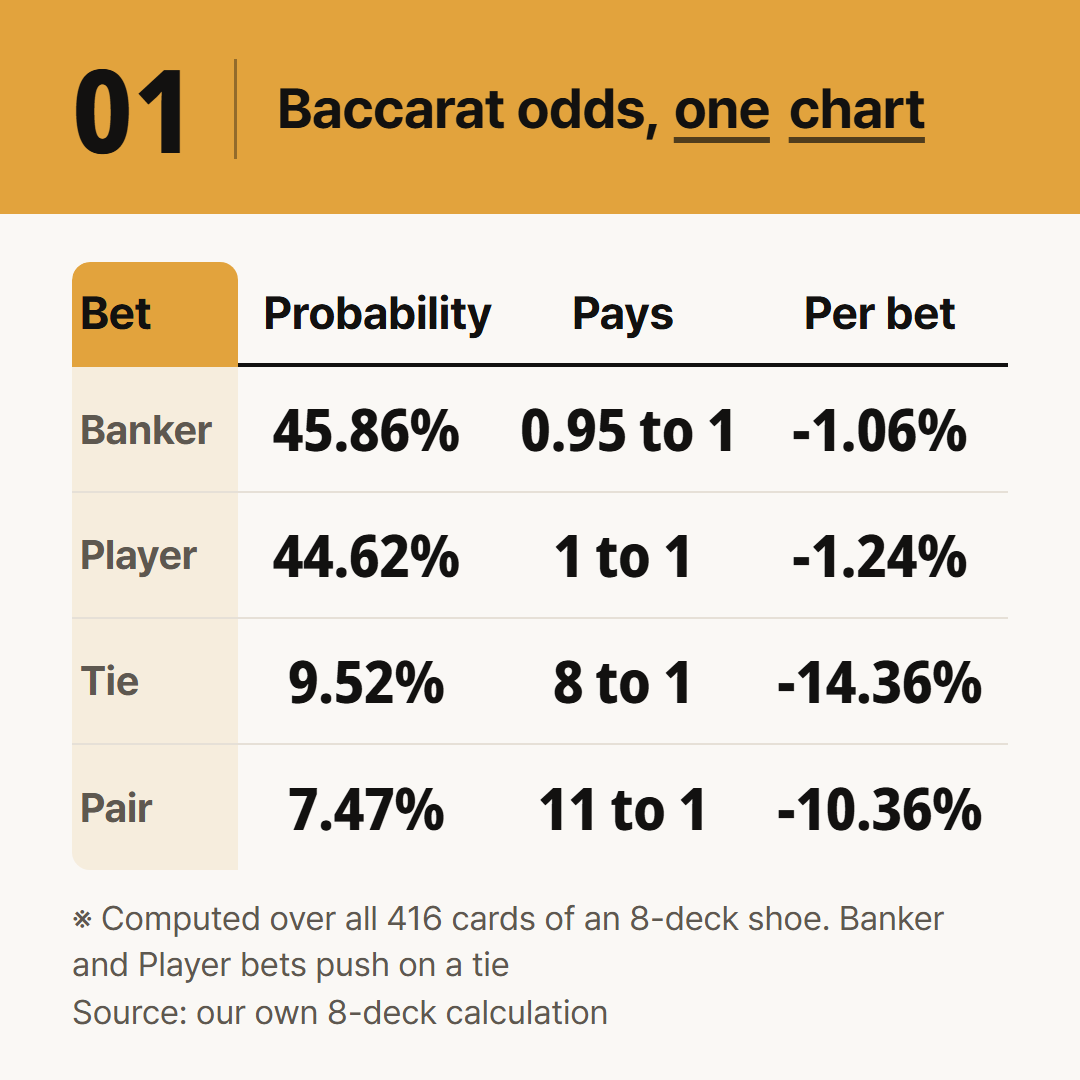
The four positions are Banker, Player, Tie and Pair. Probability is how often that position wins, the payout is what a winning bet receives on top of the stake, and the right-hand column is the average that remains per bet when the same amount is wagered for a long time.
House edge: the share of each bet that stays with the casino as a long-run average. The per-bet result, sign flipped.
2.What falls out of all 416 cards
Evolution baccarat uses eight decks, 416 cards. Each deck holds four of every value from 1 to 9 and sixteen zero-value cards (10, J, Q, K), so zero-value cards make up 30.8% of the shoe. Those counts are the starting point of every figure here.
The calculation walks every possible order from the Player's first card to the Banker's third. Each draw multiplies in the chance from the cards still left, and the third-card rules decide whether to draw or stand. Adding the probability of every path gives exactly 1.
The result is Banker 45.86%, Player 44.62% and Tie 9.52% (calculated).
Leaving ties out and counting only decided hands, it is Banker 50.68% and Player 49.32%. Those two numbers are the answer when someone asks for the Banker and Player odds.
Banker wins slightly more often because of the third-card rules. The Player always draws on a two-card total of 5 or less, while the Banker decides after seeing the Player's third card. The side that moves last has the edge.
Add the payouts and the positions separate
Probability alone does not say which position is better. The payout has to be multiplied in. In Evolution's standard rooms, Banker pays 1 to 1 less a 5% commission, so 0.95, Player pays 1 to 1 and Tie pays 8 to 1.
Put one unit on each position. A tie returns the stake on Banker and Player bets, so it counts as zero.
- Banker: 45.86% × 0.95 - 44.62% × 1 = -1.06%
- Player: 44.62% × 1 - 45.86% × 1 = -1.24%
- Tie: 9.52% × 8 - 90.48% × 1 = -14.36%
Even after the commission, Banker loses 0.18 points less per bet than Player. Rooms that pay the tie at 9 to 1 bring it down to -4.84%, still more than four times the Banker figure.
A pair wins when the first two cards of that side share a rank. Whatever the first card is, 31 of the remaining 415 match it, so the probability is 7.47%, and at 11 to 1 the result is -10.36% (calculated).
All four positions carry a minus sign. They only lose at different speeds.
3.What 50,000 real shoes showed
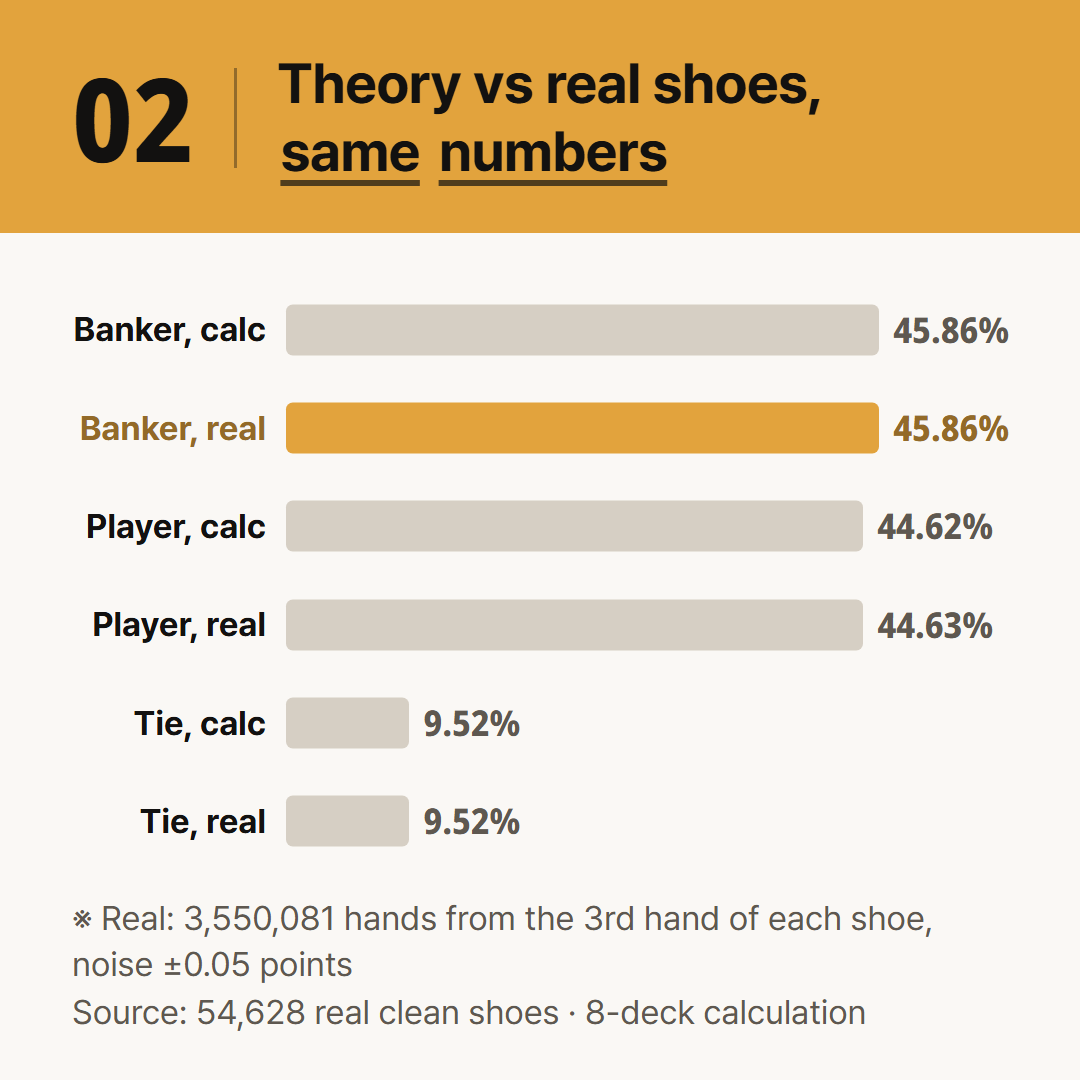
The data is shoes that started between 9 September and 21 October 2026. They were recorded to the end at 73 tables across six room types, with no collection fault where hands were logged under 12 seconds apart: 54,628 shoes and 3,659,337 hands.
The first two hands of each shoe were dropped. Counted on their own, ties come out at 4.78% there, a sign that the collector blends them with neighbouring hands. The base is 3,550,081 hands from the third hand onward.
The result is Banker 45.86%, Player 44.63% and Tie 9.52%. That matches the calculation to the second decimal, and the Banker share excluding ties is the same 50.68%.
With 3.55 million hands, random noise is about ±0.05 points either way, and everything sits inside that. Flat one-unit bets at the real shares, leaving out the no-commission and Lightning rooms, gave Banker -1.06%, Player -1.24% and Tie -14.40% across 51,529 shoes.
4.Where "50-50" breaks down

It is Banker or Player, so the odds must be even. The table disagrees in two places.
The first is the tie. Close to one hand in ten (9.52%) is a tie, so neither Banker nor Player reaches 50%. Even with ties removed it is 50.68 to 49.32.
The second is the commission. Assume 50-50 and work out Banker at 0.95 and the answer is -2.50%, more than twice as far off as the real-probability figure of -1.06%.
A 50% chance at 1 to 1, giving a result of 0%, exists at no position on the chart. All four are negative.
Switching positions cannot change the sign of this table.
5.Questions that come up reading the chart
Q.Banker wins 50.68%, so is it the winning side?
A.That is its share of decided hands. A winning Banker bet receives only 0.95, so the result per bet is -1.06%.
Q.Isn't it odd that the real shoes matched the calculation exactly?
A.Over 3.55 million hands the noise is ±0.05 points, so agreement to the second decimal is what should happen. Single shoes that lean hard one way are common.
Q.Does the chart change with the number of decks?
A.Yes. This is an 8-deck chart, and with six decks the tie and pair figures shift a little. Evolution live baccarat uses eight decks.
Q.Is Banker better in a no-commission room?
A.Those rooms pay only half on a Banker win with six points, so they need their own calculation. The -1.06% here is for the 5% commission rooms.
Hiddenpick is a Windows program that keeps on its server the betting rules that pick owners do not make public, and runs them as they are on the PC of the person who received them through a referral code. It currently runs on Evolution live baccarat at Stake (stake.com). How the odds in this chart differ from trying to call the next hand from the last ones is laid out with real shoe numbers in the baccarat prediction guide.
We are recruiting national pickster representatives, and those selected receive benefits worth $12,000, a one-year pass. Apply: https://hiddenpick.my/pickster
- 25,000+ real shoes collected and analysed since September 2026
- 90+ baccarat tables from the lobby on one screen · refreshed every 0.35s · seated 2 to 4 seconds after a click
- Stops by itself at your take-profit and stop-loss · tie several PCs into one team and stop on the total
- No browser extension · your money stays in your own Stake account · 12 languages