Baccarat tie odds of 9.52% at 8 to 1 vs 9 to 1, why the same chance costs 14.4% or 4.8% per bet
2026-10-30
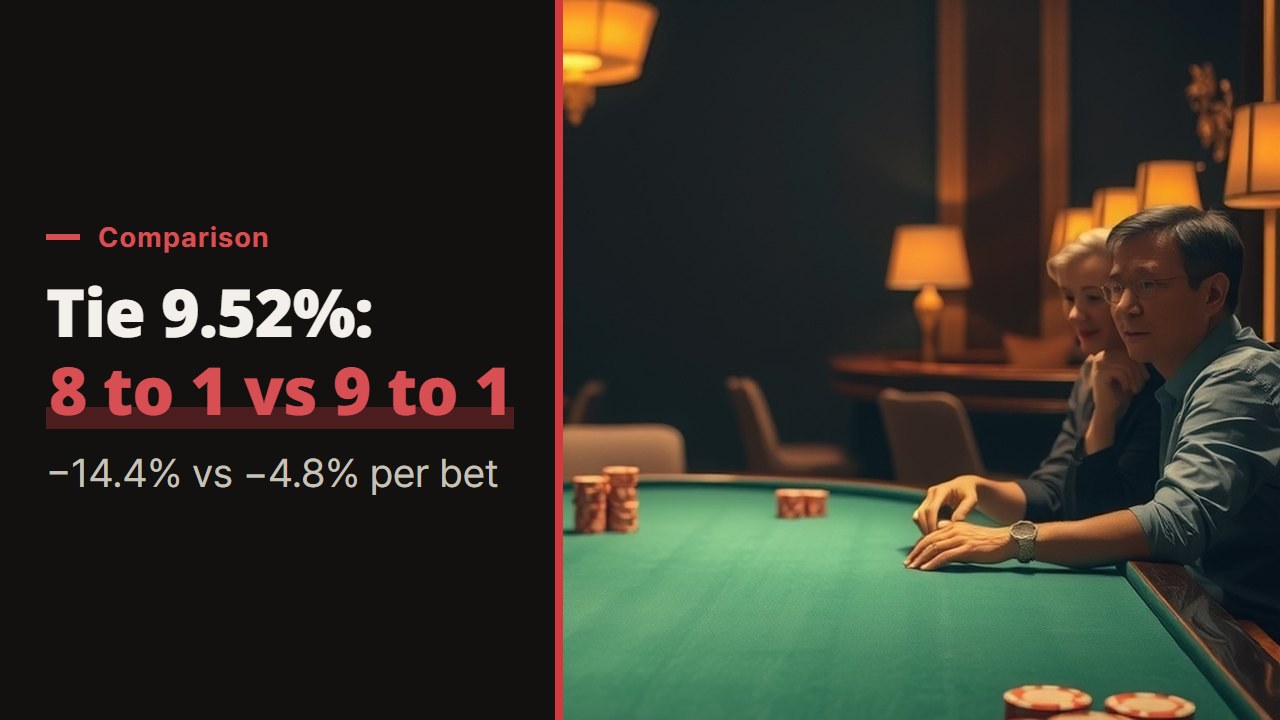
If the Tie pays 8 to 1, shouldn't it come out ahead as long as it lands about once in ten hands? Most people looking up baccarat tie odds stop the calculation right there.
The answer depends on how the payout is written. At the same 9.52%, a Tie bet at 8 to 1 loses 14.4% of the stake on average, and at 9 to 1 it loses 4.8%. We set the two payouts side by side and also counted what would have happened in real collected shoes if every bet had gone on Tie.
1.How often does a tie happen in baccarat: 9.52%
Working through all 416 cards of 8 decks gives a Tie chance of 9.5156% per hand. With Banker at 45.86% and Player at 44.62%, the three add up to 100%. The step-by-step method is in how baccarat probability is calculated.
The real shoes agreed.
In 66,947 clean shoes and 4,349,574 hands collected from September 9 to October 27, Tie came out 9.506% of the time. With that many hands the noise is within 0.03 percentage points either way.
Clean shoe: recorded start to finish with no gaps and normal hand intervals.
The first two hands of each shoe were left out because the collection log can misplace a Tie there.
2.Baccarat tie payout compared: 8 to 1 vs 9 to 1
Match the wording first
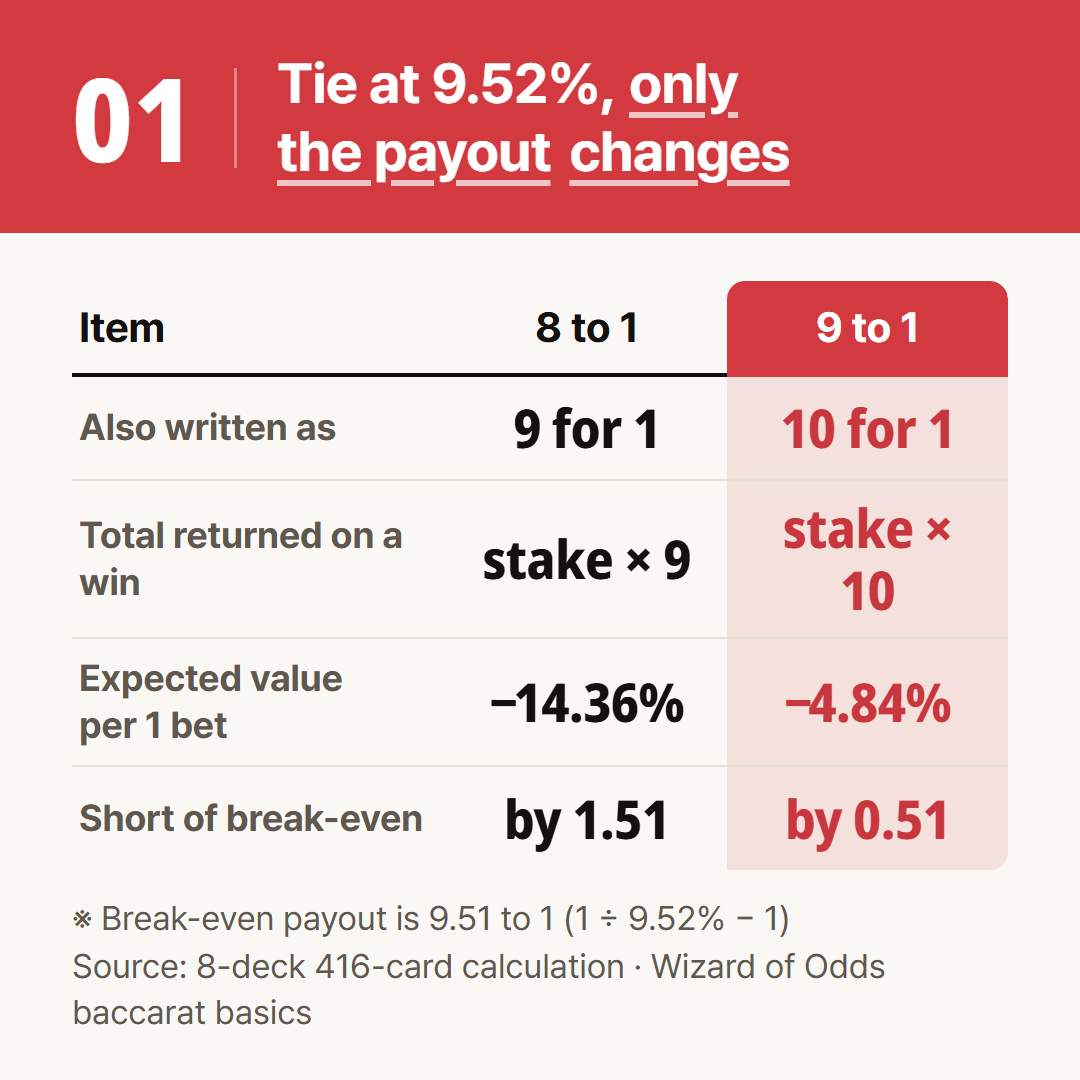
A Tie payout is written two ways. At 8 to 1 a win returns the 1 you staked plus 8 more, 9 in total. Some places write that same payout as "9 for 1" (Wizard of Odds baccarat basics).
So a table that says 9 for 1 is usually paying the same as 8 to 1. A true 9 to 1 adds 9 to the 1 staked and returns 10. The same source notes that some casinos have paid 9 to 1.
Evolution's baccarat rules list the Tie at 8:1 (Evolution baccarat rules). Check whether the paytable says "to 1" or "for 1" before running the numbers below.
The expected value
For a 1 unit bet, expected value is (total returned × chance) − 1.
- 8 to 1: 9 × 9.52% − 1 = −14.36%
- 9 to 1: 10 × 9.52% − 1 = −4.84%
- Break-even: 1 ÷ 9.52% − 1 = 9.51 to 1
One step on the paytable nearly triples the loss.
Even so, 9 to 1 still falls a little short of the 9.51 to 1 break-even. The gap comes from Tie landing slightly less than once in ten hands.
Next to Banker and Player
In the same 8-deck calculation Banker is −1.06% and Player is −1.24%. A Tie at 8 to 1 costs more than 13 times what Banker does, and a Tie at 9 to 1 still costs more than 4 times as much.
Over 100 hands at 1 unit each, the average loss is about 1.1 units on Banker, about 4.8 units on a 9 to 1 Tie and about 14.4 units on an 8 to 1 Tie.
The 9.52% never moves.
All the bets and their probabilities are in one table in the baccarat probability table post.
3.If only the Tie had been bet in real shoes
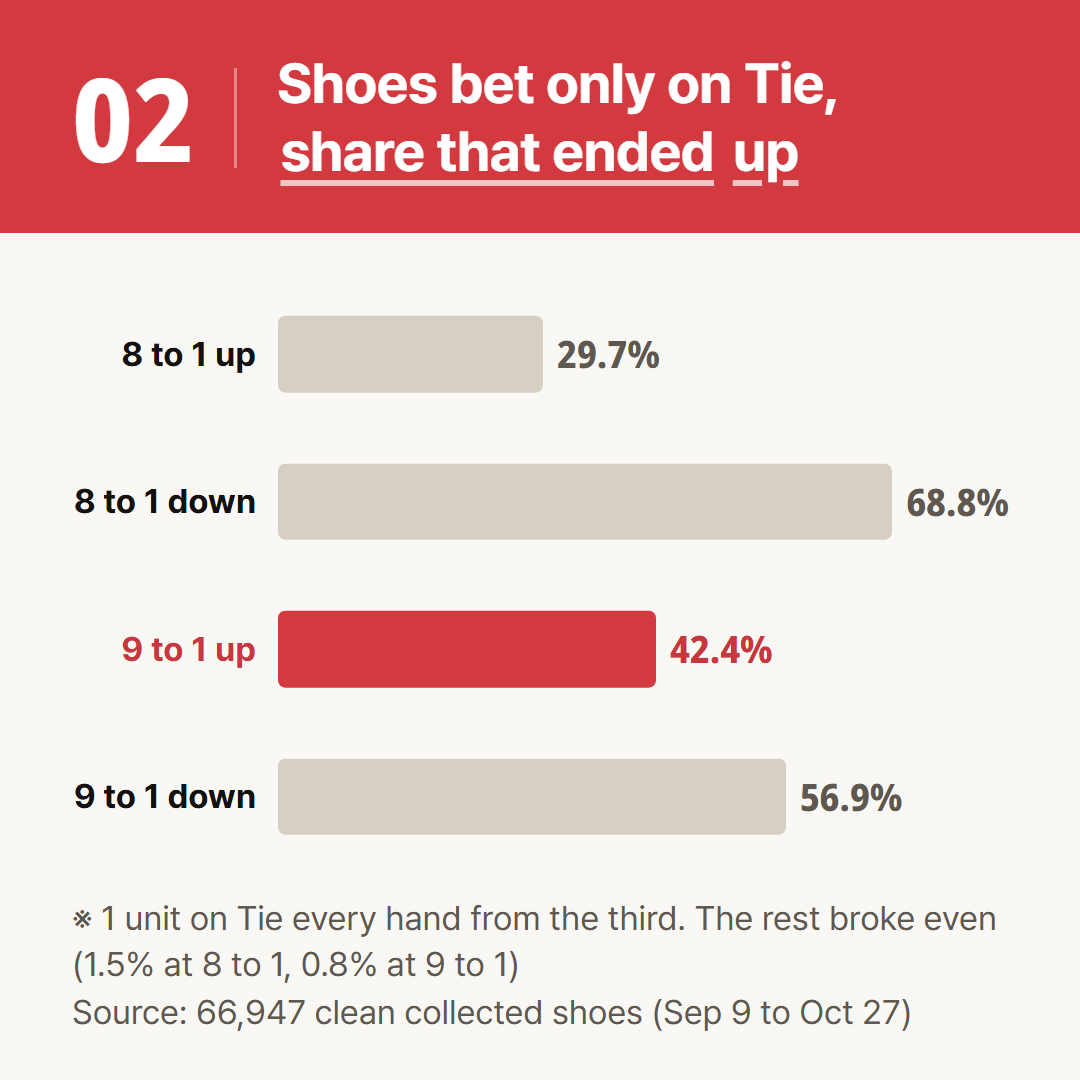
We checked whether the math holds in real shoes. In each shoe we put 1 unit on Tie every hand from the third hand to the end, then looked at the result when the shoe ran out. Counted this way a shoe averages 65.0 hands.
At 8 to 1 the average shoe ended at −9.39 units, or −14.45% of the money bet, almost exactly the calculated figure. 29.71% of shoes finished up and 1.49% finished exactly even.
At 9 to 1 the average shoe ended at −3.21 units, −4.94% of the money bet. The share of shoes that finished up rose to 42.35%.
Even with three or four shoes in ten finishing up, the losing shoes lose more, so the total stays negative.
Remembering a good shoe does not change the arithmetic.

Summary in three lines
- Baccarat tie probability is 9.52% by the 8-deck calculation and 9.51% across 66,947 real collected shoes
- 8 to 1 (sometimes written 9 for 1) is −14.36%, 9 to 1 is −4.84%, and break-even is 9.51 to 1
- Betting only Tie in real shoes, 29.71% of shoes finished up at 8 to 1 and 42.35% at 9 to 1
Hiddenpick is a Windows program that keeps on its server the betting rules that pick owners do not make public, and runs them as they are on the PC of the person who received them through a referral code. It currently runs on Evolution live baccarat at Stake (stake.com). Whether past results can predict the next hand is covered with real shoe numbers in the baccarat prediction guide.
We are recruiting national pickster representatives, and those selected receive benefits worth $12,000, a one-year pass (apply at https://hiddenpick.my/pickster).
- 25,000+ real shoes collected and analysed since September 2026
- 90+ baccarat tables from the lobby on one screen · refreshed every 0.35s · seated 2 to 4 seconds after a click
- Stops by itself at your take-profit and stop-loss · tie several PCs into one team and stop on the total
- No browser extension · your money stays in your own Stake account · 12 languages