Is online gambling illegal in Korea? Played a baccarat site once, is there a fine? Five questions from the first police call to the final decision
2026-10-25
5,196. That is how many people the Korean National Police Agency arrested in its cyber gambling crackdown between 1 November 2024 and 31 October 2025. 314 of them were detained.
People who ask whether online gambling is illegal in Korea usually mean something narrower: my case. Does one session bring a fine, where does the call come from, how does the decision split.
This post answers five questions using only the statute text, Supreme Court case numbers and police releases. It is not a substitute for a lawyer.
1.Played once. Is there a fine?
Article 246(1) of the Criminal Act fines a person who gambles up to 10 million won, and excepts only gambling that amounts to momentary amusement (Criminal Act art. 246). The article says nothing about how many times.
Where momentary amusement ends was set out by the Supreme Court on 12 November 1985 in case 85Do2096. The court judges it concretely from the time and place, the gambler's social standing and property, how trivial the stake is, and the circumstances that led to the gambling(Supreme Court 85Do2096).
Triviality of the stake: how small the money is for that person, read together with their property.
Both ends of the scale survive in case law. In 82Do2151 (1983) the court treated 100 won per hand over about 20 hands of a flower card game as momentary amusement (Supreme Court 82Do2151). In 85Do748 (1985) it found that about 3,000,000 won passing across six games in a short period was not amusement, and was habitual (Supreme Court 85Do748).
Habitual gambling falls under paragraph 2: up to three years in prison or a fine of up to 20 million won.
2.Where does an investigation start?
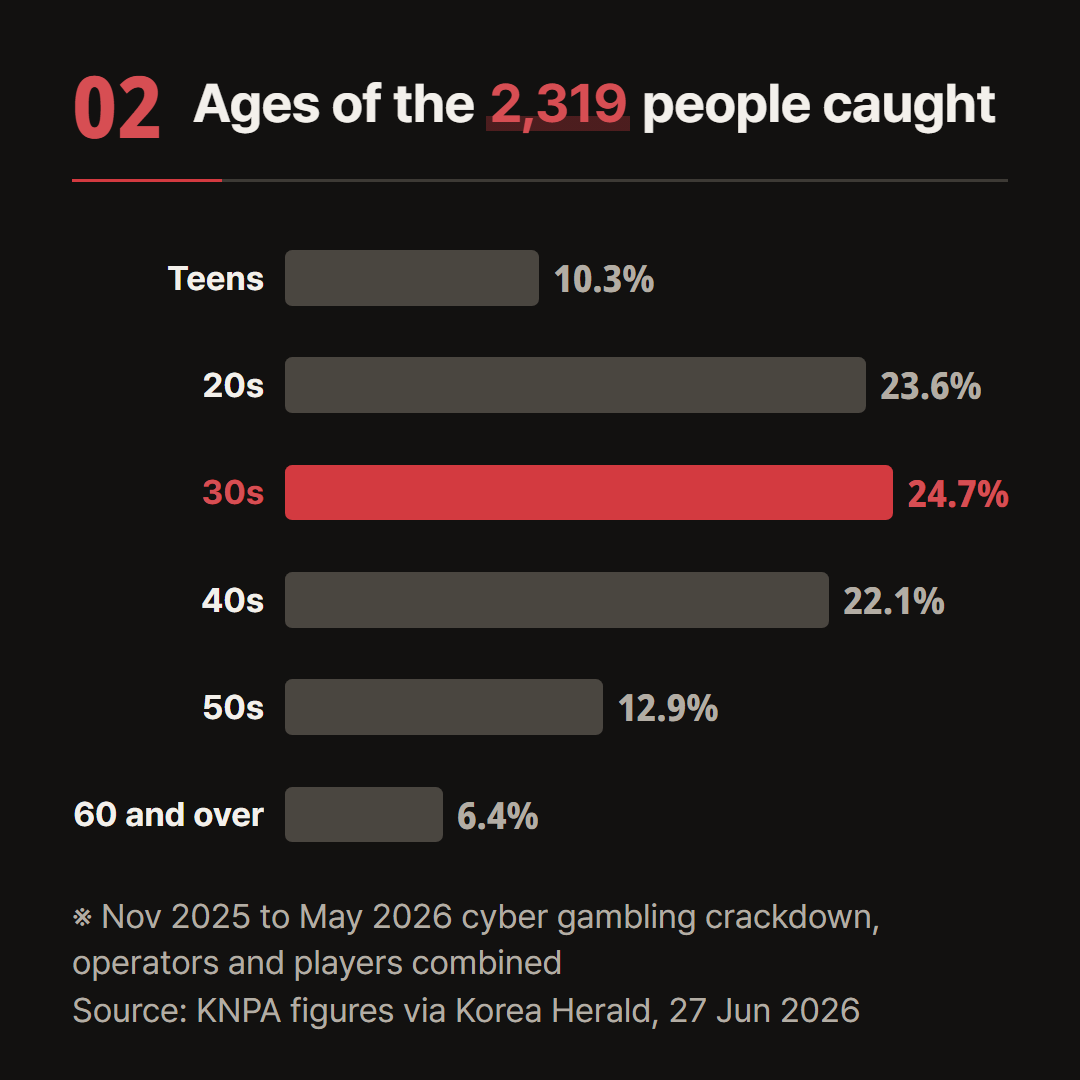
In the crackdown results the casino type led with 1,016 cases, 27.2 percent of the total (Newdaily). Baccarat sites sit in that type.
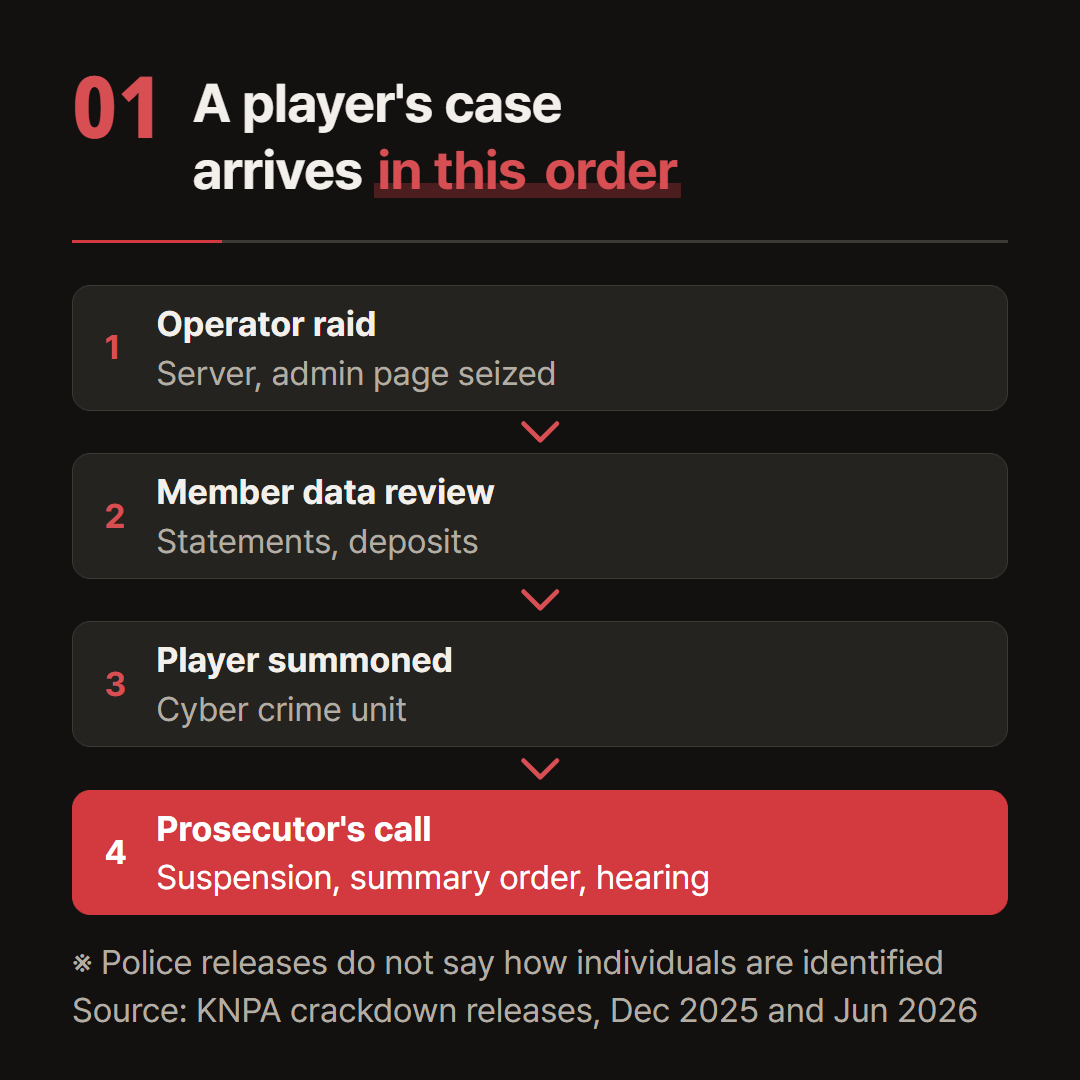
In its June 2026 release the police said it had analysed seized admin pages and suspect statements (Herald Economy). When an operator is caught, the member data goes with it.
The 2026 target list names operators and agents first, then high stakes and habitual gamblers and minors(policy briefing). The crackdown runs from 1 November 2025 to 31 October 2026.
If a call came, the release suggests the operator investigation came first.
3.After questioning, how does the decision split?
Once police questioning ends the file goes to a prosecutor. The choices are three: no indictment, a request for a summary order, or a full court hearing.
Suspended indictment
The prosecutor accepts the facts but does not indict. No official statistic on how often this happens was found, so none is given here.
A record remains. Article 8-2 of the Act on the Lapse of Criminal Sentences keeps the investigation record of a suspended indictment for a fine offence for five years, then deletes it (Lapse Act art. 8-2).
Summary order
Article 448 of the Criminal Procedure Act lets a court, on the prosecutor's request, impose a fine, a minor fine or confiscation by summary order without a hearing (Criminal Procedure Act art. 448). This is the route where the fine arrives by post and nobody stands in a courtroom.
To contest it, Article 453 gives seven days from the day the order is served to request a full court hearing (Criminal Procedure Act art. 453).
The seven days count from the day of service. An unopened envelope does not stop the clock.
Paying the fine
Article 69 of the Criminal Act requires payment within 30 days of the judgment becoming final, and provides for detention in a workhouse from one day up to three years if it is not paid (Criminal Act art. 69).
On 3 August 2025 the Supreme Prosecutors' Office announced that for fines of 5 million won or less a payment plan alone would be enough for instalments over up to a year or a six month deferral (Etoday). That measure ran until 31 December 2025, and whether it was extended was not confirmed for this post. The execution desk of the district prosecutors' office is the place to ask.
Does it count as a criminal record
Article 2 of the Lapse Act limits the convict register kept by prosecutors to sentences of suspension of qualifications or heavier. A fine goes in the criminal record data held by the police (Lapse Act art. 2).
Under Article 7, a fine lapses two years after it has been paid in full(Lapse Act art. 7).
Does the money come back
Article 48 of the Criminal Act confiscates things produced by or acquired through the crime, and collects the equivalent value when confiscation is impossible (Criminal Act art. 48). Article 49 adds confiscation on top of another punishment.
No article provides for returning money lost on a site. Money won can be subject to collection.

4.What if the player is a minor?
Over the same year the police caught 7,153 underage gamblers. Minor cases go to a guidance committee; the rest end in a warning, a request for summary judgment or referral, with counselling arranged on consent (Herald Economy).
A case sent to the juvenile court ends in a protective disposition under Article 32 of the Juvenile Act. There are ten, from custody with a guardian through attendance orders, community service and probation to committal to a juvenile reformatory (Juvenile Act art. 32).
Paragraph 6 of the same article states that a protective disposition has no effect on the juvenile's future status.
5.What to do when the call comes
Write down which police station, which team and the case number. Anyone asking for money by phone is not an investigator.
Taking legal advice before an interview is a right set by law. If gambling has already caused money trouble, the Korea Center on Gambling Problems answers on 1336 (KCGP).
Three lines
- Momentary amusement is judged on four factors (time and place, standing and property, the stake, the circumstances), not on how many times
- Member data from an operator raid is where a player's case begins, and the prosecutor's decision splits into suspended indictment, summary order or a court hearing
- A fine is due within 30 days, instalments go through the prosecutors' execution desk, and the record lapses after two years
Hiddenpick is a Windows program that keeps on its server the betting rules that pick owners do not make public, and runs them as they are on the PC of the person who received them through a referral code. It currently runs on Evolution live baccarat at Stake (stake.com). The program does not judge the law of the place you live, and what it does and does not do is in the baccarat bot guide.
We are recruiting national pickster representatives, and those selected receive benefits worth $12,000, a one-year pass. Apply: https://hiddenpick.my/pickster
- 25,000+ real shoes collected and analysed since September 2026
- 90+ baccarat tables from the lobby on one screen · refreshed every 0.35s · seated 2 to 4 seconds after a click
- Stops by itself at your take-profit and stop-loss · tie several PCs into one team and stop on the total
- No browser extension · your money stays in your own Stake account · 12 languages