Can a government employee have a side business? Korea's 4,982 approved side jobs of 2024 and the rules behind the permit
2026-10-21
Three things first
- In Korea, ongoing work done for profit is banned, and any other side job needs prior permission
- National and local officials follow the same structure, and only the person who grants permission differs
- Korea's 51 central ministries approved 4,982 side jobs in 2024, up 55.2% on the year before
1.Banned work and permitted work
Most questions about a government employee side business mix two things up. Article 64 of Korea's State Public Officials Act puts both in one sentence (Article 64).
For-profit work: work aimed at profit outside official duties. Doing it is banned.
Concurrent post: taking on another role that is not for-profit work. It needs the head of the agency's permission.
Work on the banned list cannot be unlocked with a permit, and work off that list needs one. The articles leave no third box for work that needs nothing.
2.National and local rules side by side
The acts
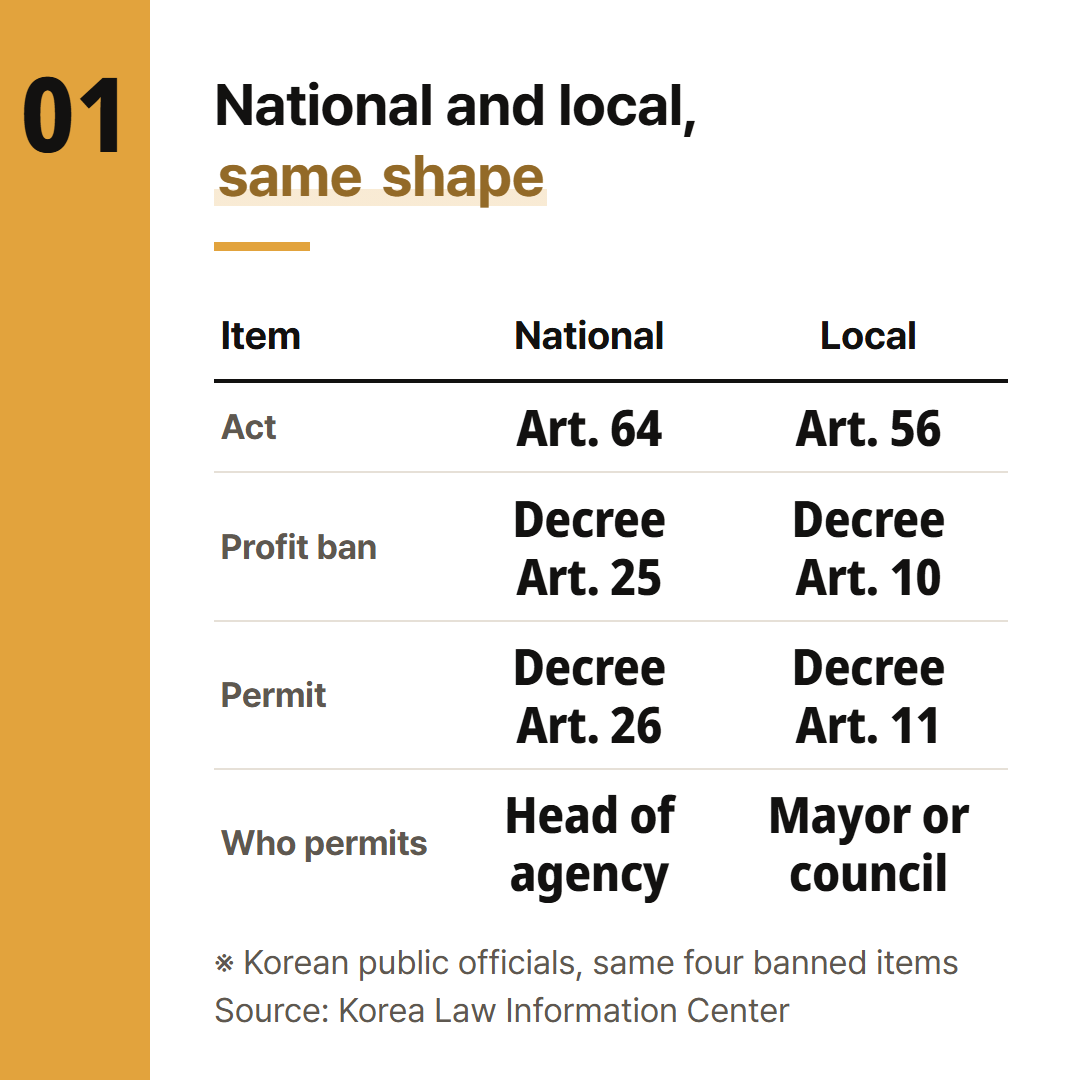
Article 64 of the State Public Officials Act and Article 56 of the Local Public Officials Act read almost the same. Officials may not do for-profit work or hold another post without the agency head's permission, and the limits of for-profit work are left to a presidential decree.
The banned for-profit work
Article 25 of the service decree for national officials holds the list (Decree Article 25).
- Item 1: running a commercial, industrial, financial or other business oneself, clearly seeking profit
- Item 2: becoming a director, an auditor's executive partner, a manager, a promoter or another officer of a for-profit private company
- Item 3: investing in another person's company that is related to the official's own duties
- Item 4: any other work done continuously for financial gain
A condition is attached: the work is banned when it may lower work efficiency, unduly influence official duties, gain interests opposed to the state's, or bring dishonour on the government. Article 10 of the local decree keeps the same four items and puts the local government's interest where the state's would be.
The side job permit
Article 26 of the national decree says an official who wants another post that is not for-profit work needs the agency head's prior permission. Permission is given only where the side job does not get in the way of the official's duties (Decree Article 26).
For local officials, Article 11 of the local decree does the same, and permission comes from the head of the local government or the council chair. The difference between the two systems comes down mostly to who signs.
The continuity test
Korea's Ministry of Personnel Management describes for-profit work as continuously gaining financial benefit, and judges continuity four ways (Ministry guidance).
Work done on a cycle such as daily, weekly or monthly, seasonal work, work that continues without a clear cycle, and work the official intends and is able to keep doing. Unless the work is clearly not continuous, the same guidance says the official must apply for a permit.
3.How YouTube is treated
YouTube has its own line.
On December 31, 2019, Seoul Shinmun reported a standard guideline on public officials' online streaming drawn up by the ministry and others. It said YouTube channels with at least 1,000 subscribers and 4,000 watch hours a year needed a permit, granted a year at a time.
Those numbers mirrored YouTube's monetization threshold at the time. We could not find the guideline itself, so the current standard is best confirmed with the agency's service team.

4.Stocks and crypto
The articles block two kinds of investment directly. Item 3 of Article 25 covers investing in companies tied to one's own duties, and Article 12 of the Code of Conduct covers trading on information learned on the job (Code of Conduct Article 12).
We found no official ministry sentence saying other personal investing needs no permit. Someone trading as often as a business should hold it against the continuity test above.
The US federal rules for comparison
For US federal employees, 5 CFR 2635.802 says employees may not take outside employment or activity that conflicts with their official duties (5 CFR 2635.802). Under 2635.803, prior approval is needed when an agency's supplemental regulation requires it.
Under 2635.807, an employee may not be paid by anyone other than the government for teaching, speaking or writing that relates to official duties, with an exception for multi-session courses in a regular university curriculum (5 CFR 2635.807).
5.Side jobs in numbers
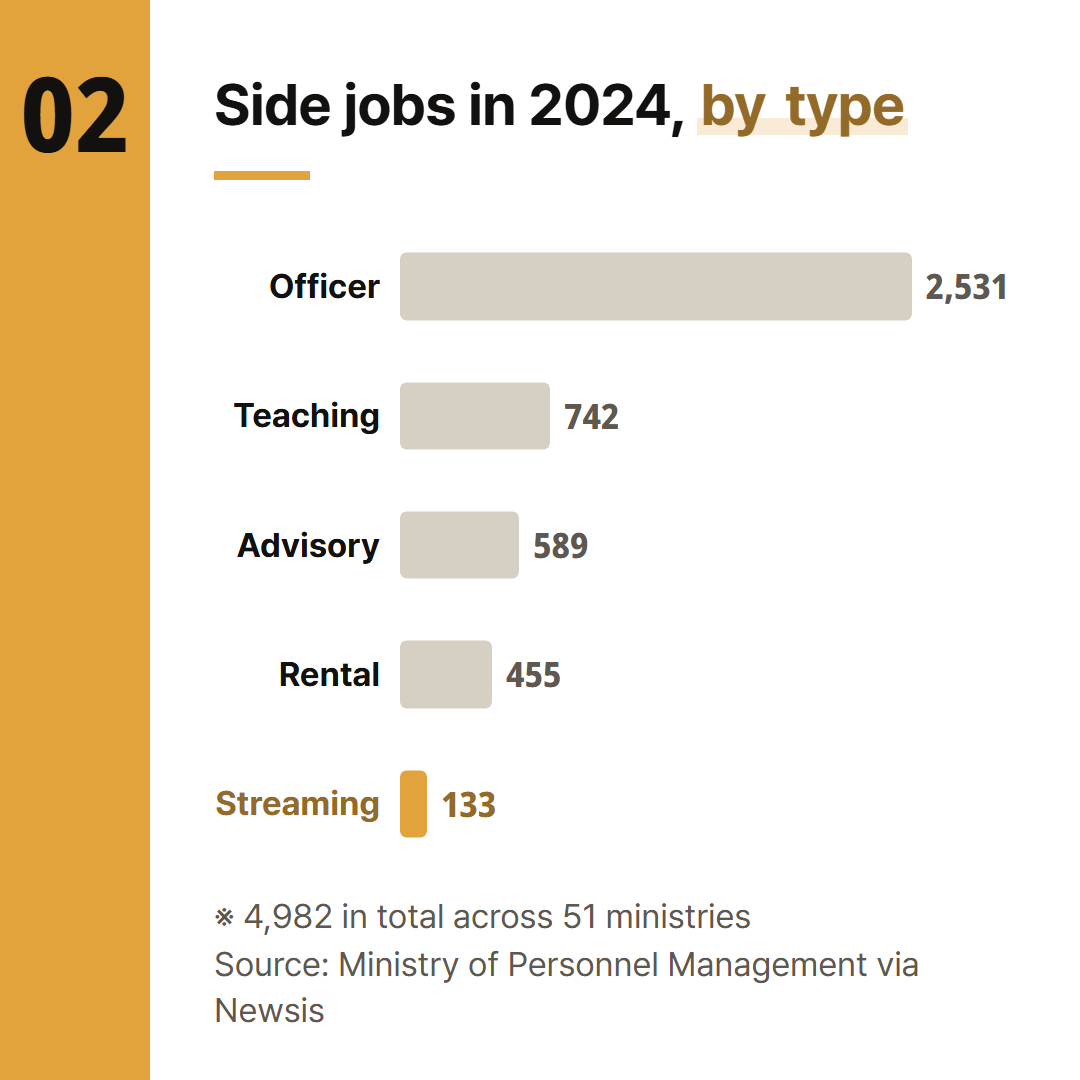
According to ministry data reported by Newsis on April 23, 2025, national officials at 51 central ministries held 4,982 approved side jobs in 2024. That was 55.2% more than the 3,209 of 2023 (Newsis).
Officer roles at public bodies and academic societies led with 2,531, followed by teaching with 742, advisory and research with 589, and rental business with 455. Streaming such as YouTube went from 38 in 2022 to 58 in 2023 and 133 in 2024.
Discipline for breaking the side job rules came to 16 cases in 2021, 19 in 2022 and 15 in 2023.
Choosing a side job in general is covered in our side jobs for office workers post.
Before a public official starts a side job
- For-profit work: checked whether it falls under one of the four items of Article 25
- Continuity: held it against the ministry's four continuity tests
- Who permits: the agency head for national officials, the local head or council chair for local ones
- Investing: made sure it is not a company tied to the job or a trade on job information
- YouTube: asked the service team which standard applies now
Hiddenpick is a Windows program that keeps on its server the betting rules that pick owners do not make public, and runs them as they are on the PC of the person who received them through a referral code. It currently runs on Evolution live baccarat at Stake (stake.com). Public officials are bound by the gambling provisions of criminal law as well as the rules above, so the baccarat bot guide is only for those who have checked the law where they live. We are recruiting national pickster representatives, and those selected receive benefits worth $12,000, a one-year pass (apply at hiddenpick.my/pickster).
- 25,000+ real shoes collected and analysed since September 2026
- 90+ baccarat tables from the lobby on one screen · refreshed every 0.35s · seated 2 to 4 seconds after a click
- Stops by itself at your take-profit and stop-loss · tie several PCs into one team and stop on the total
- No browser extension · your money stays in your own Stake account · 12 languages